

Window Tint Specs Explained starts with three numbers you will see again and again when comparing automotive film: VLT, TSER, and IR rejection. These percentages may look similar on a specification sheet, but they measure different parts of window-film performance.
VLT tells you how much visible light passes through the glass and film.
TSER tells you how much total solar energy is rejected.
IR rejection tells you how much infrared energy is rejected within the range used by the film manufacturer’s test method.
Knowing the difference can prevent a common mistake: choosing a film because one large percentage looks better than another.
A film advertising more than 90% IR rejection is not automatically rejecting more than 90% of all incoming solar energy. IR is only part of the solar spectrum, and manufacturers may measure infrared rejection across different wavelength ranges.
The International Window Film Association recommends looking at TSER alongside IR rejection when judging heat-related film performance.
For Bakersfield, CA drivers comparing Rayno automotive tint, these measurements can help you choose around the things you actually care about, such as cabin heat, glare, privacy, daytime visibility, and appearance.
Table of Contents
- What Do Window Tint Specs Actually Tell You?
- What Is VLT in Window Tint?
- Does Lower VLT Mean Better Tint?
- What Is TSER?
- Why TSER Matters When Comparing Heat Rejection
- What Is IR Rejection?
- Why IR Rejection Numbers Can Be Confusing
- VLT vs TSER vs IR Rejection
- Can Light Tint Reject More IR Than Dark Tint?
- Rayno S5 Window Tint Specs
- Rayno S7 Window Tint Specs
- Rayno S9 Window Tint Specs
- What Rayno Specs Show About Film Darkness
- What Does UV Rejection Mean?
- What Does Visible Light Reflection Mean?
- What Does Shading Coefficient Mean?
- Why Glass Changes the Finished VLT
- How Factory Privacy Glass Changes Tint Specs
- Which Specs Matter Most for Bakersfield Drivers?
- How to Compare Two Window Films
- Window Tint Specs in Bakersfield CA
- FAQs About Window Tint Specs
What Do Window Tint Specs Actually Tell You?
Window-film specification sheets turn film behavior into numbers.
Those numbers can help you compare two films without relying only on how dark they look on a sample board.
Automotive film sheets may list:
- Visible Light Transmission
- Total Solar Energy Rejected
- Infrared rejection
- UV rejection
- Visible Light Reflection
- Shading Coefficient
- Glare reduction
- Film fading rate
Not every manufacturer reports every measurement the same way.
That matters most with IR rejection.
The International Window Film Association notes that infrared rejection may be measured across different wavelength ranges from one manufacturer to another.
TSER gives you a broader measurement of total solar energy rejected.
VLT answers another question entirely: how much visible light gets through.
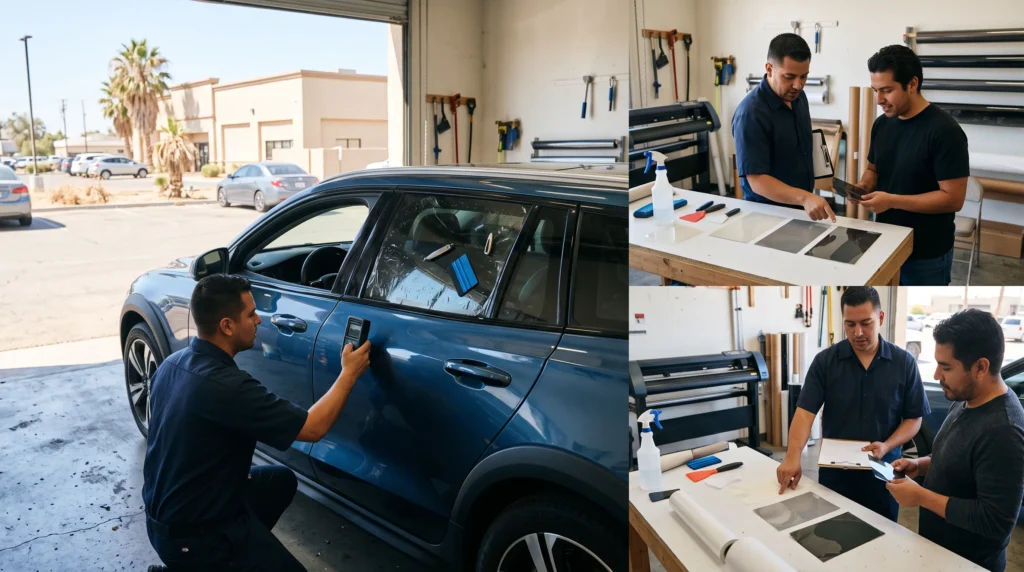
Think of the numbers as separate tools rather than competing scores.
What Is VLT in Window Tint?
VLT stands for Visible Light Transmission.
The International Window Film Association defines VLT as the visible-light portion of the solar spectrum that passes through the glass.
The lower the percentage, the less visible light passes through.
A 5% film is much darker than a 50% film.
A 70% film can look quite light.
Here is a simple way to picture common VLT levels:
5% VLT
Very dark.
Only a small portion of visible light passes through.
This type of shade is commonly associated with strong privacy where legally permitted.
15% VLT
Dark, but lighter than 5%.
It still creates a noticeably dark appearance.
20% VLT
A common dark-film range for rear glass where allowed.
35% VLT
Moderate darkness.
More visible light enters than with 20% film.
50% VLT
Much lighter.
This can fit drivers who want solar performance while keeping a brighter cabin.
70% VLT
Very light compared with common privacy shades.
Products in this range can look close to clear depending on the glass.
Does Lower VLT Mean Better Tint?
No.
Lower VLT only tells you that less visible light passes through.
It does not tell you that the film has stronger IR rejection.
It does not tell you that the film has higher TSER.
It does not tell you that the film has better UV rejection.
It does not tell you how well the film resists fading.
A very dark film from one product line may have weaker published IR rejection than a lighter ceramic film from another line.
That is why choosing tint from VLT alone can be misleading.
Use VLT when you care about:
- Darkness
- Privacy
- Daytime brightness
- Glare
- Appearance
- Night visibility
Use other measurements when you care about solar performance.
What Is TSER?
TSER stands for Total Solar Energy Rejected.
This measurement looks at the total solar energy rejected by the film and glazing system under the stated test conditions.
The solar spectrum contains:
- Ultraviolet radiation
- Visible light
- Infrared radiation
TSER looks at total incoming solar energy rather than isolating only one region.
A higher TSER percentage means more total solar energy is rejected under that test setup.
Suppose one film has 41% TSER and another has 53% TSER.
Under the manufacturer’s stated measurements, the 53% film rejects a larger share of total solar energy.
That makes TSER one of the more useful numbers when cabin heat is your concern.
Why TSER Matters When Comparing Heat Rejection
IR rejection gets a lot of attention because the percentages can be very high.
TSER gives you a broader picture.
The International Window Film Association’s 2026 automotive education guide explains that infrared makes up only part of the solar spectrum.
It also warns that IR rejection should be considered with TSER or SHGC rather than treated as a stand-alone measure of total heat rejection.
This matters because a film could advertise 90% IR rejection while showing a much lower TSER figure.
Those two percentages are not contradicting each other.
They are measuring different things.
If your goal is reducing the amount of total solar energy entering a vehicle, TSER deserves close attention.
What Is IR Rejection?
IR stands for infrared.
Infrared radiation occupies part of the solar spectrum beyond visible red light.
Window-film manufacturers can report how much infrared energy their film rejects within a stated measurement range.
Higher IR rejection means the film rejects more infrared energy within that tested range.
Rayno’s current Phantom S9 lineup, for example, lists IR rejection around 91% to 93% across the published shades.
Rayno Phantom S5 shows lower IR rejection figures.
That gives Bakersfield drivers a way to compare Rayno film tiers.
The measurement still needs context.
Ask which wavelength range was tested.
Why IR Rejection Numbers Can Be Confusing
This is where window tint specifications become tricky.
The International Window Film Association warns that IR rejection values may not use the same test range across manufacturers.
One company may measure across a broad infrared range.
Another may report rejection over a much narrower range.
The IWFA gives examples including measurements across 780 to 2,500 nanometers versus narrower testing around 900 to 1,000 nanometers.
Those results should not be treated as though they are automatically identical measurements.
This is why comparing IR percentages from two unrelated brands can be harder than comparing two films within the same product family.
If one brand advertises 95% IR rejection and another says 88%, you still need to know:
- The wavelength range tested
- The measurement method
- The TSER
- The glass used during testing
Do not choose from the biggest IR percentage alone.
VLT vs TSER vs IR Rejection
Here is the easiest way to separate the three.
VLT
Question answered: How much visible light gets through?
Lower VLT means darker glass.
TSER
Question answered: How much total solar energy is rejected?
Higher TSER means more total solar energy is rejected under the stated test.
IR Rejection
Question answered: How much measured infrared energy is rejected?
Higher IR rejection means more infrared energy is rejected within the tested wavelength range.
Each number tells you something different.
A good film comparison looks at all three.
Can Light Tint Reject More IR Than Dark Tint?
Yes.
Rayno’s current Phantom data gives a clear example.
Rayno S5-05 is listed at:
- 5% VLT
- 72% IR rejection
- 66% TSER
Rayno S9-50 is listed at:
- 50% VLT
- 92% IR rejection
- 53% TSER
The S9-50 film is much lighter by VLT, yet its published IR rejection is higher.
At the same time, the much darker S5-05 shows higher TSER than S9-50.
That is exactly why the specifications need to be separated.
One measurement does not replace the others.
Rayno S5 Window Tint Specs
Dynamic Window Tint carries Rayno Window Film for automotive installations in Bakersfield, CA.
Rayno’s current Phantom S5 specifications include several shade choices.
Rayno S5-05
Rayno lists:
- 5% VLT
- 66% TSER
- 72% IR rejection
- 99.9% UV rejection
- Less than 1% fading rate
Rayno S5-20
Rayno lists:
- 20% VLT
- 51% TSER
- 53% IR rejection
- 99.9% UV rejection
- Less than 1% fading rate
Rayno S5-35
Rayno lists:
- 35% VLT
- 51% TSER
- 53% IR rejection
- 99.9% UV rejection
- Less than 1% fading rate
Rayno S5-50
Rayno lists:
- 50% VLT
- 41% TSER
- 56% IR rejection
- 99.9% UV rejection
- Less than 1% fading rate
S5 gives drivers several darkness levels while keeping the same published UV rejection.
Rayno S7 Window Tint Specs
Rayno Phantom S7 provides higher published IR figures than S5 across much of the lineup.
Rayno S7-05
Rayno lists:
- 5% VLT
- 66% TSER
- 81% IR rejection
- 99.9% UV rejection
Rayno S7-20
Rayno lists:
- 20% VLT
- 58% TSER
- 73% IR rejection
- 99.9% UV rejection
Rayno S7-35
Rayno lists:
- 35% VLT
- 54% TSER
- 70% IR rejection
- 99.9% UV rejection
Rayno S7-50
Rayno lists:
- 50% VLT
- 47% TSER
- 74% IR rejection
- 99.9% UV rejection
These numbers show why two films with the same VLT can have different solar performance.
Compare S5-50 with S7-50.
Both are listed at 50% VLT.
S5-50 lists 41% TSER and 56% IR rejection.
S7-50 lists 47% TSER and 74% IR rejection.
The visual darkness is similar by VLT, but the published solar measurements differ.
Rayno S9 Window Tint Specs
Rayno Phantom S9 carries Rayno’s strongest published IR figures among the current S5, S7, and S9 lines.
Rayno S9-05
Rayno lists:
- 5% VLT
- 70% TSER
- 92% IR rejection
- 99.9% UV rejection
Rayno S9-20
Rayno lists:
- 20% VLT
- 64% TSER
- 93% IR rejection
- 99.9% UV rejection
Rayno S9-35
Rayno lists:
- 35% VLT
- 58% TSER
- 92% IR rejection
- 99.9% UV rejection
Rayno S9-50
Rayno lists:
- 50% VLT
- 53% TSER
- 92% IR rejection
- 99.9% UV rejection
These figures show why S9 may interest Bakersfield drivers who want stronger published IR performance without automatically choosing the darkest shade.
What Rayno Specs Show About Film Darkness
Compare three Rayno 50% films:
| Film | VLT | TSER | IR Rejection | UV Rejection |
|---|---|---|---|---|
| Rayno S5-50 | 50% | 41% | 56% | 99.9% |
| Rayno S7-50 | 50% | 47% | 74% | 99.9% |
| Rayno S9-50 | 50% | 53% | 92% | 99.9% |
All three share the same listed VLT.
They do not share the same TSER or IR rejection.
Now compare three 20% films:
| Film | VLT | TSER | IR Rejection | UV Rejection |
|---|---|---|---|---|
| Rayno S5-20 | 20% | 51% | 53% | 99.9% |
| Rayno S7-20 | 20% | 58% | 73% | 99.9% |
| Rayno S9-20 | 20% | 64% | 93% | 99.9% |
Again, all three have the same listed VLT while their solar figures differ.
This is why asking only for “20% tint” does not tell you which film you are buying.
What Does UV Rejection Mean?
UV rejection tells you how much ultraviolet radiation the tested film rejects.
Rayno currently lists 99.9% UV rejection across its Phantom S5, S7, and S9 lines.
That figure stays high across both dark and light shades.
This gives you another reminder that darkness and UV rejection are not the same measurement.
A 50% film can still publish 99.9% UV rejection.
UV rejection can help reduce ultraviolet exposure through treated glass.
It can also reduce one source of fading inside a vehicle.
UV is not the only contributor to interior aging, so tint should not be treated as a guarantee that dashboards, seats, fabrics, and trim will never fade.
What Does Visible Light Reflection Mean?
Visible Light Reflection, or VLR, tells you how much visible light reflects from the glass and film.
This affects how reflective the tint appears.
A film with lower VLR tends to have a less mirror-like look than a highly reflective film.
Rayno publishes separate interior and exterior VLR figures for the Phantom line.
This can matter if you want:
- A more neutral appearance
- Less interior reflection at night
- A less mirrored exterior
- Better visual consistency across windows
VLR and VLT should not be confused.
One tells you how much light passes through.
The other tells you how much visible light reflects.
What Does Shading Coefficient Mean?
Rayno also publishes Shading Coefficient, shown as SC.
Shading Coefficient compares solar heat gain through a filmed glass system with a reference clear-glass system.
Lower SC means less solar heat gain compared with that reference.
Many consumers do not use SC as often as VLT, TSER, and IR rejection when comparing automotive film.
Still, it is another measurement that can appear on technical specification sheets.
For everyday tint shopping, VLT, TSER, IR rejection, and UV rejection usually provide an easier starting point.
Why Glass Changes the Finished VLT
The percentage printed on a film specification sheet does not always equal the final reading on your vehicle.
Automotive glass is not perfectly transparent.
The glass itself already reduces some visible light.
When film is installed, the two work together.
Suppose a piece of vehicle glass has 80% VLT.
If a 50% film is installed over it, an approximate combined calculation would be:
0.80 × 0.50 = 0.40
That produces an approximate 40% finished VLT.
Real measurements can vary because of glass construction and testing conditions.
This matters when choosing film for legally restricted windows.
How Factory Privacy Glass Changes Tint Specs
Factory privacy glass makes this effect even stronger.
Suppose rear factory glass transmits about 25% of visible light.
If you add 50% film:
0.25 × 0.50 = 0.125
That produces an approximate 12.5% finished VLT.
If you add 35% film:
0.25 × 0.35 = 0.0875
That is roughly 8.75% finished VLT.
This is why adding a medium film over dark factory glass can produce a very dark result.
You can read more in our guide to tinting over factory privacy glass.
Which Specs Matter Most for Bakersfield Drivers?
That depends on why you want tint.
If You Want Privacy
Look closely at VLT.
Lower VLT creates a darker appearance.
If You Want Less Glare
VLT also matters because it determines how much visible light passes through.
If You Want Solar Heat Control
Look at TSER and IR rejection together.
The IWFA recommends using IR figures with broader measurements rather than treating IR rejection as the only heat number.
If You Want UV Reduction
Check the manufacturer’s UV rejection figure.
If You Want a Lighter Appearance
Look for higher VLT combined with the solar specifications you want.
If You Want the Best Comparison Between Film Tiers
Compare films at the same VLT.
That removes darkness as a variable and makes performance differences easier to see.
For instance, compare S5-50, S7-50, and S9-50 rather than comparing S5-05 with S9-50.
How to Compare Two Window Films
Use a simple sequence.
1. Start With VLT
Decide how dark you want the glass to look.
2. Compare TSER
Check how much total solar energy each film rejects.
3. Compare IR Rejection
Look at the infrared figure and the manufacturer’s test method.
4. Check UV Rejection
See what the manufacturer publishes.
5. Look at Reflection
Decide whether you want a neutral or reflective appearance.
6. Check the Film Construction
Ask whether the film is dyed, carbon, ceramic, metallic, or another construction.
7. Ask About Warranty
Know what the manufacturer and installer cover.
8. Consider Existing Glass
Factory privacy glass and factory tint can change the finished darkness.
9. Check California Tint Rules
The film specification does not determine whether a shade is legal on a certain window.
A high-performing film can still be too dark for a restricted glass position.
Window Tint Specs in Bakersfield CA
Window Tint Specs Explained comes down to separating measurements that are often lumped together.
VLT tells you about visible light and darkness.
TSER tells you how much total solar energy is rejected under the stated test.
IR rejection tells you how much infrared energy is rejected within the tested wavelength range.
UV rejection tells you how much ultraviolet radiation is rejected.
For Bakersfield, CA drivers dealing with strong sun and hot vehicles, looking at all of these numbers gives you a much better comparison than picking tint from darkness alone.
Rayno’s current Phantom lineup shows this clearly.
At 50% VLT:
- S5-50 lists 41% TSER and 56% IR rejection
- S7-50 lists 47% TSER and 74% IR rejection
- S9-50 lists 53% TSER and 92% IR rejection
The visible darkness stays at the same listed VLT while the published solar figures change.
Dynamic Window Tint installs Rayno automotive window tint in Bakersfield, CA.
The shop is located at:
4609 New Horizon Blvd Suite #10 Bakersfield, CA 93313
Dynamic Window Tint serves drivers in Bakersfield, CA and nearby areas including Rosedale, CA, Oildale, CA, Greenacres, CA, Shafter, CA, Lamont, CA, Arvin, CA, Wasco, CA, and surrounding Kern County communities.
If you are comparing Rayno S5, S7, S9, or a lighter ceramic film, ask to see the specifications at the same VLT.
That makes it easier to decide whether you care more about:
- Darkness
- Privacy
- IR rejection
- TSER
- UV rejection
- Glare reduction
- Nighttime visibility
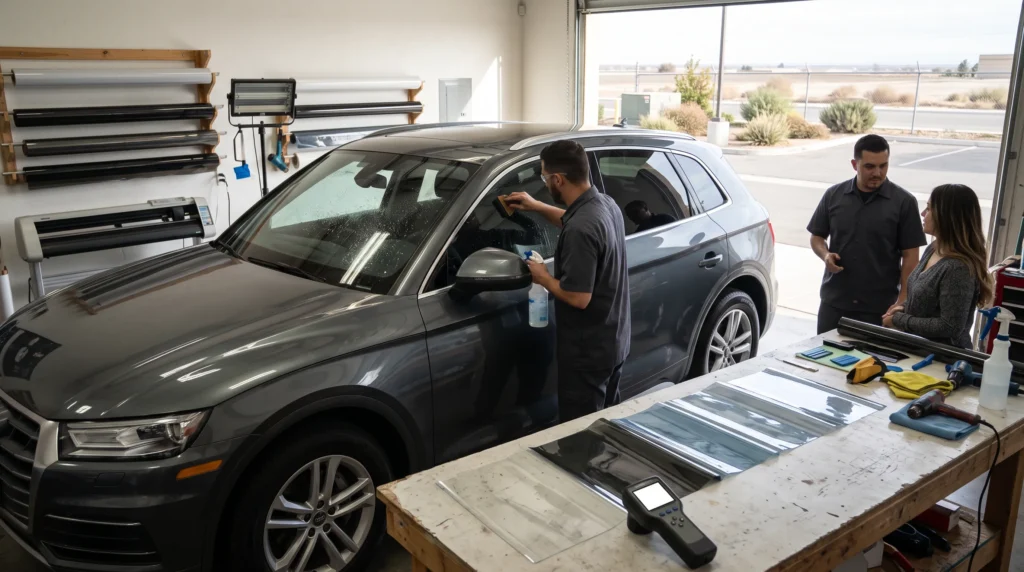
Call (661) 634-5585 or visit the Dynamic Window Tint contact page to discuss the film choices for your vehicle.
FAQs About Window Tint Specs
1. What does VLT mean in window tint?
VLT means Visible Light Transmission. It tells you how much visible light passes through the film or glass system. Lower VLT produces a darker appearance, while higher VLT allows more visible light through.
2. What does TSER mean in window tint?
TSER means Total Solar Energy Rejected. It measures how much total solar energy is rejected by the tested film and glazing system. Higher TSER means more total solar energy is rejected under the stated testing.
3. What does IR rejection mean?
IR rejection tells you how much infrared energy is rejected within the wavelength range used for the manufacturer’s test. Because manufacturers may test different IR ranges, the figure should be considered with TSER.
4. Is 90% IR rejection better than 60% TSER?
Those percentages cannot be compared directly. IR rejection measures only the tested infrared range, while TSER measures total solar energy rejected. The International Window Film Association recommends looking at TSER when judging total heat-related performance and reading IR figures in context.
5. Does darker tint have better heat rejection?
Not always. A lighter ceramic film can publish higher IR rejection than a darker lower-tier film. Compare VLT, TSER, and IR rejection separately.
6. Why does my finished tint read darker than the film percentage?
The glass already reduces some visible light before film is added. The film and glass combine, so a 50% film installed on automotive glass can produce a finished VLT below 50%.
7. Where can I compare Rayno window tint specs in Bakersfield, CA?
Dynamic Window Tint installs Rayno automotive window film at 4609 New Horizon Blvd Suite #10, Bakersfield, CA 93313. Call (661) 634-5585 or visit the contact page to compare Rayno S5, S7, S9, VLT, TSER, IR rejection, UV rejection, and shade choices.
Sources
- Rayno Phantom Series
Publisher: Rayno Window Film
Publication Date: Not listed
Information referenced: Current S5, S7, and S9 VLT, TSER, IR rejection, UV rejection, visible light reflection, shading coefficient, fading rate, and film construction. - Automotive Education Guide 2026
Publisher: International Window Film Association
Publication Date: 2026
Information referenced: Solar spectrum, TSER, infrared rejection, differences in IR wavelength testing, VLT, and guidance on comparing IR rejection with TSER. - Interactive Tint Laws and Definitions
Publisher: International Window Film Association
Publication Date: Current online guidance
Information referenced: Visible Light Transmission and Visible Light Reflection definitions. - Does Window Film Need to Be Dark to Work?
Publisher: International Window Film Association
Publication Date: Not listed
Information referenced: VLT, lighter film, visible appearance, solar heat reduction, glare, and UV performance. - National Fenestration Rating Council
Publisher: National Fenestration Rating Council
Publication Date: Current online guidance
Information referenced: Visible transmittance and Solar Heat Gain Coefficient definitions. - Front Windshield Tint in Bakersfield: Clear IR Film Explained
Publisher: Dynamic Window Tint
Publication Date: Not listed
Information referenced: VLT, IR rejection, TSER, Rayno Platinum Air 7090, lighter film, and differences between visible darkness and solar performance. - Window Tint in Bakersfield, CA
Publisher: Dynamic Window Tint
Publication Date: Not listed
Information referenced: Rayno automotive window film, S5, S7, S9, certified installation, warranty-backed service, and Bakersfield vehicle tint. - Contact Dynamic Window Tint
Publisher: Dynamic Window Tint
Publication Date: Not listed
Information referenced: Bakersfield address, phone number, and appointment information.
