

Front windshield tint in Bakersfield is often requested by drivers who want help with solar heat and UV exposure without giving their windshield a dark appearance. That is where clear or high-visible-light-transmission IR film gets attention. These films are designed to let much of the visible light through while rejecting part of the infrared energy and UV radiation reaching the glass.
There is a legal issue Bakersfield, CA drivers need to understand before covering the full windshield. California does not allow unrestricted aftermarket film across the entire windshield simply because the film looks clear. California Vehicle Code Section 26708 contains a medical exception for clear, colorless, transparent film on a full windshield, and that exception has several conditions, including film with at least 88% visible light transmittance and documentation from a licensed dermatologist.
California separately allows transparent material on the topmost portion of the windshield when it follows the placement, color, lettering, and reflection rules in Section 26708(c).
So, when discussing front windshield tint in Bakersfield, the film technology and the legal installation area need to be treated as two separate questions.
Dynamic Window Tint installs vehicle window tint at its Bakersfield, CA shop and carries Rayno Window Film. The shop is certified and carries warranties on products and services.
This guide explains what clear IR film does, how it differs from dark tint, what VLT and IR rejection mean, and what California law says about putting film on the front windshield.
Table of Contents
- What Is Clear IR Windshield Film?
- Why Bakersfield Drivers Ask About Front Windshield Tint
- How Infrared Rejection Works
- Clear Film Does Not Mean Zero Tint
- What VLT Means on Windshield Film
- IR Rejection Versus Total Solar Energy Rejected
- Rayno Clear IR Film Options
- Can You Tint the Full Front Windshield in California?
- California’s Medical Exception for Clear Windshield Film
- Why 70% Windshield Film Is Not Automatically Legal
- Legal Windshield Tint Strips in California
- Clear IR Film and UV Rejection
- Clear Windshield Film and Driving Visibility
- Windshield Tint Versus Windshield Protection Film
- Choosing Window Tint for Bakersfield Heat
- Schedule Window Tinting in Bakersfield, CA
- Frequently Asked Questions
- Sources
What Is Clear IR Windshield Film?
Clear IR film is automotive window film made to let a high percentage of visible light through while rejecting part of the infrared energy coming from sunlight.
IR stands for infrared.
Infrared radiation makes up part of the solar energy associated with the heat people feel when sunlight comes through vehicle glass.
A film can look light while still having measurable infrared rejection.
That distinction is one of the main reasons front windshield tint in Bakersfield attracts attention.
Some drivers do not want a windshield that appears dark. They want the vehicle to retain a factory-like appearance while addressing solar exposure.
Clear or lightly tinted IR film may be made for that type of use, but California law determines whether a particular film can legally cover the full windshield.
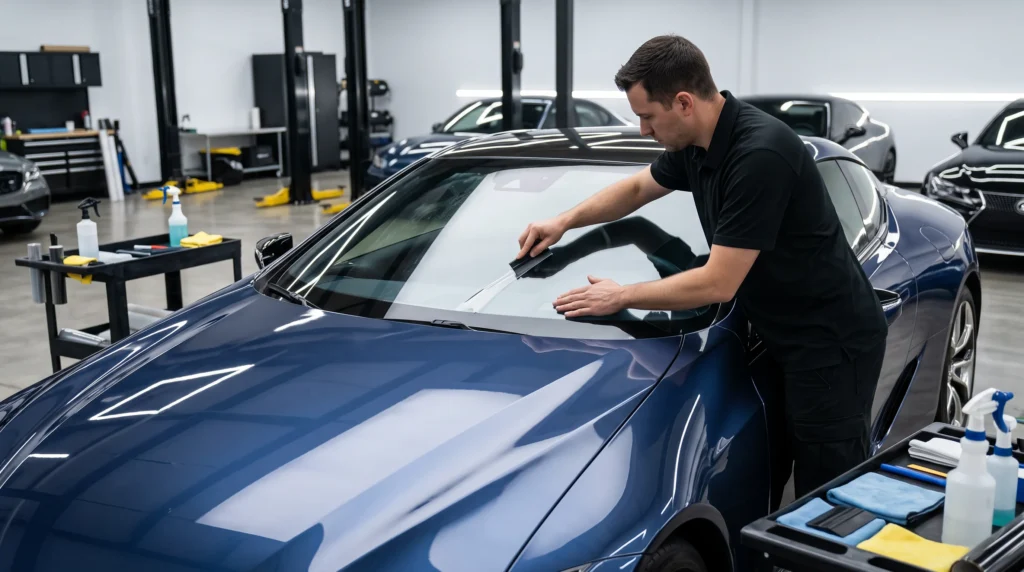
The film’s appearance alone does not decide legality.
Why Bakersfield Drivers Ask About Front Windshield Tint
Bakersfield, CA gets long periods of bright, hot weather.
The windshield is also one of the largest pieces of glass on most vehicles.
When the vehicle faces the sun, sunlight can pass through that large glass area and reach:
- The dashboard
- Steering wheel
- Front seats
- Center console
- Driver
- Front passenger
Drivers often notice the windshield because side-window tint does not cover the large opening at the front of the cabin.
You may have ceramic film on the side and rear windows while still feeling strong sunlight coming through the windshield.
That leads many vehicle owners to ask whether clear front windshield tint in Bakersfield can help.
From a film-performance standpoint, high-VLT IR film can reject measured solar energy while remaining much lighter than common side-window tint shades.
From a legal standpoint, California places much tighter restrictions on the windshield.
Both parts need to be considered.
How Infrared Rejection Works
Infrared rejection is one specification manufacturers use to describe window film.
The figure tells you how much infrared radiation the film rejects within the manufacturer’s stated testing range.
A higher IR-rejection number means more of that tested infrared energy is rejected.
The number should not be confused with VLT.
A film can have:
- High VLT
- Strong IR rejection
- High UV rejection
at the same time.
That is one reason drivers should not assume a dark tint is required to address solar heat.
Rayno’s published automotive film specifications give a good illustration.
Its Platinum Air 7090 film is listed at 70% VLT, 99% UV rejection, and 42% Total Solar Energy Rejected. Rayno’s automotive specifications have also reported 88% IR rejection for Air7090 under its stated test method.
That is a light film compared with common 20%, 15%, or 5% tint shades.
The catch is that film performance and California legality are separate matters.
A film being sold for windshield applications elsewhere does not mean it can legally cover an ordinary California driver’s full windshield.
Clear Film Does Not Mean Zero Tint
People often use the phrase “clear tint.”
That can sound contradictory, but it refers to window film with high visible light transmission.
A completely untreated windshield and a windshield with high-VLT film may look similar from a short distance, yet the film can still change the amount of visible light, UV, infrared energy, and total solar energy passing through the glass.
This is why you should ask for actual specifications.
A nearly clear appearance does not mean the film has 100% visible light transmission.
It also does not make a full-windshield installation legal by itself.
When considering front windshield tint in Bakersfield, ask for the film’s published:
- VLT
- IR rejection
- UV rejection
- TSER
- Visible light reflection
Those figures tell you more about the product than the word “clear.”
What VLT Means on Windshield Film
VLT means Visible Light Transmission.
It measures the percentage of visible light that passes through a film.
The higher the VLT, the lighter the film generally appears.
A 90% VLT film allows much more visible light through than a 50% film.
A 20% film is much darker.
There is another factor.
The final amount of visible light passing through a finished windshield depends on both the film and the original glass.
If film is rated at one VLT, that number should not automatically be treated as the completed windshield’s final VLT.
The factory windshield already has optical properties of its own.
For California drivers, this becomes especially relevant because Vehicle Code Section 26708 refers to both the film’s light transmission and the completed glazing system under the medical exception.
IR Rejection Versus Total Solar Energy Rejected
IR rejection gets a lot of attention in window-film advertising, but it is not the only solar measurement worth reading.
TSER means Total Solar Energy Rejected.
TSER looks at the total solar energy rejected by the film and glazing system rather than infrared radiation alone.
That makes it useful when comparing films for Bakersfield, CA heat.
Here is a simple way to think about the measurements:
- VLT: How much visible light passes through
- IR rejection: How much tested infrared energy is rejected
- UV rejection: How much ultraviolet radiation is rejected
- TSER: How much total solar energy is rejected
If your goal is front windshield tint in Bakersfield because the dashboard and front seats get hit with sunlight, compare more than one number.
A large IR figure can sound impressive, but TSER helps provide another view of the film’s solar performance.
Rayno Clear IR Film Options
Dynamic Window Tint carries Rayno Window Film.
Rayno currently markets Platinum Air 7090 as a light automotive film that can be used on curved automotive glass.
Rayno publishes the following figures for Platinum Air 7090:
- 70% VLT
- 99% UV rejection
- 7.3% visible light reflection
- 42% TSER
- 0.58 Solar Heat Gain Coefficient
Rayno’s automotive specification material has also reported 88% IR rejection for Air7090.
Those specifications help explain why a driver may be interested in a light IR film.
It can look much lighter than common dark tint while still providing measurable solar properties.
Yet the 70% VLT figure raises a legal issue for full-windshield use in California.
California’s medical exception for full-windshield clear film calls for the material itself to have a minimum VLT of 88%.
That means a film listed at 70% VLT does not meet that particular 88% film threshold for a full-windshield installation under Vehicle Code Section 26708(e).
Ask the installer about California-compliant choices and where a particular product can legally be used before installation.
Can You Tint the Full Front Windshield in California?
For an ordinary California driver, a full windshield cannot simply be covered with aftermarket tint because the film looks light or clear.
California Vehicle Code Section 26708(a) generally prohibits material on the windshield or windows when it is not covered by one of the statute’s exceptions.
There are two windshield-related exceptions that often come up in tint discussions.
The first covers transparent material on the topmost portion of the windshield.
The second covers clear, colorless, transparent material on the windshield under stated medical conditions.
The medical provision is not a general rule allowing everyone to install clear ceramic windshield film.
This distinction matters for anyone searching for front windshield tint in Bakersfield.
A shop can explain film technology, but the installation also needs to fit California law.
California’s Medical Exception for Clear Windshield Film
Vehicle Code Section 26708(e) allows clear, colorless, transparent material on a windshield when several conditions are met.
Under the current law:
- The material must have at least 88% visible light transmittance.
- The completed glazing with the material must meet Federal Motor Vehicle Safety Standard No. 205 requirements referenced by the statute, including at least 70% light transmittance.
- The material must be designed to help the existing glass block UVA radiation.
- The driver must have a certificate signed by a licensed dermatologist stating that a medical condition requires protection from ultraviolet rays.
- Film that tears, bubbles, or becomes worn enough to interfere with clear vision must be removed or replaced.
That is a narrow exception.
It does not mean a California driver can install any 70%, 80%, or light ceramic film across the entire windshield simply because the product is marketed as clear.
For full-windshield film, the medical requirements matter.
Why 70% Windshield Film Is Not Automatically Legal
A common misconception is that 70% VLT automatically means legal front windshield tint in California.
That is not what Vehicle Code Section 26708 says.
The 70% figure referenced in the statute relates to the federal glazing requirement for the finished glass-and-film combination under the applicable exceptions.
For the medical full-windshield exception, California separately says the transparent film itself must have a minimum VLT of 88%.
Those are separate requirements.
A product labeled “70% tint” does not become California-legal full-windshield film because its label includes the number 70.
Rayno Platinum Air 7090, for instance, is published at 70% VLT.
That specification may make it a light film, but 70% is below the 88% minimum film-transmission requirement written into California’s medical full-windshield exception.
This is why checking the actual statute matters.
Legal Windshield Tint Strips in California
California also allows transparent material on the topmost portion of a windshield without the dermatologist requirement when the conditions in Vehicle Code Section 26708(c) are met.
The bottom edge of the material must be at least 29 inches above the undepressed driver’s seat when measured using the method written into the law.
The driver’s seat is placed in its rearmost and lowermost position on a level surface.
California also says the material:
- Cannot be red
- Cannot be amber
- Cannot contain opaque lettering
- Cannot distort color recognition or vision
- Cannot reflect sunlight or headlights toward other drivers more than the untreated windshield
This windshield-strip provision is different from covering the full windshield with clear IR film.
If your main concern is high-angle sun or glare near the top of the windshield, a properly placed strip may be another option to discuss.
Clear IR Film and UV Rejection
UV rejection is another reason people ask about clear film.
UV stands for ultraviolet.
Rayno lists 99% UV rejection for Platinum Air 7090.
Its Phantom ceramic films also publish high UV-rejection figures.
UV rejection does not require very dark glass.
That is one of the useful traits of modern window-film technology.
A driver who does not like a dark appearance can still compare lighter films based on their published UV and solar specifications.
California’s medical windshield-film exception even requires qualifying clear material to be designed to help existing glass block UVA radiation.
That legal wording shows why UV and visible darkness should not be treated as the same thing.
Clear Windshield Film and Driving Visibility
Visibility should stay at the center of any windshield-film decision.
The windshield is your main forward viewing area.
Even a light film needs good optical clarity.
Poor film, damaged film, contamination, haze, bubbling, or poor installation can affect what you see through the glass.
California specifically requires film covered by the medical exception to be removed or replaced if tearing, bubbling, or wear interferes with clear vision.
Drivers should also think about:
- Night driving
- Rain
- Oncoming headlights
- Road markings
- Traffic signals
- Windshield cameras
- Driver-assistance sensors
Many late-model vehicles have cameras and sensors mounted near the windshield.
A trained installer should inspect the vehicle before applying any film near those areas.
Windshield Tint Versus Windshield Protection Film
Front windshield tint and windshield protection film serve different purposes.
Windshield tint is chosen for light and solar control.
Windshield protection film is a clear exterior layer made for physical coverage of the windshield surface.
Drivers may consider windshield protection film because of:
- Small road debris
- Highway driving
- Surface wear
- Rock-chip concerns
Dynamic Window Tint also provides windshield chip repair and windshield replacement.
If the concern is cabin heat, ask about window-film choices.
If the concern is road debris hitting the glass, ask about windshield protection film.
If there is already a chip or crack, ask whether repair or replacement should happen before any other windshield service.
Choosing Window Tint for Bakersfield Heat
If full-windshield film is not available for your vehicle under California law, you can still discuss other ways window film may help manage solar exposure.
Legal film choices on other windows can make a noticeable difference because side and rear glass account for a large portion of the cabin’s glass area.
Drivers often compare ceramic film for:
- Front side windows where California requirements are met
- Rear side windows
- Rear glass
- Quarter glass
- Sunroofs where the vehicle and film are suitable
Rayno’s Phantom ceramic films are available in several VLT levels with published IR, UV, and TSER figures.
That lets Bakersfield, CA drivers compare films based on solar performance instead of relying only on darkness.
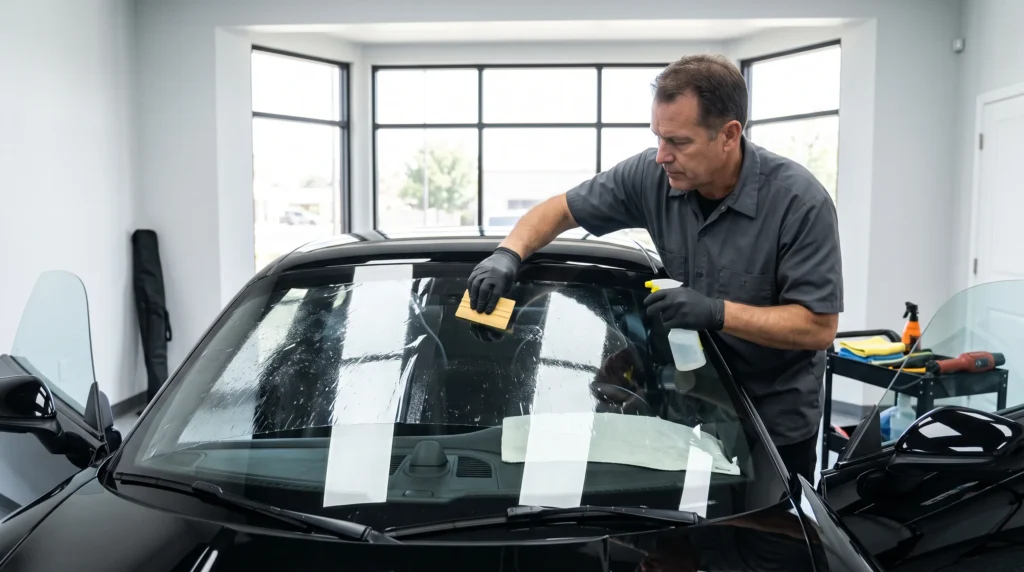
Your vehicle, glass, driving schedule, desired appearance, and California rules should shape the final choice.
Schedule Window Tinting in Bakersfield, CA
Front windshield tint in Bakersfield deserves a careful conversation because clear IR film can have strong solar specifications while still being subject to California windshield rules.
A light appearance does not automatically make full-windshield tint legal.
California’s current law limits ordinary windshield material and provides a separate medical exception for qualifying clear, colorless, transparent film.
If you want help with heat, UV, or glare, Dynamic Window Tint can go over your vehicle and available Rayno Window Film choices.
Dynamic Window Tint is located at:
4609 New Horizon Blvd Suite #10 Bakersfield, CA 93313
Call (661) 634-5585 to discuss your car, truck, or SUV.
You can also visit the Dynamic Window Tint contact page to schedule an appointment.
The shop serves Bakersfield, CA and nearby communities such as Shafter, CA, Wasco, CA, Lamont, CA, Arvin, CA, Rosedale, CA, Oildale, CA, and other Kern County areas.
Film choice, vehicle glass, installation area, existing tint, and the work needed can affect the job. Call the shop or use the contact form for information based on your vehicle rather than relying on a generic online price.
Frequently Asked Questions
1. Is clear front windshield tint legal in Bakersfield, CA?
California law applies in Bakersfield, CA. Clear film covering the full windshield is not automatically legal. Vehicle Code Section 26708(e) provides a medical exception for qualifying clear, colorless, transparent film when the film has at least 88% VLT, the finished glazing meets the referenced federal requirements, and the driver carries certification from a licensed dermatologist.
2. What is clear IR windshield film?
Clear IR film is high-VLT window film designed to let much of the visible light through while rejecting part of the infrared energy and UV radiation reaching the glass. The exact VLT, IR rejection, UV rejection, and TSER depend on the product.
3. Does clear ceramic windshield film reduce heat?
It can reduce part of the solar energy transmitted through treated glass. Check the manufacturer’s IR-rejection and TSER figures when comparing films. A nearly clear appearance does not mean a film has no solar-control properties.
4. Is 70% windshield tint legal in California?
A 70% film is not automatically legal across the full windshield. California’s medical full-windshield exception says the material itself must have at least 88% visible light transmittance, along with other conditions. A product published at 70% VLT does not meet that 88% film threshold.
5. What is the difference between IR rejection and VLT?
VLT measures how much visible light passes through a film. IR rejection measures how much infrared energy within the manufacturer’s testing range is rejected. A light film can have high VLT and still provide measurable IR rejection.
6. Can I install a tint strip at the top of my windshield?
California allows transparent material on the topmost portion of the windshield when it meets the conditions in Vehicle Code Section 26708(c). The bottom edge must meet the state’s 29-inch seat-based measurement, and the material must follow California rules for color, lettering, visibility, and reflected glare.
7. How do I ask about windshield tint in Bakersfield, CA?
Call Dynamic Window Tint at (661) 634-5585 or visit the contact page. Tell the team your vehicle year, make, model, whether you are interested in heat rejection, UV rejection, glare control, or a windshield strip, and they can discuss available film and California placement requirements.
Sources
California Vehicle Code Section 26708
Publisher: California Legislative Information
Publication Date: Amended by Stats. 2025, Ch. 417, Sec. 5, effective January 1, 2026
Information referenced: Windshield restrictions, top windshield strip requirements, front-side-window film conditions, and the medical exception for clear, colorless, transparent windshield film.
Aftermarket Tinting Guidance
Publisher: California Highway Patrol
Publication Date: Current CHP-hosted guidance
Information referenced: California enforcement guidance concerning aftermarket window tinting and Federal Motor Vehicle Safety Standard No. 205.
Platinum Air 7090
Publisher: Rayno Film
Publication Date: Not listed
Information referenced: Air7090 VLT, UV rejection, TSER, visible light reflection, solar specifications, and automotive applications.
Phantom Series Automotive Window Film
Publisher: Rayno Film
Publication Date: Not listed
Information referenced: Rayno ceramic film VLT, IR rejection, TSER, UV rejection, and film choices.
Window Tint in Bakersfield, CA
Publisher: Dynamic Window Tint
Publication Date: Not listed
Information referenced: Rayno Window Film, window tint services, shop location, contact information, and warranty-backed work.
Windshield Protection Film in Bakersfield, CA
Publisher: Dynamic Window Tint
Publication Date: Not listed
Information referenced: Windshield protection film service and its role as a different product from automotive tint.
