

Tinting a new car in Bakersfield is one of the first changes many owners consider after taking delivery. New vehicles can have large windshields, panoramic roofs, tall side glass, and dark factory rear windows, yet the amount of solar control built into each piece of glass can differ.
You usually do not need to own the car for weeks before installing window film.
If the vehicle is ready to use, the glass is in good condition, and there is no repair work scheduled that affects the windows, automotive film can often be installed soon after delivery.
The bigger decisions happen before the appointment.
You need to know which windows already have factory privacy glass, how dark you want the cabin, whether solar heat or privacy matters more, and which film specifications you want to compare.
Then comes the first week after tinting.
Automotive film is installed using moisture that allows the installer to position the film on the glass. Some of that moisture remains temporarily after installation. The International Window Film Association explains that complete adhesion takes time while this residual moisture dries.
That means the first several days call for a little patience.
Here is what Bakersfield, CA drivers should know about tinting a newly purchased vehicle and taking care of the film during its first week.
Table of Contents
- Can You Tint a Brand-New Car Right Away?
- What to Check Before Tinting a New Car
- Check for Factory Privacy Glass First
- Decide What You Want the Tint to Do
- Choose VLT Before Choosing a Film Tier
- Compare TSER and IR Rejection
- Rayno S5 for a New Car
- Rayno S7 for a New Car
- Rayno S9 for a New Car
- Do New Cars Need Dark Tint for Heat Control?
- What About Panoramic Glass Roofs?
- What About the Windshield?
- California Tint Rules Still Apply to New Cars
- What Happens During Installation?
- What to Do During the First 24 Hours
- What to Do During Days Two Through Seven
- Why New Tint Can Look Hazy at First
- When Can You Roll the Windows Down?
- When Can You Clean Newly Tinted Windows?
- What Not to Do During the First Week
- What Should You Inspect After the Film Dries?
- Tinting a New Car in Bakersfield CA
- FAQs About Tinting a New Car
Can You Tint a Brand-New Car Right Away?
In many cases, yes.
There is no normal need to wait several weeks simply because a vehicle is new.
Automotive window film is applied to the inside surface of compatible vehicle glass.
The International Window Film Association describes the installation process as cleaning the glass, measuring and preparing the film, applying it to the interior side, and removing installation solution from beneath the film.
A new vehicle can be a good candidate because the glass may not have years of old adhesive, failed aftermarket tint, scratches, or heavy contamination.
Still, inspect the vehicle first.
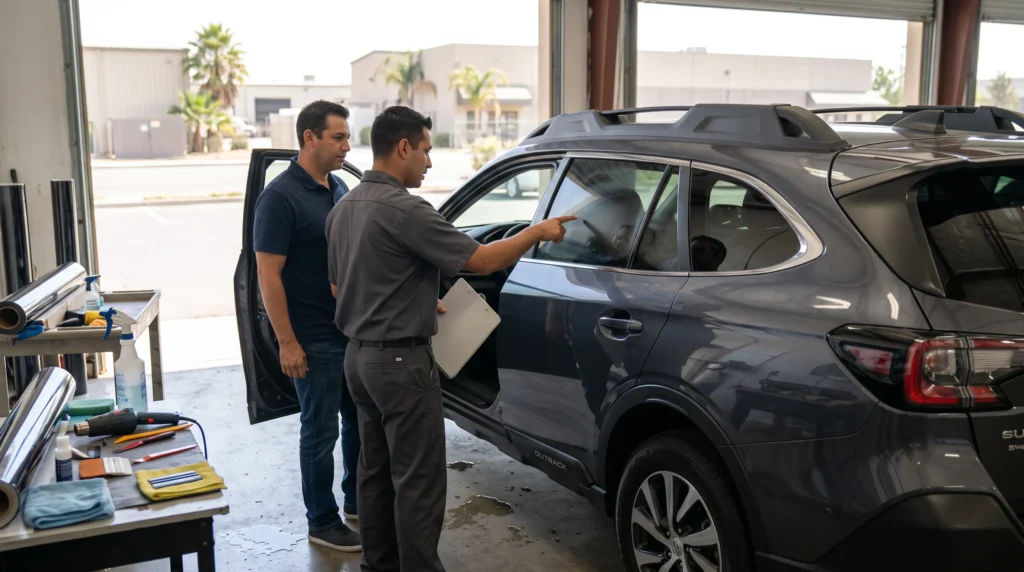
If a dealership or repair center needs to replace a window, repair damaged glass, or perform work that requires removing interior window trim, it may make sense to complete that work before tinting.
What to Check Before Tinting a New Car
Walk around your vehicle before deciding on film.
Look at every piece of glass you want treated.
Check for:
- Dealer stickers
- Temporary labels
- Scratches
- Chips
- Existing tint film
- Factory privacy glass
- Rear defroster lines
- Panoramic roof glass
- Cameras near the windshield
- Rear quarter windows
A brand-new vehicle can still have glass characteristics that affect film selection.
The rear doors may already be dark.
The windshield may contain cameras.
The roof may have factory tint or coatings.
Knowing what is already present helps you avoid choosing film from a shade sample alone.
Check for Factory Privacy Glass First
SUVs, trucks, crossovers, and some other vehicles often arrive with dark rear glass.
This is usually factory privacy glass rather than aftermarket film.
That distinction matters because adding film over factory privacy glass can make the finished window much darker.
Suppose the factory glass transmits about 25% of visible light.
Adding a 50% film would produce an approximate combined transmission of:
0.25 × 0.50 = 0.125
That is approximately 12.5% VLT before allowing for differences in the actual glass and measurement method.
A film that looks light on clear glass can create a much darker result over factory privacy glass.
If the rear glass is already dark enough for your taste, consider a lighter ceramic film when your goal is solar performance rather than more privacy.
Decide What You Want the Tint to Do
Do this before choosing a shade.
Ask yourself why you want tint.
Possible reasons include:
- Reducing glare
- Adding rear privacy
- Reducing UV exposure
- Managing solar heat
- Giving the vehicle a darker appearance
- Helping rear passengers with bright sunlight
- Matching front and rear glass more closely
- Keeping a light appearance while adding ceramic film
Your answer changes the film discussion.
Someone who wants a dark appearance may choose differently from a driver whose main concern is solar heat.
A parent tinting rear windows for children may have different priorities from someone tinting a sports car.
Choose VLT Before Choosing a Film Tier
VLT stands for Visible Light Transmission.
It describes how much visible light passes through the film or glass system.
Lower VLT means darker glass.
Higher VLT keeps more visible light.
Common film ranges include:
- 5% for very dark glass
- 15% to 20% for dark rear glass
- 30% to 35% for a moderate appearance
- 50% for a lighter appearance
The film percentage does not always equal the final VLT measured through your vehicle window because the glass already reduces some light.
This is one reason a new-car tint consultation should account for the actual vehicle.
Compare TSER and IR Rejection
Once you know the appearance you want, compare solar specifications.
TSER stands for Total Solar Energy Rejected.
IR rejection describes how much infrared energy is rejected within the manufacturer’s tested wavelength range.
These are different measurements.
A film can publish a very high IR percentage while having a much lower TSER.
When heat is one reason you are tinting a new car in Bakersfield, compare both measurements rather than choosing from an IR number alone.
The same goes for VLT.
A darker film is not automatically the film with stronger ceramic or infrared performance.
Rayno S5 for a New Car
Dynamic Window Tint carries Rayno Window Film.
Rayno Phantom S5 gives new-car owners several shade choices using Rayno’s carbon ceramic construction.
Rayno currently publishes:
- 99.9% UV rejection across listed S5 shades
- Less than 1% fading rate
- IR rejection ranging from 53% to 72%
- TSER ranging from 41% to 66%
Rayno S5-50 is listed at:
- 50% VLT
- 56% IR rejection
- 41% TSER
- 99.9% UV rejection
That lighter shade may fit a driver who does not want a heavily darkened cabin.
Rayno S7 for a New Car
Rayno Phantom S7 carries higher published IR figures than S5 across its current lineup.
Rayno currently lists:
- 99.9% UV rejection
- 70% to 81% IR rejection
- 47% to 66% TSER
- Less than 1% fading rate
Rayno S7-50 is listed at:
- 50% VLT
- 74% IR rejection
- 47% TSER
- 99.9% UV rejection
Compare that with S5-50.
Both are listed at the same 50% VLT, but their published IR and TSER figures differ.
That is a good example of why VLT should not be used as a stand-in for solar performance.
Rayno S9 for a New Car
Rayno Phantom S9 carries the strongest published IR figures among Rayno’s current S5, S7, and S9 Phantom choices.
Rayno currently lists:
- 91% to 93% IR rejection
- 53% to 70% TSER
- 99.9% UV rejection
- Less than 1% fading rate
S9-50 is listed at:
- 50% VLT
- 92% IR rejection
- 53% TSER
- 99.9% UV rejection
A driver buying a new vehicle and planning to keep it for years may want to compare S5, S7, and S9 at the same VLT.
That lets you compare film performance without changing the visible darkness at the same time.
See the available options on the Dynamic Window Tint vehicle window tint page.
Do New Cars Need Dark Tint for Heat Control?
No.
Heat-related film performance and visible darkness are not the same measurement.
Consider Rayno’s 50% Phantom films:
- S5-50: 56% IR rejection
- S7-50: 74% IR rejection
- S9-50: 92% IR rejection
All three are listed at 50% VLT.
The darkness stays similar while the published IR performance changes.
That can be useful on a new vehicle when you like the bright cabin but still want ceramic film.
You do not have to choose extremely dark rear glass solely because Bakersfield summers are hot.
What About Panoramic Glass Roofs?
Many new vehicles now have large panoramic or fixed glass roofs.
Treat the roof as a separate part of the tint plan.
Factory roof glass may already include:
- Dark tint
- Laminated glass
- UV-reducing properties
- Solar coatings
- Other factory treatments
Do not assume the same film used on the doors should automatically go on the roof.
Ask what the existing roof glass already does and whether the chosen film is suitable for that application.
Also think about why you want roof film.
Is overhead brightness bothering you?
Does the roof feel warm?
Do rear passengers complain about direct sun?
Do you want to keep the clear upward view?
Those answers can point toward a lighter film, a different film, a shade, or leaving the roof as delivered.
What About the Windshield?
The windshield is another area where new-car owners often ask about ceramic film.
A large windshield allows a broad area of sunlight into the cabin.
Modern windshields may also contain:
- Driver-assistance cameras
- Rain sensors
- Light sensors
- Head-up display areas
- Antennas
- Factory coatings
California also restricts windshield film.
Do not assume that a nearly clear film can legally be installed across the entire windshield merely because it does not look dark.
Review the current rules before adding any windshield film.
Dynamic Window Tint also covers this subject in its Bakersfield windshield tint guide.
California Tint Rules Still Apply to New Cars
A brand-new vehicle receives no special exemption from California window tint rules.
California Vehicle Code Section 26708 regulates materials placed on vehicle windows and windshields.
Front side windows are much more restricted than windows behind the driver.
California law includes a provision allowing clear, colorless, transparent material on front side windows when listed requirements are met. Those requirements include film and combined glass-film light-transmission standards plus installer certification.
Rear side windows have broader allowances.
Rear glass also has separate rules involving qualifying outside mirrors.
This means a tint plan may use different shades in different parts of the vehicle.
Do not choose the front window film simply to match dark factory rear privacy glass.
Review our California window tint laws guide for Bakersfield drivers before choosing your setup.
What Happens During Installation?
Automotive window tint is installed on the inside of the vehicle glass.
The International Window Film Association describes the process as beginning with cleaning the windows so dirt and debris do not interfere with adhesion.
The film is then cut and fitted for the window.
Installation solution allows it to be positioned against the glass.
The installer removes as much solution as possible from beneath the film.
Some residual moisture remains.
That moisture is one reason newly installed film may not look completely settled immediately.
The film needs time to dry and develop normal adhesion.
What to Do During the First 24 Hours
The first day is about leaving the film alone.
Keep the newly tinted windows closed.
Do not clean the interior film surface.
Do not press bubbles or moisture pockets.
Do not pick at edges.
Do not attach suction-cup accessories to the tint.
You may notice:
- Slight haze
- Small moisture pockets
- A cloudy appearance in certain light
- Minor visual distortion from drying moisture
The International Window Film Association notes that residual water can temporarily affect clarity while the film dries.
That alone does not mean the tint has failed.
What to Do During Days Two Through Seven
Continue treating the windows gently.
Dynamic Window Tint recommends keeping the windows up and avoiding interior cleaning during the early curing period.
The exact drying period can change with:
- Film thickness
- Film coatings
- Weather
- Temperature
- Humidity
- Where the vehicle is stored
Bakersfield’s warmer weather may change drying conditions, but do not assume hot weather means the film is fully dried immediately.
Follow the installer’s directions for your film.
During this period:
- Leave visible moisture alone
- Avoid picking at film edges
- Keep hard objects away from the film
- Avoid interior-glass cleaning until instructed
- Watch the film as moisture gradually clears
Why New Tint Can Look Hazy at First
Some haze after installation can be normal.
The International Window Film Association explains that installation uses a water-based solution and that residual moisture can remain between the film and glass.
During drying, that moisture can affect visual clarity.
The IWFA automotive inspection guideline says water distortion and water haze during the clearing and drying period should not automatically be treated as film defects.
The appearance should change as the moisture leaves.
Do not try to remove the haze by pressing on the film.
Doing so can disturb film that is still bonding to the glass.
When Can You Roll the Windows Down?
Follow the installer’s instructions.
Dynamic Window Tint recommends keeping newly tinted windows up during the first days while the film dries and adheres.
Rolling a door window down too early can put pressure on the film edge as it passes through the window seals.
That can cause an edge to lift.
The IWFA notes that installers commonly leave a small top-edge gap so film does not make unwanted contact with the frame gasket as the glass moves.
Even with a properly fitted edge, giving the film time to dry before operating the window reduces unnecessary contact during the early stage.
When Can You Clean Newly Tinted Windows?
Do not rush to clean the inside of the glass immediately after installation.
The film is on the interior side.
Cleaning too early means touching the surface while the film is still drying.
Wait until the installer says the film is ready for normal care.
When you do clean it, use:
- A soft microfiber cloth
- Window-film-safe cleaner
- Gentle wiping
Avoid:
- Razor blades
- Abrasive scrubbers
- Hard scraping tools
- Rough paper products
- Picking at film edges
Your exterior glass can be treated differently because the tint is installed on the inside.
What Not to Do During the First Week
Several simple mistakes can damage fresh tint.
Do Not Roll the Windows Down Too Soon
The seals can catch an edge before adhesion has developed enough.
Do Not Pick at Small Moisture Pockets
Give the drying process time.
Do Not Scrub the Film
New tint is not the place for aggressive interior detailing.
Do Not Use a Razor on the Film
A blade can cut window film.
Do Not Add Stickers Immediately
Avoid pressing adhesive items onto fresh film.
Do Not Judge the Final Appearance on Day One
Residual moisture can temporarily change the way the film looks.
Do Not Assume Every Bubble Is Permanent
Water-related distortion may disappear as drying continues.
Air contamination or an installation issue is different, which is why the film should be reassessed after it has had time to settle.
What Should You Inspect After the Film Dries?
Once the expected drying period has passed, look at the windows in natural daylight.
The IWFA inspection guideline recommends assessing applied automotive film from normal viewing positions rather than placing your face directly against the glass searching for microscopic flaws.
Look for problems such as:
- Persistent air bubbles
- Edge lifting
- Creases
- Tears
- Unusual contamination
- Sections of film separating from the glass
Some small visual differences need context because applied film is not the same surface as bare automotive glass.
If something does not look right after the expected drying period, contact the installer rather than trying to repair it yourself.
Tinting a New Car in Bakersfield CA
Tinting a new car in Bakersfield can be done soon after purchase when the vehicle glass is ready and no glass-related repair work is pending.
The best time to make decisions is before installation.
Check:
- Factory privacy glass
- Panoramic roof glass
- Windshield cameras and sensors
- Rear defroster lines
- Desired VLT
- TSER
- IR rejection
- UV rejection
- California tint requirements
Then think about how you plan to use the car.
If you commute daily in Bakersfield, CA, solar performance may matter more.
If you bought an SUV for family use, rear-passenger glare and UV rejection may carry more weight.
If you bought a sports car, keeping a lighter glass appearance may matter.
If your new truck already has dark factory privacy glass, you may want lighter ceramic film over the rear glass rather than making it much darker.
Dynamic Window Tint installs Rayno automotive window tint in Bakersfield, CA.
The shop is located at:
4609 New Horizon Blvd Suite #10 Bakersfield, CA 93313
Dynamic Window Tint works with new:
- Cars
- Trucks
- SUVs
- Crossovers
- Teslas
- Cybertrucks
- Electric vehicles
- Family vehicles
The shop serves Bakersfield, CA and nearby communities including Rosedale, CA, Oildale, CA, Greenacres, CA, Shafter, CA, Lamont, CA, Arvin, CA, Wasco, CA, and surrounding Kern County areas.
Dynamic Window Tint is certified and carries warranties on its products and services.
After installation, follow the care instructions instead of treating the film like fully cured glass on the first day.
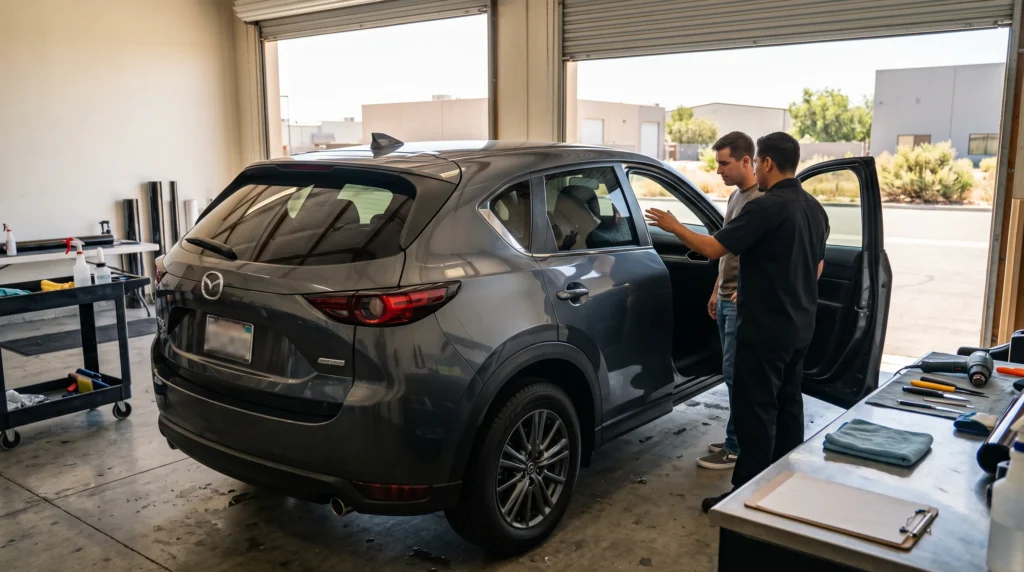
Keep the windows up, avoid touching the film, and give the remaining installation moisture time to dry.
For a new-car tint appointment, call (661) 634-5585 or visit the Dynamic Window Tint contact page.
FAQs About Tinting a New Car
1. How soon can I tint a brand-new car?
A new car can often be tinted shortly after delivery if the glass is in good condition and there is no upcoming glass repair or replacement work. There is normally no need to wait weeks simply because the vehicle is new.
2. Should I tint a new car before or after adding other accessories?
If another planned service requires removing windows, glass, door trim, or related parts, discuss the order with the shops involved. Ordinary accessories that do not affect the glass may not change the tint schedule.
3. How long should I keep the windows up after tinting?
Follow the installer’s instructions for the film and current conditions. During the first days, keep the windows closed so the moving seals do not catch film edges while adhesion is still developing.
4. Are small bubbles normal right after window tint is installed?
Residual installation moisture can create temporary haze, water distortion, or small moisture pockets. The International Window Film Association notes that these drying effects should not automatically be treated as defects. Contact the installer if they remain after the expected drying period.
5. Should I tint factory privacy glass on my new SUV?
Only if you want something the factory glass is not giving you. You may want ceramic film for additional published solar characteristics even if the rear glass is already dark. A lighter film can help avoid making the finished glass excessively dark.
6. Does a new car need dark tint to reject heat?
No. VLT and solar performance are different measurements. Rayno S9-50, for example, is listed at 50% VLT while publishing 92% IR rejection and 53% TSER. Compare the film specifications rather than choosing by darkness alone.
7. Where can I tint a new car in Bakersfield, CA?
Dynamic Window Tint installs Rayno automotive window film at 4609 New Horizon Blvd Suite #10, Bakersfield, CA 93313. Call (661) 634-5585 or visit the contact page to discuss your new vehicle, factory glass, preferred shade, and Rayno film choices.
Sources
- Automotive Installation Process
Publisher: International Window Film Association
Publication Date: Current online guidance
Information referenced: Automotive film selection, glass preparation, interior-side installation, film fitting, and installation process. - Automotive Visual Inspection Guideline for Applied Window Film
Publisher: International Window Film Association
Publication Date: January 1, 2020
Information referenced: Residual installation moisture, drying time, adhesion, water haze, water distortion, inspection, and film-edge fit. - Rayno Phantom Series
Publisher: Rayno Window Film
Publication Date: Not listed
Information referenced: Current Phantom S5, S7, and S9 VLT, TSER, IR rejection, UV rejection, reflection, fading rate, and carbon ceramic construction. - California Vehicle Code Section 26708
Publisher: California Legislative Information
Publication Date: Current California Vehicle Code
Information referenced: Restrictions and exceptions for material applied to windshields, front side windows, rear side windows, and rear glass. - How to Care for New Window Tint: The First 7 Days
Publisher: Dynamic Window Tint
Publication Date: Not listed
Information referenced: First-week care, keeping windows closed, avoiding interior cleaning, drying moisture, film edges, and Bakersfield window-tint service. - California Window Tint Laws: What Bakersfield Drivers Need to Know
Publisher: Dynamic Window Tint
Publication Date: Not listed
Information referenced: California tint requirements for vehicle glass and Bakersfield driver considerations. - Front Windshield Tint in Bakersfield: Clear IR Film Explained
Publisher: Dynamic Window Tint
Publication Date: Not listed
Information referenced: Windshield film, lighter ceramic film, VLT, IR rejection, and California windshield considerations. - Window Tint in Bakersfield, CA
Publisher: Dynamic Window Tint
Publication Date: Not listed
Information referenced: Rayno automotive window film, S5, S7, S9, new vehicle tinting, certified installation, and warranty-backed service. - Contact Dynamic Window Tint
Publisher: Dynamic Window Tint
Publication Date: Not listed
Information referenced: Bakersfield address, phone number, and appointment information.
