

Home office window film in Bakersfield can make a bright workspace easier to use when sunlight keeps washing out your monitor or reflecting across the screen. Working next to a sunny window may sound ideal until you spend half the afternoon squinting, raising your monitor brightness, closing the blinds, or moving your laptop around the room.
The problem is often not that your office has too much natural light. It is that the light reaches your eyes or screen at the wrong angle.
Residential window film can reduce visible light coming through problem windows without requiring you to work in a dark room. The right film can also reduce solar heat and UV exposure while preserving an outdoor view.
For a Bakersfield, CA home office, film selection should start with glare, window direction, monitor position, and how much daylight you want to keep.
Here is what to consider before choosing home office window film.
Table of Contents
- Why Home Office Windows Cause Screen Glare
- How Home Office Window Film Cuts Glare
- Window Behind the Monitor vs Behind Your Chair
- Why Window Direction Matters in Bakersfield
- What VLT Means for a Home Office
- Does Darker Window Film Reduce More Glare?
- Can Window Film Keep a Home Office Bright?
- Home Office Window Film and Afternoon Heat
- Rayno Platinum Film for Home Offices
- Rayno Platinum Air 7090 for a Lighter Office
- Rayno Trinity for Office Windows
- Window Film vs Blinds for Screen Glare
- What About Dual Monitors and Large Screens?
- Can Home Office Film Add Privacy?
- What About Nighttime Privacy?
- Check the Glass Before Installing Film
- Which Bakersfield Home Offices Benefit Most?
- Home Office Window Film in Bakersfield, CA
- FAQs About Home Office Window Film
Why Home Office Windows Cause Screen Glare
Screen glare usually starts with the relationship between the window, your eyes, and your monitor.
If bright daylight is directly behind your monitor, your eyes have to look at a screen while facing a much brighter background.
If the window is behind you, sunlight can reflect directly across the screen.
A side window can also create problems when low-angle morning or afternoon sun crosses your desk.
Homeowners often respond by:
- Closing blinds
- Closing curtains
- Tilting the monitor
- Moving the desk
- Raising monitor brightness
- Turning off overhead lights
- Working farther away from the window
Those changes may help, but they can also turn a bright home office into a closed-off room.
Home office window film gives you another way to control the light at the glass.
Rather than covering the window completely, film reduces a portion of the visible light entering the room.
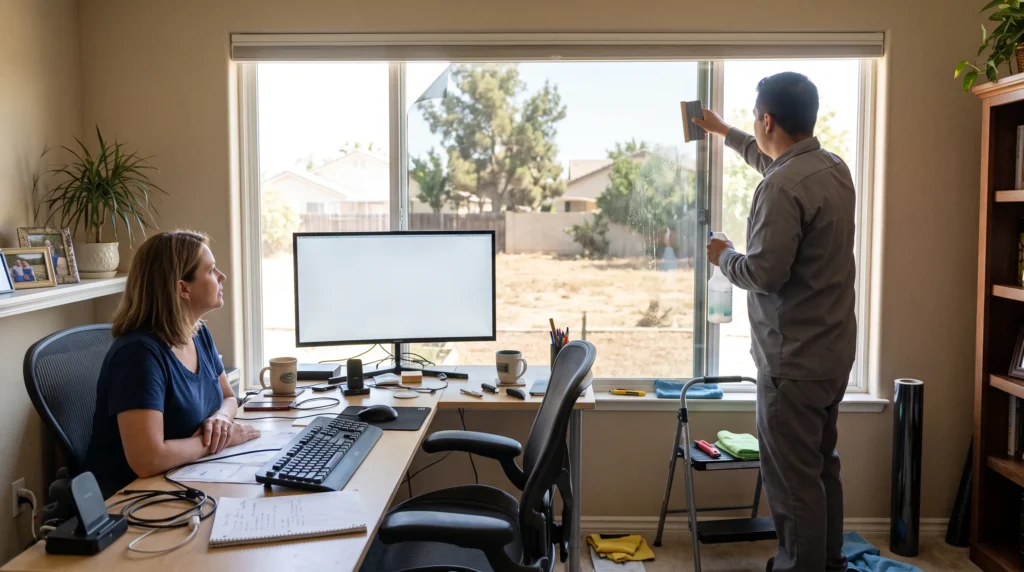
That can make the contrast between the screen and surrounding window easier to manage.
How Home Office Window Film Cuts Glare
Glare control is closely tied to Visible Light Transmission, commonly shortened to VLT.
VLT tells you how much visible light passes through the film.
A higher VLT lets more visible light through.
A lower VLT reduces more visible light.
Imagine an untreated office window allowing a large amount of daylight into the room. When that sunlight reaches your desk, the monitor has to compete with the brightness around it.
A residential film with a lower VLT reduces some of that incoming visible light.
The room can still receive daylight, but the difference between the bright glass and the computer screen may become less harsh.
For home office window film in Bakersfield, the goal usually is not to create a dark room.
It is to reduce enough brightness to make the monitor easier to see while preserving the benefits of working near a window.
Window Behind the Monitor vs Behind Your Chair
Before choosing film, look at where the window sits in relation to your desk.
Window Behind the Monitor
A bright window directly behind your monitor can create strong contrast.
Your eyes move between a screen and a much brighter background.
You may notice eye fatigue or find yourself increasing the screen brightness.
Film can reduce the brightness of the window without requiring you to close the blinds all day.
Window Behind Your Chair
This setup creates a different problem.
Light can hit the display directly and create reflections.
Dark parts of the screen may become difficult to see.
Glossy monitors can make the reflection even more obvious.
Window film can reduce the intensity of the incoming light before it reaches the screen.
Window Beside the Desk
Side windows are often easier to work with, but they can still create glare during certain hours.
The issue may only appear in the morning or late afternoon when sunlight reaches the window at a lower angle.
This is why the time of day matters when choosing home office window film.
Why Window Direction Matters in Bakersfield
The direction your office window faces can tell you a lot about when glare will occur.
East-Facing Home Offices
East-facing windows receive stronger direct sunlight earlier in the day.
If you work from home in the morning, glare may become noticeable shortly after sunrise and continue through part of the morning.
West-Facing Home Offices
West-facing windows can become difficult later in the day.
The U.S. Department of Energy notes that managing glare and solar gain can be harder on east- and west-facing glass because of the lower sun angle.
For Bakersfield, CA homeowners, west-facing offices can become especially bright in the afternoon.
If your screen looks fine before lunch but becomes difficult to read later, the window direction may explain why.
You can read more about west-facing windows and afternoon heat when comparing film for other rooms in your home.
South-Facing Home Offices
South-facing windows can receive strong sun during much of the day depending on the season, overhangs, trees, and surrounding structures.
North-Facing Home Offices
North-facing rooms often receive softer daylight, though glare can still happen depending on surrounding surfaces and the position of the desk.
Film choice should follow the actual problem rather than assuming every office needs the same shade.
What VLT Means for a Home Office
VLT is one of the first specifications to check when screen glare is your main complaint.
Consider three general ranges.
Higher VLT
A higher-VLT film keeps more natural light.
This may make sense if:
- Your office is already somewhat dark
- You want the window to look close to clear
- Glare is mild
- You want to keep as much daylight as possible
Mid-Range VLT
A mid-range film reduces more visible light while keeping the room bright enough for daytime work.
This may suit offices with:
- Large windows
- West-facing glass
- Strong screen reflections
- Bright outdoor views
- Several sources of daylight
Lower VLT
Lower-VLT architectural film reduces more visible light.
This may work for an extremely bright office, but it can change the room more noticeably.
A darker film should not be selected only because glare is annoying.
Compare samples and think about how the room looks during hours when the sun is not directly on the window.
Does Darker Window Film Reduce More Glare?
Lower VLT usually means less visible light reaches the room through the treated glass.
That can reduce glare.
Yet the darkest film is not automatically the right film for a home office.
Imagine your screen glare only becomes noticeable from 3 PM to 5 PM.
A very dark film would affect the room from morning until night even though the severe glare only lasts two hours.
A lighter film may reduce enough brightness to make those afternoon hours comfortable without making the room feel dim during the rest of the day.
This is why home office window film in Bakersfield should be chosen around the entire workday.
Think about:
- What time glare starts
- How long it lasts
- How bright the room is before the glare begins
- Whether other windows bring in daylight
- Whether your monitor has a matte or glossy screen
- How much outdoor visibility you want
Can Window Film Keep a Home Office Bright?
Yes, depending on the film.
Residential architectural films are available at different VLT levels.
Rayno Platinum Air 7090, for example, currently lists a VLT of 70%.
Rayno Platinum also offers architectural options with 50% and 35% VLT.
These choices let homeowners compare the amount of daylight they want to keep with the level of glare reduction they need.
A higher VLT can be appealing for a smaller office where one window provides most of the natural light.
A lower VLT may make more sense for a large west-facing office that becomes extremely bright during the afternoon.
The goal is balance.
You should not have to choose between staring at a washed-out monitor and working behind closed blinds all day.
Home Office Window Film and Afternoon Heat
Screen glare may be the reason you start looking at window film, but heat can be another problem.
A desk positioned beside a sunny window can become uncomfortable even if the thermostat says the room should feel fine.
You may feel direct warmth on:
- Your arms
- Your face
- Your desk
- Your chair
- Your keyboard
- The floor beside the window
Solar-control film can reduce part of the solar energy entering through compatible glass.
When comparing heat-related performance, look at:
- Solar Heat Gain Coefficient, or SHGC
- Total Solar Energy Rejected, or TSER
Lower SHGC means less solar heat passes through the tested glazing system.
Higher TSER means more total solar energy is rejected under the stated test conditions.
This makes it possible to compare home office window film for both glare and solar heat.
Rayno Platinum Film for Home Offices
Dynamic Window Tint carries Rayno Window Film for residential installations in Bakersfield, CA.
Rayno Platinum is made for residential and commercial architectural glass.
Rayno states that Platinum reduces glare while maintaining visibility through the window.
Two current Platinum specifications give homeowners useful choices.
Rayno Platinum PL-BL5099
Current Rayno specifications list:
- 50% Visible Light Transmission
- 99.9% UV rejection
- 0.49 SHGC
- 51% TSER
- 6.8% Visible Light Reflection
A 50% VLT can reduce a noticeable amount of visible light while still keeping substantial daylight in the room.
For a bright Bakersfield home office, this type of balance may be worth comparing.
Rayno Platinum PL-BC3599
Current Rayno specifications list:
- 35% Visible Light Transmission
- 99.9% UV rejection
- 0.45 SHGC
- 55% TSER
- 6.8% Visible Light Reflection
The 35% option allows less visible light through than the 50% film.
It also carries a lower published SHGC and a higher published TSER.
An office dealing with strong west-facing afternoon sun may benefit from comparing these two film levels.
The exact glass should be checked before a film is selected.
Learn more about residential window tint in Bakersfield, CA.
Rayno Platinum Air 7090 for a Lighter Office
Rayno Platinum Air 7090 is worth comparing when you want the window to remain visually light.
Rayno lists the film for architectural as well as automotive applications.
Current specifications include:
- 70% Visible Light Transmission
- 99% UV rejection
- 0.58 SHGC
- 42% TSER
- 7.3% Visible Light Reflection
A 70% VLT means it keeps more natural light than the 35% and 50% Platinum options.
This may suit a home office where glare is moderate but maintaining a bright, open appearance matters.
It may also appeal to homeowners who do not want their office windows to look heavily tinted.
The catch is that keeping more visible light means the glare reduction may feel different from a lower-VLT film.
That is why looking at samples can help.
Rayno Trinity for Office Windows
Rayno Trinity is another architectural film available for residential spaces.
Current Rayno specifications list:
- 50% VLT
- 99% UV rejection
- 0.49 SHGC
- 51% TSER
- 6.8% Visible Light Reflection
Trinity also includes glass-retention characteristics.
A homeowner considering window film for both solar control and added glass retention may want to ask about this type of film.
For a home office, the same rule applies.
Start with the glare problem.
Then compare the other film features that matter to you.
Window Film vs Blinds for Screen Glare
Blinds can block glare.
The problem is what happens when you close them.
Your outdoor view disappears.
Natural light drops.
You may need to turn on overhead lights in the middle of the afternoon.
Window film works differently.
It remains on the glass and reduces a portion of incoming visible light throughout the day.
This can allow you to keep the blinds open longer.
You do not have to choose one or the other.
Home office window film and blinds can work together.
Use the film to manage daily brightness and glare.
Close the blinds when you need:
- A darker room for video work
- Strong nighttime privacy
- Less light during a presentation
- Complete visual separation from outdoors
This combination gives a home office more flexibility.
What About Dual Monitors and Large Screens?
More screen area can mean more places for reflections to appear.
A dual-monitor setup may have one screen facing the window at a slightly different angle from the other.
One monitor may look fine while the second reflects a bright patch of sky.
Large ultrawide monitors can make reflections more noticeable because the screen covers a broader viewing angle.
When choosing home office window film, sit at your normal desk position and look at the glass.
Notice:
- Where the brightest reflections appear
- Which time of day they occur
- Whether one screen is worse than another
- Whether glare comes from direct sun or bright sky
- Whether the reflection moves during the day
This information can help determine whether a lighter or darker architectural film makes sense.
Can Home Office Film Add Privacy?
Certain residential films can also make it harder to see into a home during daylight.
That may be useful if your office faces:
- A sidewalk
- A street
- A neighbor’s home
- A shared driveway
- An apartment walkway
- A backyard common area
Rayno describes its Platinum architectural film as adding interior privacy while maintaining visibility toward the outside.
This can be useful when you work near a street-facing window and do not want to keep your curtains closed throughout the day.
Privacy still depends heavily on lighting.
What About Nighttime Privacy?
Tinted or reflective film should not be treated as guaranteed nighttime privacy.
During the day, the exterior of the home is often brighter than the interior.
At night, the relationship reverses.
Your computer monitors, desk lamps, and overhead lights can make the office much brighter than the area outside.
Someone outside may then be able to see through the glass more easily.
If nighttime privacy matters, use:
- Blinds
- Curtains
- Shades
- Frosted film where an outdoor view is not needed
Window film can handle glare during the workday while a window covering handles privacy after dark.
Check the Glass Before Installing Film
Home office window film should be selected for the actual glass.
Residential windows may use:
- Single-pane glass
- Dual-pane insulated glass
- Tempered glass
- Laminated glass
- Low-e coatings
- Factory-tinted glass
These glazing systems do not all handle solar energy in the same way.
Film changes the amount of energy absorbed, reflected, and transmitted by the glass.
That is why architectural film compatibility should be checked before installation.
If your home was built recently, the windows may already include low-e coatings.
If the office was part of a remodel or addition, its glass may also differ from other rooms in the house.
Tell the installer what you know about the windows.
If you do not know the glass type, have it checked before choosing the film.
Which Bakersfield Home Offices Benefit Most?
Home office window film in Bakersfield can be useful in several situations.
West-Facing Offices
If screen glare appears later in the afternoon, west-facing glass may be the reason.
These rooms can receive lower-angle late-day sunlight that reaches farther into the office.
East-Facing Offices
Morning workers may deal with the same problem from the opposite direction.
Direct morning sunlight can create glare during early calls and computer work.
Offices With Large Windows
A large window can create a very bright background next to a monitor.
Reducing part of that incoming light may make the screen easier to view.
Offices With Sliding Glass Doors
Some home offices occupy converted bedrooms, dens, or rooms beside patios.
Large sliding glass doors can bring substantial daylight into the workspace.
Read our guide to sliding glass door window film for Bakersfield patios if a patio door is part of the problem.
Offices With Multiple Monitors
A larger screen area provides more surfaces for light reflections.
Film may help manage the amount of visible light reaching the workspace.
Street-Facing Home Offices
These offices may need both glare reduction and daytime privacy.
A suitable architectural film can address both concerns without keeping the blinds closed all day.
Home Office Window Film in Bakersfield, CA
Home office window film in Bakersfield can make a workspace more comfortable when bright windows interfere with your computer screen.
You do not need to turn your office into a dark room.
Start by identifying the actual glare problem.
Ask:
- Is the window behind the monitor?
- Is the window behind your chair?
- What direction does the glass face?
- What time does glare appear?
- Does the office also get hot?
- How much daylight do you want to keep?
- Do you want daytime privacy?
- What type of glass is installed?
Once those questions are answered, compare VLT, SHGC, TSER, UV rejection, and visible light reflection.
Dynamic Window Tint provides residential window tint in Bakersfield, CA using Rayno Window Film.
The shop is located at:
4609 New Horizon Blvd Suite #10 Bakersfield, CA 93313
Dynamic Window Tint also serves homeowners in nearby communities including Rosedale, CA, Oildale, CA, Shafter, CA, Lamont, CA, Arvin, CA, Wasco, CA, and surrounding Kern County areas.
Dynamic Window Tint is certified and carries warranties on its products and services.
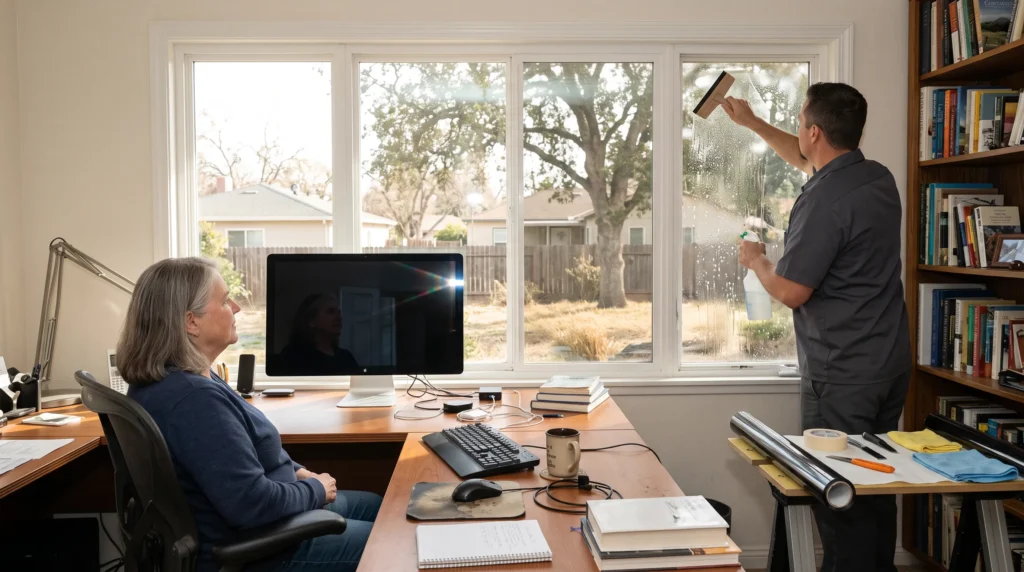
If your office has a bright window that makes it harder to work comfortably, call (661) 634-5585 or visit the Dynamic Window Tint contact page to schedule an appointment.
FAQs About Home Office Window Film
1. Does window film help with computer screen glare?
Yes. Window film can reduce visible light entering through treated glass, which can reduce glare and bright reflections on computer monitors. Compare VLT when screen glare is your main concern.
2. What VLT is good for a home office?
There is no single VLT that fits every office. A brighter office with severe glare may benefit from a lower VLT, while a darker room may need a lighter film. Rayno currently offers architectural options including 70%, 50%, and 35% VLT products.
3. Will home office window film make the room dark?
It depends on the VLT. Higher-VLT film keeps more natural light, while lower-VLT film reduces more visible light. The right film can reduce glare without turning the office into a dark room.
4. Is window film good for west-facing home offices?
It can be. West-facing windows can receive strong lower-angle afternoon sunlight. Solar-control film may reduce visible glare and part of the solar energy entering through compatible glass.
5. Can home office window film reduce heat too?
Some architectural films provide both glare reduction and solar control. Compare SHGC and TSER when afternoon heat is also a problem. Lower SHGC means less solar heat transmission under the stated testing, while higher TSER means more total solar energy is rejected.
6. Does home office window film provide privacy?
Certain tinted or reflective films can provide stronger daytime privacy when the exterior is brighter than the room. They should not be relied on for full nighttime privacy when interior lights are on.
7. Where can I get home office window film in Bakersfield, CA?
Dynamic Window Tint installs Rayno residential window film for home offices and other rooms in Bakersfield, CA. Call (661) 634-5585 or visit the contact page to discuss screen glare, solar heat, privacy, and your home’s glass.
Sources
- Rayno Platinum Architectural Window Film
Publisher: Rayno Window Film
Publication Date: Not listed
Information referenced: Glare reduction, residential and office applications, VLT, UV rejection, SHGC, TSER, visible light reflection, and current Platinum specifications. - Rayno Platinum Air 7090
Publisher: Rayno Window Film
Publication Date: Not listed
Information referenced: Architectural use, 70% VLT, 99% UV rejection, 0.58 SHGC, 42% TSER, and visible light reflection. - Rayno Trinity Architectural Window Film
Publisher: Rayno Window Film
Publication Date: Not listed
Information referenced: 50% VLT, 99% UV rejection, 0.49 SHGC, 51% TSER, visible light reflection, and glass-retention characteristics. - Rayno Architectural Window Film
Publisher: Rayno Window Film
Publication Date: 2026
Information referenced: Home and office window film applications, natural light, solar heat, UV reduction, and architectural film choices. - Which Rooms Need Window Film Most in a Bakersfield Home?
Publisher: Dynamic Window Tint
Publication Date: Not listed
Information referenced: Home offices with computer screen glare, west-facing windows, monitor position, and Bakersfield residential applications. - Residential Window Tint in Bakersfield, CA
Publisher: Dynamic Window Tint
Publication Date: Not listed
Information referenced: Residential window tint services, home office applications, Rayno Window Film, privacy, glare, and warranty-backed installation. - Contact Dynamic Window Tint
Publisher: Dynamic Window Tint
Publication Date: Not listed
Information referenced: Business address, phone number, and appointment information.
