

Back-Seat Window Tint for Families can help Bakersfield, CA parents reduce the amount of ultraviolet radiation, visible glare, and direct sunlight reaching children riding beside large rear windows. Kids in car seats and booster seats often stay in one fixed position, so they cannot simply move away when the afternoon sun lands directly on their face, arms, or legs.
Window film can add another layer of solar protection to compatible rear glass while also making the cabin more comfortable for family trips.
The shade of the tint is only one part of the decision.
Parents should also compare UV rejection, infrared rejection, Total Solar Energy Rejected, factory privacy glass, nighttime visibility, and the amount of visible light they want inside the vehicle.
A very dark rear window is not automatically the film with the strongest UV or heat-related performance.
For families driving around Bakersfield, CA, Rosedale, CA, Oildale, CA, and nearby Kern County communities, choosing back-seat tint around how the family actually uses the vehicle usually makes more sense than simply asking for the darkest rear glass available.
Table of Contents
- Why Back-Seat Window Tint Matters for Families
- What UV Radiation Has to Do With Car Windows
- Can Window Tint Reduce UV Exposure for Kids?
- Why Kids in Car Seats Notice Direct Sun More
- Does Back-Seat Tint Help With Heat Too?
- Why Darker Tint Is Not Always Better
- Factory Privacy Glass vs Window Film for Families
- Ceramic Tint for Family Vehicles
- Rayno S5 Nano Ceramic for Back Seats
- Rayno S7 Ceramic Plus for Family Vehicles
- Rayno S9 Ceramic Supreme for Back Seats
- How Dark Should Rear Tint Be for a Family Car?
- Back-Seat Window Tint and Night Driving
- What About SUVs With Factory Dark Rear Glass?
- Does Window Tint Replace Sunscreen or Other Sun Protection?
- Never Rely on Window Tint in a Parked Car
- Which Family Vehicles Benefit From Rear Tint?
- California Rules for Rear Window Tint
- What Parents Should Ask Before Choosing Film
- Back-Seat Window Tint in Bakersfield, CA
- FAQs About Back-Seat Window Tint for Families
Why Back-Seat Window Tint Matters for Families
Children riding in the rear of a vehicle often sit very close to the side glass.
A rear-facing car seat may place a baby’s head and arms near one window.
A forward-facing car seat or booster seat may keep a child beside the same window for the entire drive.
Adults can lean away from direct sunlight, lower a visor, or change their seating position.
A child secured in a car seat cannot.
That makes direct sunlight through the rear doors more noticeable on family trips.
Parents may see children:
- Squinting in bright sun
- Turning their head away from the window
- Holding a hand over their eyes
- Complaining that the sun feels hot
- Falling asleep with sunlight landing directly on their face
- Getting bright glare from the rear quarter glass
- Sitting beside dark factory glass that still feels warm in direct sun
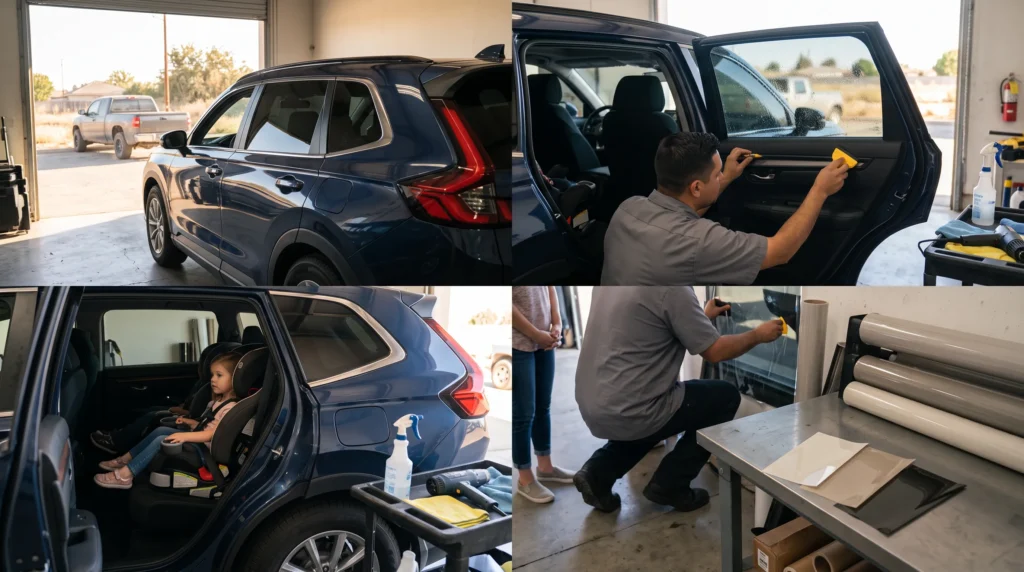
Back-Seat Window Tint for Families gives parents another way to manage that glass without attaching a removable shade every time the sun changes direction.
What UV Radiation Has to Do With Car Windows
UV stands for ultraviolet.
The Centers for Disease Control and Prevention divides ultraviolet radiation into UVA, UVB, and UVC based on wavelength.
The CDC states that almost all UV radiation reaching Earth’s surface is UVA, with some UVB also reaching the surface.
Too much UV exposure can damage skin, which is why sun protection is recommended throughout the year.
Vehicle glass can reduce UV exposure to different degrees depending on how that glass is built.
A windshield may behave differently from side glass.
Factory-tinted rear glass may perform differently from clear side glass.
Laminated glass may differ from tempered glass.
That is why you should not assume every window in a family vehicle blocks the same amount of UV.
The CDC’s current UV guidance recommends protecting children from excessive UV exposure using several methods rather than relying on one measure alone.
Can Window Tint Reduce UV Exposure for Kids?
Automotive window film can be manufactured to reject a very high percentage of ultraviolet radiation.
Rayno currently publishes 99.9% UV rejection across its Phantom S5, S7, and S9 automotive window films.
That UV specification is one reason ceramic film can be worth discussing for family vehicles.
Here is why.
The darkest shade is not required to get the published UV figure.
Rayno lists the same 99.9% UV rejection across multiple VLT choices within its Phantom ceramic lines.
That means a family can compare lighter and darker shades without assuming UV protection only comes from nearly black glass.
This can be useful if you want strong published UV rejection while keeping more visible light inside the rear cabin.
You can see the current Rayno choices on the Dynamic Window Tint vehicle window tint page.
Why Kids in Car Seats Notice Direct Sun More
A child’s seating position barely changes during a drive.
That matters when the sun stays on the same side of the vehicle for miles.
Suppose your family is driving across Bakersfield in the late afternoon.
The child behind the driver may sit beside direct western sunlight for much of the trip.
A fixed car seat keeps that child in the same location while the sunlight continues through the side glass.
Rear-door window tint can reduce visible light and UV transmission according to the film selected.
A ceramic film can also add published infrared and total solar energy rejection.
This combination can make rear-window film useful for:
- School runs
- Daycare trips
- Family road trips
- Afternoon errands
- Weekend travel
- Drives to sports activities
- Long highway trips
Does Back-Seat Tint Help With Heat Too?
It can.
UV rejection and heat rejection are different measurements.
If reducing solar heat is part of your goal, look beyond the UV number.
Two other measurements matter.
Infrared Rejection
Infrared energy is part of sunlight.
Film manufacturers often publish an IR-rejection figure based on the range tested.
Higher-performing ceramic films can reject a large percentage of measured infrared energy.
Total Solar Energy Rejected
TSER stands for Total Solar Energy Rejected.
It looks at a broader portion of incoming solar energy.
Rayno publishes both IR rejection and TSER across its Phantom film range.
For families comparing Back-Seat Window Tint for Families, reading both numbers gives you a better idea of the film’s solar performance.
Why Darker Tint Is Not Always Better
A very dark tint may give you more privacy and reduce more visible light.
That does not automatically make it the strongest option for solar heat.
VLT measures visible light.
A low VLT means the glass looks darker.
IR rejection and TSER measure different properties.
Rayno’s current specifications show why this matters.
A lighter premium ceramic film can publish stronger infrared rejection than a darker film from another tier.
That lets parents separate two decisions:
How dark do we want the back seat to look?
and
How much solar performance do we want from the film?
Those answers do not have to produce the same film choice.
Factory Privacy Glass vs Window Film for Families
Many family SUVs, crossovers, trucks, and minivans already have dark rear privacy glass.
That dark appearance can make people assume nothing else needs to be done.
Factory privacy glass and aftermarket film are different.
Factory privacy glass usually gets its color from the glass itself.
Aftermarket film adds a separate layer to the interior surface.
That film can carry published specifications for:
- UV rejection
- IR rejection
- TSER
- VLT
- Visible light reflection
This is why a parent may choose ceramic film over rear glass that already looks dark.
The goal may not be additional privacy.
The goal may be adding the solar characteristics of a particular film.
Read our guide to tinting over factory privacy glass if your SUV or truck already has dark rear windows.
Ceramic Tint for Family Vehicles
Ceramic film can make sense for a family vehicle because it lets parents compare solar performance without choosing by darkness alone.
Rayno describes its Phantom automotive line as using carbon and ceramic technology.
The current Phantom lineup includes S5, S7, and S9.
All three publish 99.9% UV rejection.
The differences become more noticeable in their published IR and TSER figures.
That gives families several levels to compare depending on:
- How much the vehicle is driven
- Where it parks
- How much direct sun rear passengers receive
- Desired darkness
- Desired privacy
- Night driving
- How long the family plans to keep the vehicle
Rayno S5 Nano Ceramic for Back Seats
Rayno Phantom S5 is one of the ceramic choices offered by Dynamic Window Tint.
Current Rayno specifications list:
- 99.9% UV rejection
- 53% to 72% IR rejection across listed shades
- 41% to 66% TSER across listed shades
- Less than 1% fading rate
S5 can fit a family looking for ceramic film without moving to Rayno’s higher Phantom levels.
Parents can compare several VLT choices rather than automatically choosing the darkest S5 film.
Rayno S7 Ceramic Plus for Family Vehicles
Rayno S7 sits above S5 in Rayno’s published infrared performance.
Current specifications list:
- 99.9% UV rejection
- 70% to 81% IR rejection
- 47% to 66% TSER
- Less than 1% fading rate
This can interest families who spend more time on the road during sunny hours.
Suppose a family makes a long Bakersfield commute every weekday with children in the rear seats.
The added IR performance may carry more weight for them than it would for a vehicle used mainly for short weekend trips.
Rayno S9 Ceramic Supreme for Back Seats
Rayno Phantom S9 carries Rayno’s strongest published IR rejection among the current S5, S7, and S9 lines.
Current Rayno specifications list:
- 99.9% UV rejection
- 91% to 93% IR rejection
- 53% to 70% TSER
- Less than 1% fading rate
This can be worth comparing when rear-seat solar heat is one of the main reasons you want tint.
It does not mean every family needs S9.
A family should compare the film level, shade, driving pattern, and desired appearance before deciding.
How Dark Should Rear Tint Be for a Family Car?
There is no single shade that fits every family.
Very dark rear tint can provide stronger daytime privacy and reduce visible brightness.
A lighter ceramic film keeps more daylight inside.
Think about:
- How much daytime privacy you want
- Whether your child dislikes bright sunlight
- Whether you regularly drive after dark
- Whether the vehicle already has privacy glass
- Whether rear passengers like seeing outside
- How often you drive rural roads
- Whether you use the rear glass for direct visibility
A parent may prefer a dark film on an SUV used mainly around well-lit city streets.
Another family may choose a lighter ceramic shade because they spend evenings driving rural roads around Kern County.
Back-Seat Window Tint for Families should fit the way your family actually travels.
Back-Seat Window Tint and Night Driving
Very dark glass can change outward visibility after sunset.
That is worth considering before adding film over factory privacy glass.
The finished window may become much darker than the film’s stated VLT because the film and existing glass work together.
A 35% film installed over glass that is already dark will not produce a 35% finished window.
If your SUV already feels dark from the inside at night, ask about lighter ceramic film.
You can still compare strong UV and IR specifications without turning the rear cabin into the darkest possible space.
What About SUVs With Factory Dark Rear Glass?
SUVs are one of the most common family vehicles with privacy glass behind the front seats.
That glass may already give you enough visual privacy.
If so, tell the installer that you care more about solar performance than additional darkness.
A high-VLT ceramic film may fit that goal better than another dark layer.
Ask the shop to consider:
- Existing glass VLT
- Desired finished VLT
- UV rejection
- IR rejection
- TSER
- Night visibility
- Rear passenger comfort
This approach keeps the conversation centered on what you actually want the film to do.
Does Window Tint Replace Sunscreen or Other Sun Protection?
No.
Window tint should be viewed as one part of sun protection, not a replacement for every other method.
The CDC recommends several ways to reduce excessive UV exposure, including shade, protective clothing, sunglasses, and broad-spectrum sunscreen when appropriate.
Automotive window film can reduce UV transmission through treated glass according to its published specifications.
It cannot protect a child once they leave the vehicle.
It also does not cover sunlight entering through untreated glass or an open window.
Parents should use window film as one layer alongside normal sun-safety habits.
Never Rely on Window Tint in a Parked Car
Back-Seat Window Tint for Families should never be treated as a way to make it safe to leave a child in a parked vehicle.
The CDC warns that vehicles can reach dangerous temperatures very quickly, even when windows are cracked open.
Window tint can reduce some incoming solar energy through treated glass.
It cannot stop a parked vehicle from becoming dangerously hot.
Never leave an infant or child unattended in a parked car.
That remains true whether the vehicle has:
- Dark tint
- Ceramic tint
- Factory privacy glass
- A sunshade
- A panoramic roof
- Remote climate features
Tint is a comfort and solar-control product, not protection against a hot parked vehicle.
Which Family Vehicles Benefit From Rear Tint?
Back-Seat Window Tint for Families can make sense on many types of vehicles.
SUVs
Three-row SUVs may have rear doors, quarter glass, cargo glass, and a rear hatch.
Children can sit beside several large pieces of glass depending on the row.
Crossovers
Crossovers often combine family-friendly rear seats with large side windows.
Rear ceramic film may help with glare and direct sun during everyday travel.
Minivans
Minivans carry passengers close to large sliding-door windows.
Children may sit beside those windows for long road trips.
Crew-Cab Trucks
Modern crew-cab trucks often serve as family vehicles.
Dynamic Window Tint’s guide to truck window tint in Bakersfield discusses rear passengers, car seats, privacy glass, solar heat, and glare.
Sedans
A sedan may have less rear glass than a large SUV, but a child can still sit very close to a rear door window for every trip.
Electric Vehicles
Many EVs have large windows or glass roofs.
Parents should think about the side glass and roof separately rather than choosing one tint plan for every piece of glass.
California Rules for Rear Window Tint
California gives drivers more freedom with rear side windows than with the front side glass.
That makes the back half of a vehicle the usual area for stronger privacy tint.
The rear window also has separate rules tied to outside mirrors.
Families still need to think about visibility.
A legal shade is not automatically the shade that feels right during nighttime driving.
The front side windows have much tighter requirements, so do not assume the same dark rear shade can simply be installed up front.
Review our California window tint laws guide before choosing a full vehicle setup.
What Parents Should Ask Before Choosing Film
When shopping for Back-Seat Window Tint for Families, ask more than “How dark can you make it?”
What Is the UV Rejection?
Ask for the manufacturer’s published specification.
Rayno currently lists 99.9% UV rejection across its Phantom S5, S7, and S9 lines.
What Is the IR Rejection?
This matters when direct solar heat on rear passengers is one of your concerns.
What Is the TSER?
Use this alongside IR rejection for a broader look at solar performance.
What VLT Will the Rear Glass Finish At?
This matters even more if the vehicle already has factory privacy glass.
Is the Film Ceramic?
Ask for the film manufacturer and exact series rather than accepting a broad description.
How Will It Look at Night?
Tell the installer if your family regularly drives after sunset or on darker roads.
Does the Film Have a Warranty?
Ask what the film manufacturer covers and what the installer covers.
Which Windows Should Be Treated?
Your rear doors may be the biggest concern.
Another family may also want quarter windows or rear hatch glass treated.
Match the coverage to where passengers actually sit.
Back-Seat Window Tint in Bakersfield, CA
Back-Seat Window Tint for Families can help parents manage UV exposure, glare, privacy, and solar heat through rear vehicle glass.
For Bakersfield families, the right film is not necessarily the darkest film.
Look at:
- UV rejection
- IR rejection
- TSER
- VLT
- Existing factory glass
- Nighttime visibility
- Film warranty
- Where children sit
Rayno’s current Phantom S5, S7, and S9 films all publish 99.9% UV rejection while giving families different infrared, TSER, and VLT choices.
That makes it possible to choose around the family’s needs rather than assuming UV protection requires nearly black windows.
Dynamic Window Tint installs Rayno automotive window film at:
4609 New Horizon Blvd Suite #10 Bakersfield, CA 93313
The shop works with family cars, SUVs, crossovers, minivans, trucks, Teslas, and other vehicles.
Dynamic Window Tint serves drivers in Bakersfield, CA and nearby areas such as Rosedale, CA, Oildale, CA, Greenfield, CA, Shafter, CA, Lamont, CA, Arvin, CA, Wasco, CA, and surrounding Kern County communities.
When scheduling, tell the shop:
- Your vehicle year, make, and model
- Where the child seats are located
- Whether the rear glass has factory privacy tint
- Whether UV, heat, glare, or privacy is your biggest concern
- How dark you want the rear cabin
- Whether your family regularly drives at night
Dynamic Window Tint is certified and carries warranties on its products and services.
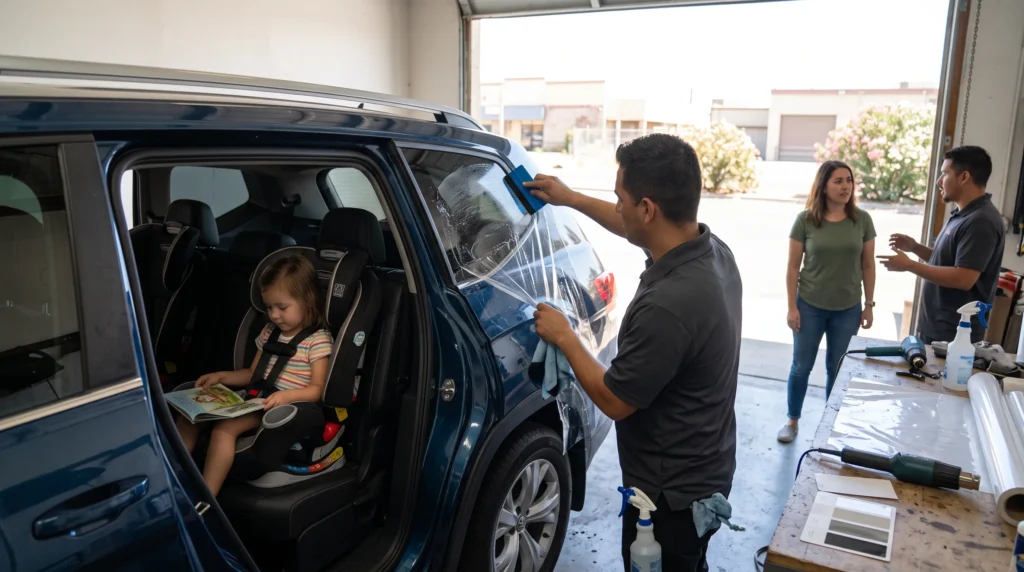
Call (661) 634-5585 or visit the Dynamic Window Tint contact page to discuss back-seat window film for your family vehicle.
FAQs About Back-Seat Window Tint for Families
1. Does car window tint block UV for kids in the back seat?
It depends on the film. Rayno currently publishes 99.9% UV rejection across its Phantom S5, S7, and S9 automotive films. Check the exact film manufacturer’s specification rather than assuming every tint provides the same UV rejection.
2. Do I need very dark tint to get UV protection?
No. UV rejection and darkness are different measurements. Rayno publishes the same 99.9% UV rejection across multiple VLT choices in its Phantom ceramic lines, so a lighter shade can still carry the published UV specification.
3. Is ceramic tint good for a family SUV?
Ceramic film can make sense for family SUVs because it lets parents compare UV rejection, IR rejection, TSER, glare, and shade separately. It can also be applied over compatible factory privacy glass when additional film performance is wanted.
4. Can I tint over the dark factory glass behind my kids?
In many vehicles, yes. Aftermarket film can be installed over compatible factory privacy glass. The finished window will become darker, so ask about final VLT and nighttime visibility before choosing the film.
5. Does back-seat tint keep a parked car safe for children?
No. Never leave a child unattended in a parked vehicle. The CDC warns that cars can heat to dangerous temperatures very quickly, even with windows cracked. Window tint does not make leaving a child in a parked car safe.
6. Is darker rear tint better for kids?
Not automatically. Darker film reduces more visible light and can add privacy, but UV and heat-related performance depend on the film specifications. A lighter ceramic product may publish stronger solar performance than a darker lower-tier film.
7. Where can I get back-seat window tint for a family vehicle in Bakersfield, CA?
Dynamic Window Tint installs Rayno automotive window film at 4609 New Horizon Blvd Suite #10, Bakersfield, CA 93313. Call (661) 634-5585 or visit the contact page to discuss rear-seat UV rejection, glare, heat, factory privacy glass, and shade options.
Sources
- Ultraviolet Radiation
Publisher: Centers for Disease Control and Prevention
Publication Date: July 6, 2026
Information referenced: UVA and UVB radiation, health concerns from excessive UV exposure, and general sun-protection guidance for children and adults. - Reducing Risk for Skin Cancer
Publisher: Centers for Disease Control and Prevention
Publication Date: June 17, 2026
Information referenced: UV exposure, year-round sun protection, shade, clothing, sunglasses, and broad-spectrum sunscreen. - Infants and Children and Heat
Publisher: Centers for Disease Control and Prevention
Publication Date: June 25, 2024
Information referenced: Child heat safety, rapid heating of parked vehicles, and the warning never to leave infants or children unattended in a parked car. - Rayno Phantom Series Automotive Window Film Specifications
Publisher: Rayno Window Film
Publication Date: Not listed
Information referenced: Phantom S5, S7, and S9 VLT, UV rejection, IR rejection, TSER, glare reduction, and fading specifications. - Ceramic Tint in Bakersfield: Is the Upgrade Worth the Cost?
Publisher: Dynamic Window Tint
Publication Date: Not listed
Information referenced: Rayno S5, S7, and S9 specifications, UV rejection, rear passengers, children, factory privacy glass, solar heat, and Bakersfield driving. - Window Tint for Trucks in Bakersfield: Crew Cabs & Rear Sliders
Publisher: Dynamic Window Tint
Publication Date: Not listed
Information referenced: Family crew cabs, children in rear seats, direct sunlight, UV rejection, glare, privacy, factory glass, and nighttime driving. - Window Tint in Bakersfield, CA
Publisher: Dynamic Window Tint
Publication Date: Not listed
Information referenced: Rayno S5 Nano Ceramic, S7 Ceramic Plus, S9 Ceramic Supreme, vehicle window tint services, certified installation, and warranty-backed work. - California Window Tint Laws: What Bakersfield Drivers Need to Know
Publisher: Dynamic Window Tint
Publication Date: Not listed
Information referenced: California front and rear window tint considerations. - Contact Dynamic Window Tint
Publisher: Dynamic Window Tint
Publication Date: Not listed
Information referenced: Bakersfield address, phone number, and appointment information.
