

Ceramic tint in Bakersfield can be worth the added cost for drivers who care about heat rejection, UV protection, film clarity, color stability, and long-term use. Bakersfield summers bring long stretches of high temperatures, and a vehicle parked outdoors can receive direct sunlight through several pieces of glass for hours at a time.
That does not mean every driver needs the highest-tier ceramic film available.
Someone who mainly wants darker glass and added privacy may be satisfied with a lower-cost film. A driver who parks outside every day, commutes long distances, keeps vehicles for years, or wants strong heat rejection without using very dark tint may have more reason to consider ceramic.
The real question is what you are paying extra to get.
Ceramic film is not just darker tint with a higher price. Film makers publish separate figures for Visible Light Transmission, infrared rejection, Total Solar Energy Rejected, UV rejection, clarity, and color stability. These measurements help show why two films with similar shades can behave very differently in Bakersfield, CA sun.
Dynamic Window Tint provides window tint in Bakersfield, CA and carries Rayno Window Film, including Rayno Phantom carbon ceramic films. The shop can compare film levels based on your vehicle, how much time it spends outside, and what you want the tint to do.
Table of Contents
- Why Ceramic Tint Gets Attention in Bakersfield
- What Makes Ceramic Tint Different?
- How Hot Does Bakersfield Get?
- Ceramic Tint Versus Lower-Cost Film
- Why IR Rejection Matters
- Why TSER Matters Too
- Darker Tint Does Not Always Mean Better Heat Rejection
- Rayno Phantom S5, S7, and S9 Compared
- Is Ceramic Tint Worth It for Daily Commuters?
- Is Ceramic Tint Worth It for Cars Parked Outside?
- Is Ceramic Tint Worth It for Trucks and SUVs?
- Ceramic Tint and UV Protection
- Ceramic Tint and Nighttime Visibility
- How Long You Keep the Vehicle Matters
- What Affects Ceramic Tint Pricing?
- When Ceramic Tint May Not Be Worth the Upgrade
- California Tint Rules Still Apply
- How to Decide Which Ceramic Film Fits Your Vehicle
- Schedule Ceramic Tint in Bakersfield
- Frequently Asked Questions
- Sources
Why Ceramic Tint Gets Attention in Bakersfield
Ceramic tint in Bakersfield gets attention because local drivers deal with long periods of hot weather.
NOAA climate normals for Bakersfield show an average daily high of 92.3°F in June, 98.3°F in July, 96.9°F in August, and 91.4°F in September.
NOAA also reports an average of 13.2 days in July and 11 days in August reaching at least 100°F.
That gives vehicle owners plenty of reasons to think about solar heat.
A car may sit outside:
- At work
- At school
- At a shopping center
- In a driveway
- At a job site
- During a charging stop
- In an uncovered apartment lot
Sunlight entering through side and rear windows can reach seats, trim, dashboards, and passengers.
Ceramic tint cannot keep a parked vehicle cold indefinitely.
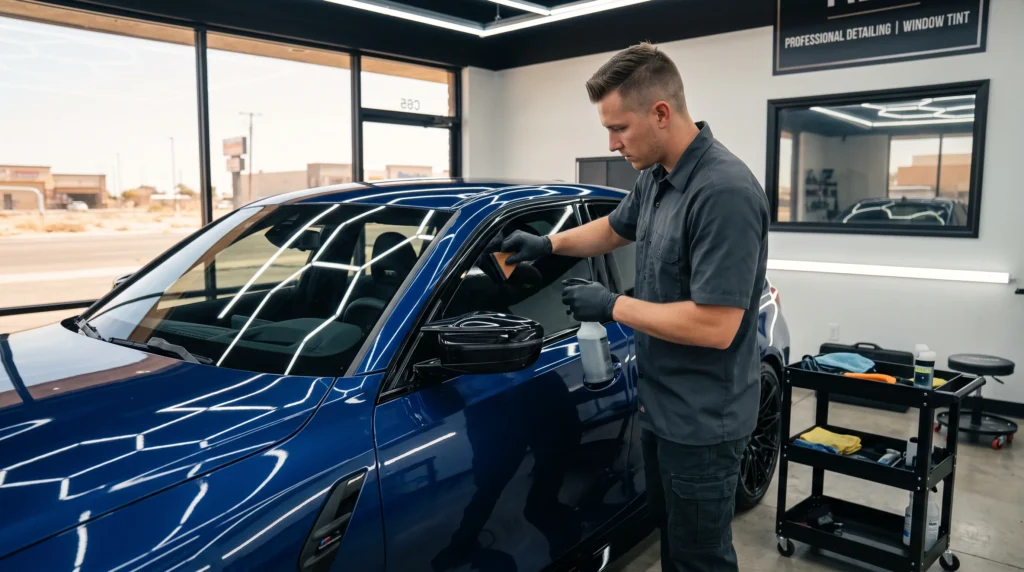
It can reduce the amount of solar energy passing through treated glass, which is why film specifications matter in a climate like Bakersfield, CA.
What Makes Ceramic Tint Different?
Ceramic automotive film uses ceramic particles within the film construction.
Rayno’s Phantom Series combines nano-scaled carbon particles with ceramic particles.
Rayno publishes several measurements for these films rather than presenting them only by shade.
Those include:
- Visible Light Transmission
- Infrared rejection
- Total Solar Energy Rejected
- UV rejection
- Visible light reflection
- Fading rate
These figures allow you to compare film performance at the same time you compare appearance.
A lower-priced film may darken the glass and reduce glare.
A ceramic film can also be built around stronger solar-control figures.
That is where the added cost can make sense for some drivers.
How Hot Does Bakersfield Get?
Bakersfield’s climate gives this decision more context.
According to NOAA’s 1991–2020 climate normals for Bakersfield Airport, the average daily maximum temperature reaches:
- 92.3°F in June
- 98.3°F in July
- 96.9°F in August
- 91.4°F in September
July averages 29.3 days at or above 90°F.
August averages 27.8 days at or above 90°F.
That means high temperatures are not limited to one or two unusual heat waves.
Drivers can face weeks of hot conditions.
For ceramic tint in Bakersfield, that repeated exposure is one reason heat-related film measurements deserve attention.
Ceramic Tint Versus Lower-Cost Film
A lower-cost film may still provide a darker appearance, privacy, glare reduction, and some solar protection.
Ceramic film usually costs more because its construction is designed for stronger solar properties and long-term color performance.
Think about what each buyer may value.
A Lower-Cost Film May Fit Someone Who Wants:
- Darker glass
- Privacy
- Reduced visible glare
- A smaller upfront spend
Ceramic Tint May Fit Someone Who Wants:
- Stronger infrared rejection
- Higher total solar energy rejection
- Strong UV rejection
- Good optical clarity
- Better color stability
- Heat control without relying only on very dark glass
That does not make one choice right for every customer.
The upgrade makes the most sense when you will actually use the extra film performance.
Why IR Rejection Matters
IR stands for infrared.
Infrared radiation is part of the solar energy associated with the heat people feel from sunlight.
Window-film manufacturers publish IR-rejection figures so buyers can compare how much of that measured infrared energy a film rejects.
Rayno’s current Phantom specifications show clear differences between its ceramic levels.
Across the listed shades:
- Phantom S5 publishes IR rejection from 53% to 72%
- Phantom S7 publishes IR rejection from 70% to 81%
- Phantom S9 publishes IR rejection from 91% to 93%
That difference is one reason a higher-tier ceramic film costs more.
For someone choosing ceramic tint in Bakersfield because heat is the main concern, IR rejection deserves more attention than shade alone.
Why TSER Matters Too
IR is not the only solar measurement worth comparing.
TSER means Total Solar Energy Rejected.
It gives a broader picture of how much total solar energy the glazing system rejects.
Rayno publishes TSER for each Phantom film and shade.
Its current Phantom S9 line ranges from 53% TSER at 50% VLT to 70% TSER at 5% VLT.
The S7 line ranges from 47% to 66%.
The S5 line ranges from 41% to 66%.
When comparing ceramic tint in Bakersfield, read IR rejection and TSER together.
A large IR number can sound impressive, but TSER gives you another measurement tied to overall solar performance.
Darker Tint Does Not Always Mean Better Heat Rejection
One of the biggest misunderstandings around automotive tint is that darker automatically means cooler.
Rayno’s published specifications show why that is not always true.
Phantom S9-50 is listed at:
- 50% VLT
- 92% IR rejection
- 53% TSER
Phantom S5-20 is much darker at:
- 20% VLT
- 53% IR rejection
- 51% TSER
The much lighter S9-50 has substantially higher published infrared rejection than the darker S5-20.
This is exactly why ceramic tint in Bakersfield can appeal to someone who wants strong heat rejection without making every suitable window very dark.
Darkness and solar performance are connected in some ways, but they are not the same measurement.
Rayno Phantom S5, S7, and S9 Compared
Dynamic Window Tint carries Rayno Window Film.
Rayno’s Phantom lineup gives customers several ceramic film levels.
Rayno Phantom S5
Phantom S5 uses carbon ceramic construction and comes in several VLT levels.
Rayno publishes:
- 53% to 72% IR rejection
- 41% to 66% TSER
- 99.9% UV rejection
- Less than 1% fading rate
S5 may appeal to someone who wants ceramic film without moving to the top heat-rejection tier.
Rayno Phantom S7
Phantom S7 sits above S5 in Rayno’s published IR performance.
Rayno lists:
- 70% to 81% IR rejection
- 47% to 66% TSER
- 99.9% UV rejection
- Less than 1% fading rate
That gives drivers a middle choice between S5 and S9.
Rayno Phantom S9
Phantom S9 carries the strongest published IR-rejection figures within the current Phantom group.
Rayno lists:
- 91% to 93% IR rejection
- 53% to 70% TSER
- 99.9% UV rejection
- Less than 1% fading rate
This is the type of film worth comparing when heat rejection is near the top of your list.
Is Ceramic Tint Worth It for Daily Commuters?
Ceramic tint can make more sense when you spend a lot of time driving.
Think about a commute between Bakersfield, CA and nearby areas such as Shafter, CA, Wasco, CA, Lamont, CA, or other Kern County communities.
Repeated sunlight through the side windows can become noticeable over weeks and months of driving.
A commuter may care about:
- Heat rejection
- Glare
- UV protection
- Visibility
- Long-term color stability
If you spend one or two hours in the vehicle most workdays, paying more for film with stronger solar specifications may make more sense than it would for a vehicle driven only occasionally.
Is Ceramic Tint Worth It for Cars Parked Outside?
Outdoor parking is another factor.
A vehicle sitting in direct Bakersfield, CA sun will still heat up over time, even with high-grade tint.
Ceramic tint should not be sold as a way to make a parked car remain cool all afternoon.
The benefit is reducing part of the solar energy entering through the treated glass.
For someone who parks outside every day, that repeated reduction may be more useful than it is for a car that spends most of its time in a garage.
If your workplace has no covered parking, mention that when discussing film choices.
Is Ceramic Tint Worth It for Trucks and SUVs?
Trucks and SUVs can have a lot of glass.
Crew cabs may have four large doors plus rear cab glass.
SUVs can have rear doors, quarter glass, rear hatch glass, and sometimes panoramic roof glass.
Many trucks and SUVs also come with dark factory privacy glass behind the front seats.
That glass may already look dark, but appearance does not tell you its aftermarket-film solar specifications.
A driver may choose ceramic film over factory rear privacy glass to add published IR, TSER, and UV performance.
The final shade will become darker, so the film should be selected with the existing glass in mind.
Ceramic Tint and UV Protection
Rayno publishes 99.9% UV rejection across its current Phantom S5, S7, and S9 lines.
That figure does not depend on choosing the darkest shade.
A lighter Phantom film can still carry the same published UV-rejection percentage as a dark film within the series.
That is another reason not to judge film only by appearance.
UV rejection can matter for:
- Drivers
- Passengers
- Children in rear seats
- Upholstery
- Interior trim
- Dash surfaces
UV is only one part of solar exposure, but it belongs in the film comparison.
Ceramic Tint and Nighttime Visibility
Ceramic tint does not mean you need to choose a very dark shade.
That can matter for drivers who regularly travel after sunset.
A dark shade may feel comfortable in bright daylight but may make outward viewing harder on poorly lit roads.
Bakersfield, CA drivers may travel into rural parts of Kern County where street lighting is limited.
If that describes your routine, higher-VLT ceramic film may be worth considering.
You can get ceramic construction without choosing the darkest film available.
Tell the installer about your nighttime driving before deciding on shade.
How Long You Keep the Vehicle Matters
The longer you plan to own a vehicle, the more useful long-term film performance may become.
Rayno publishes less than 1% fading for its Phantom S5, S7, and S9 films under its stated testing.
The manufacturer also publishes warranty terms for its Phantom automotive film.
A driver leasing a vehicle for a short period may weigh the added cost differently from someone planning to keep a truck or SUV for eight years.
Ask yourself:
- How long will I keep this vehicle?
- How much do I drive each week?
- Where does it park?
- How much does heat bother me?
- Do I care about long-term color stability?
- Do I want lighter film with strong heat rejection?
Your answers can help decide whether ceramic is worth the upgrade.
What Affects Ceramic Tint Pricing?
Ceramic tint prices in Bakersfield depend on more than film type.
A quote can vary based on:
- Vehicle year
- Make
- Model
- Number of windows
- Glass size
- Glass shape
- Film series
- Old tint removal
- Rear sliders
- Quarter windows
- Existing adhesive
- Glass preparation
A two-door coupe will not necessarily receive the same quote as a three-row SUV.
A truck with a powered rear slider can require different work from a small sedan.
The film series matters too.
Rayno S5, S7, and S9 do not provide identical published performance, so they should not be expected to sit at the same price level.
Call (661) 634-5585 or use the Dynamic Window Tint contact page for a quote based on your vehicle.
When Ceramic Tint May Not Be Worth the Upgrade
Ceramic is not automatically the right answer.
A lower-priced film may make more sense when:
- Your main goal is appearance
- You mainly want rear-window privacy
- The vehicle is rarely driven
- The vehicle stays in covered parking
- You do not plan to keep it long
- Heat rejection is not a major concern
There is no reason to pay for film performance you do not care about.
Someone who only wants a darker rear window on an occasional-use vehicle may be happy with another film type.
Someone driving every day through Bakersfield heat may come to a different decision.
California Tint Rules Still Apply
Ceramic film does not bypass California window-tint law.
California Vehicle Code Section 26708 regulates material placed on the windshield, front side windows, and rear glass.
The legal conditions vary depending on the window.
That means a ceramic film can still be unsuitable for a particular front-window application if the finished glazing does not meet California requirements.
Ask the installer about legal film choices before selecting a shade.
Do not assume a light film is automatically legal everywhere.
The existing factory glass also affects the completed light transmission.
How to Decide Which Ceramic Film Fits Your Vehicle
Start with your biggest reason for buying tint.
If Heat Rejection Is First
Compare S5, S7, and S9 IR-rejection and TSER numbers.
If Price Matters More
Ask whether a lower ceramic tier or carbon film gives you enough of what you want.
If You Drive at Night
Look at lighter VLT choices.
If Privacy Is the Goal
Compare darker shades on windows where they fit California law and your visibility needs.
If You Plan to Keep the Vehicle
Ask about warranty, color stability, and long-term film performance.
If the Vehicle Has Factory Privacy Glass
Have the installer compare how added film will change the final shade.
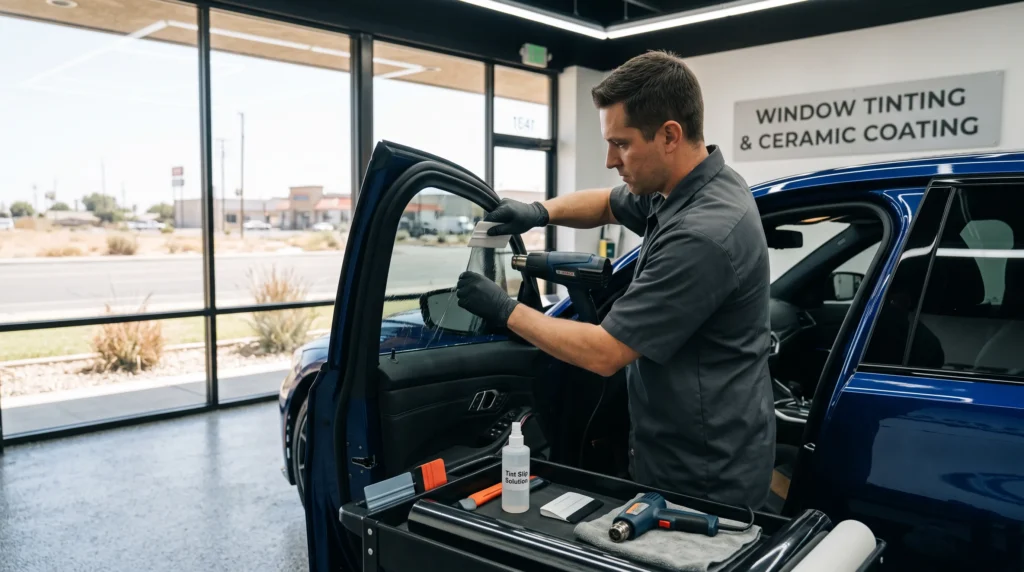
Choosing ceramic tint in Bakersfield is easier when you stop asking which tint is “best” and start asking which film fits the way you use your vehicle.
Schedule Ceramic Tint in Bakersfield
Ceramic tint in Bakersfield can be worth the added cost when heat rejection, UV protection, film clarity, color stability, and long-term use matter to you.
Bakersfield climate data gives local drivers a good reason to think seriously about solar performance.
NOAA reports an average July high of 98.3°F and an August average high of 96.9°F.
Rayno’s Phantom line gives drivers several ceramic levels with different published IR and TSER figures.
That means you can choose based on how much heat rejection you want rather than automatically buying the darkest tint.
Dynamic Window Tint is located at:
4609 New Horizon Blvd Suite #10 Bakersfield, CA 93313
The shop carries Rayno Window Film and provides certified, warranty-backed tint installation.
Call (661) 634-5585 to discuss ceramic film for your vehicle.
You can also visit the Dynamic Window Tint contact page to schedule an appointment.
Dynamic Window Tint serves Bakersfield, CA and nearby areas including Rosedale, CA, Oildale, CA, Shafter, CA, Wasco, CA, Lamont, CA, Arvin, CA, Greenacres, CA, and other Kern County communities.
Tell the shop:
- Vehicle year
- Make
- Model
- Which windows you want tinted
- Whether old tint is present
- Whether heat rejection is your main concern
- Whether you drive often at night
- How long you plan to keep the vehicle
The team can compare film options and provide a quote based on the actual job.
Frequently Asked Questions
1. Is ceramic tint worth it in Bakersfield, CA?
It can be. Bakersfield has long periods of hot weather, and ceramic film can provide stronger published IR and total solar energy rejection than lower-tier films. The upgrade makes more sense for drivers who park outside, commute often, keep vehicles for years, or care strongly about heat rejection.
2. Does ceramic tint keep a car cool all day?
No. Any closed vehicle sitting in direct sun can heat up over time. Ceramic tint can reduce part of the solar energy entering through treated glass, but it cannot keep a parked vehicle cold indefinitely.
3. Is darker ceramic tint better for heat rejection?
Not always. Rayno’s specifications show that lighter high-tier ceramic films can have stronger IR rejection than darker lower-tier films. Compare IR rejection and TSER rather than using darkness alone.
4. What is the difference between Rayno S5, S7, and S9?
Rayno publishes higher infrared rejection as you move through the Phantom levels. Current S5 films range from 53% to 72% IR rejection, S7 ranges from 70% to 81%, and S9 ranges from 91% to 93%, depending on shade.
5. Does ceramic tint block UV?
Rayno currently lists 99.9% UV rejection across its Phantom S5, S7, and S9 films. That published figure applies across the listed shade choices in each series.
6. Is ceramic tint worth it if I drive at night?
It can be, because ceramic refers to film construction rather than darkness. You can compare lighter VLT ceramic films when you want solar performance while keeping more visible light through the glass.
7. Where can I get ceramic tint in Bakersfield, CA?
Dynamic Window Tint provides ceramic window tint at 4609 New Horizon Blvd Suite #10, Bakersfield, CA 93313. Call (661) 634-5585 or use the contact page to discuss Rayno ceramic film choices and request a quote.
Sources
Summary of Monthly Normals, Bakersfield Airport, CA
Publisher: NOAA National Centers for Environmental Information
Publication Date: Generated March 14, 2026
Data Period: 1991–2020
Information referenced: Bakersfield monthly average high temperatures and average number of days at or above 90°F and 100°F.
Phantom Series Automotive Window Film
Publisher: Rayno Film
Publication Date: Not listed
Accessed: August 28, 2026
Information referenced: Phantom S5, S7, and S9 carbon ceramic construction, VLT, IR rejection, TSER, UV rejection, fading rate, and published film specifications.
How to Choose a Window Tint Shop in Bakersfield
Publisher: Dynamic Window Tint
Publication Date: Not listed
Accessed: August 28, 2026
Information referenced: Ceramic tint for Bakersfield heat, infrared rejection, glare, old film removal, Bakersfield shop location, and contact information.
Window Tint in Bakersfield, CA
Publisher: Dynamic Window Tint
Publication Date: Not listed
Accessed: August 28, 2026
Information referenced: Rayno Window Film, ceramic tint installation, warranty-backed service, shop location, service areas, and phone number.
Dynamic Window Tint Contact Page
Publisher: Dynamic Window Tint
Publication Date: Not listed
Accessed: August 28, 2026
Information referenced: Appointment and quote request path.
