

Cheap Window Tinting vs Quality Film is not just a question of how dark your windows look when you leave the shop. Two tint jobs can appear similar on day one while using very different film, preparation, installation methods, heat-rejection technology, and warranty coverage.
That difference may become much easier to see after the vehicle spends months or years in Bakersfield, CA sun.
A lower-priced film may be perfectly reasonable for a driver whose main goal is a darker appearance or added privacy. The problem starts when a low quote is presented as though it includes the same film performance, color stability, preparation, installation work, and warranty as another product.
It may not.
Before choosing window tint by price alone, find out what film is actually being installed and what comes with the job.
Here is what low window tint quotes can leave out and what Bakersfield drivers should compare before booking.
Table of Contents
- Why Cheap Window Tinting vs Quality Film Is More Than a Price Comparison
- What Are You Actually Paying for With Window Tint?
- Film Type Can Change the Entire Tint Job
- Cheap Tint May Focus Mostly on Darkness
- Heat Rejection Can Be Very Different
- Dark Tint Does Not Automatically Mean Better Heat Control
- Color Stability Matters in Bakersfield
- What Causes Tint to Turn Purple or Fade?
- Installation Prep Is Part of What You Pay For
- Clean Edges and Proper Fit Matter
- Rear Glass Takes More Skill Than a Flat Side Window
- Old Tint Removal Can Change the Job
- Warranty Coverage Can Be Missing From a Cheap Quote
- Manufacturer Warranty vs Installer Warranty
- Rayno Ceramic Film Specifications
- When a Lower-Cost Tint May Be Enough
- When Better Film Makes More Sense
- Questions to Ask Before Choosing a Tint Shop
- Window Tint in Bakersfield, CA
- FAQs About Cheap Window Tinting vs Quality Film
Why Cheap Window Tinting vs Quality Film Is More Than a Price Comparison
Cheap Window Tinting vs Quality Film sounds like a choice between spending less and spending more.
There is more to it than that.
You are comparing a combination of:
- Film construction
- Visible Light Transmission
- Infrared rejection
- Total Solar Energy Rejected
- UV rejection
- Color stability
- Optical clarity
- Glass preparation
- Cutting and fitting
- Rear-glass installation
- Old film removal when needed
- Manufacturer warranty
- Installer support
A quote that only says “full tint” does not tell you much.
You need to know what film series is being used.
A ceramic film with published solar specifications should not be compared as though it were the same product as an unidentified dyed film simply because both can be ordered in a dark shade.
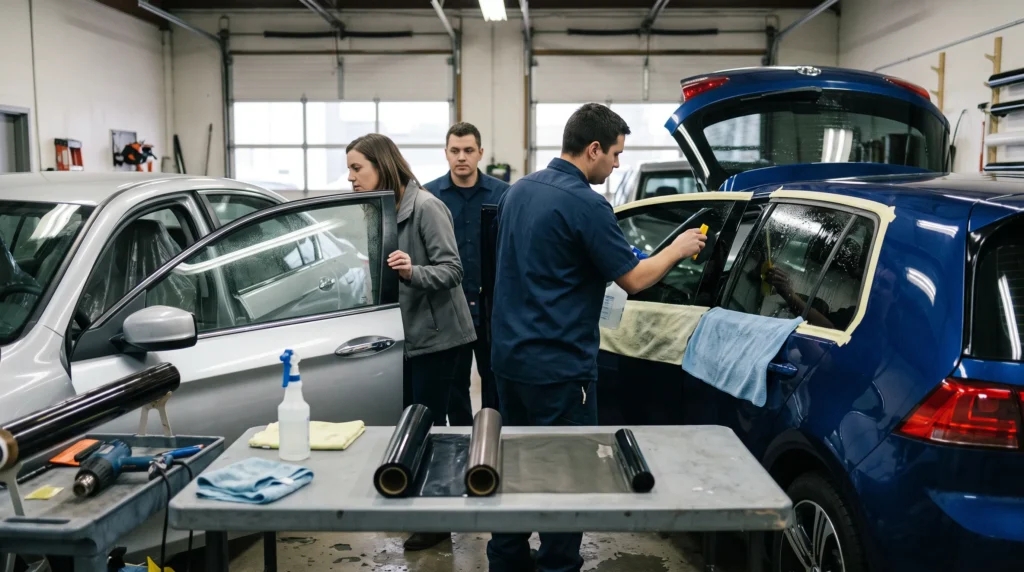
If you are comparing window tint options in Bakersfield, CA, ask what you are receiving rather than looking only at the number on the quote.
What Are You Actually Paying for With Window Tint?
Window tint is both a product and an installation service.
The product is the film.
The installation is everything required to put that film onto the vehicle correctly.
The International Window Film Association explains that automotive installation involves film selection, cleaning the glass, measuring and cutting the film, applying it to the interior glass surface, and removing the installation solution from beneath the film.
That preparation matters.
A high-performing film installed over contaminated glass can still look poor.
A good installation cannot turn an entry-level film into a higher-performing ceramic film either.
You need both parts to fit what you want from the vehicle.
Film Type Can Change the Entire Tint Job
One of the biggest differences in Cheap Window Tinting vs Quality Film is the type of film being quoted.
Automotive tint can include several constructions.
Dyed Window Film
Dyed film is commonly used for:
- Darker appearance
- Privacy
- Visible glare reduction
It often sits at the lower-cost end of automotive tint.
That may be enough if those are your main goals.
Carbon Window Film
Carbon film can provide:
- A dark appearance
- Non-metal construction
- Better color performance than many entry-level dyed products
- Solar-control properties
It can suit someone looking for a step between basic dyed tint and ceramic film.
Ceramic Window Film
Ceramic film is often chosen by drivers who care more about:
- Infrared rejection
- Total solar energy rejection
- UV rejection
- Optical clarity
- Color stability
- Heat-related performance
You can read more about these categories in our guide to window tint prices in Bakersfield.
Cheap Tint May Focus Mostly on Darkness
A low-priced tint package may still make your windows darker.
For some drivers, that is enough.
You may simply want:
- More rear privacy
- A darker vehicle appearance
- Less visible glare
- A shade that changes the look of the car
There is nothing wrong with choosing around appearance when appearance is genuinely your goal.
Problems begin when darkness is used as a substitute for film specifications.
A very dark film can still have weaker heat-related performance than a lighter ceramic product.
The darkness tells you how much visible light passes through.
It does not tell you the entire solar-performance story.
Heat Rejection Can Be Very Different
Bakersfield, CA drivers often want window tint because the cabin gets uncomfortable in the sun.
That makes film construction more relevant.
Manufacturers can publish several measurements related to solar performance.
Two worth checking are:
IR Rejection
IR means infrared.
An IR-rejection figure tells you how much infrared energy the film rejects within the manufacturer’s stated measurement range.
TSER
TSER means Total Solar Energy Rejected.
It measures a broader share of total incoming solar energy.
A film may have a high IR figure and a lower TSER figure because these measurements are not the same thing.
When comparing Cheap Window Tinting vs Quality Film, ask for both when the manufacturer publishes them.
Dark Tint Does Not Automatically Mean Better Heat Control
This is one of the easiest mistakes to make when shopping for tint.
Imagine two films.
The first looks extremely dark but is an entry-level product built mainly around shade and privacy.
The second is lighter but uses ceramic film technology and publishes stronger IR and TSER figures.
The lighter film may provide stronger measured heat-related performance.
That is why Bakersfield drivers who care about cabin comfort should not select window tint using VLT alone.
VLT means Visible Light Transmission.
A 5% film is much darker than a 50% film.
That does not mean every 5% film will reject more infrared energy than every 50% film.
Rayno’s current Phantom specifications show this clearly across its film levels.
Color Stability Matters in Bakersfield
Film color can change as a product ages.
Rayno notes that traditional dyed films can fade or discolor after long exposure to UV light and humidity.
If you have ever seen an older vehicle with purple-looking rear tint, you have seen what film aging can look like.
That does not mean every inexpensive film will turn purple.
It does mean the construction and color-stability testing are worth asking about.
Rayno currently publishes a fading rate of less than 1% for its Phantom S5, S7, and S9 films.
Rayno also publishes separate color-stability testing across those products.
For someone planning to keep a vehicle, this may carry more weight than it does for someone tinting a car that will be sold soon.
What Causes Tint to Turn Purple or Fade?
Older dyed window film can lose color as its materials age under sunlight.
The result may include:
- Purple color
- Uneven shade
- Faded areas
- Color that no longer matches between windows
Film construction matters here.
Rayno describes its Phantom Series as dye-free and metal-free, using carbon and ceramic particle technology.
That is very different from judging film simply from how black it looks on installation day.
Cheap Window Tinting vs Quality Film becomes easier to understand when you think about what the tint may look like after years of sunlight rather than only what it looks like during pickup.
Installation Prep Is Part of What You Pay For
The film needs clean glass.
The International Window Film Association states that windows should be thoroughly cleaned to remove dirt, dust, and debris that could affect adhesion.
That sounds simple.
In a tint shop, it means taking time to prepare the glass before the film goes on.
Rushed preparation can leave contamination trapped beneath the film.
The IWFA visual inspection guideline lists issues such as:
- Dirt particles
- Hair and fibers
- Adhesive gels
- Fingerprints
- Air bubbles
- Scores and scratches
- Film distortion
- Creases
- Edge lift
- Nicks
- Tears
Some temporary water haze after installation is normal while the film dries.
Obvious contamination and poor finishing are different issues.
Clean Edges and Proper Fit Matter
Automotive windows move.
Door glass slides into rubber seals every time you raise and lower it.
Film edges need to be fitted so they do not catch unnecessarily on the window frame or gasket.
The IWFA automotive inspection guideline states that the top edge may have a small edge gap, typically around 1 to 2 millimeters, unless a top-edge shaving method is used.
That gap has a purpose.
It helps keep the moving glass from lifting the edge of the film.
Tiny installation details like this are easy to overlook when comparing quotes.
They become noticeable once you live with the tint every day.
Rear Glass Takes More Skill Than a Flat Side Window
Rear windows are often curved.
The installer may need to shape the film so a flat sheet fits curved automotive glass.
Rear glass can also contain:
- Defroster lines
- Antenna elements
- Tight interior trim
- Brake-light housings
- Complex curves
This is one reason two tint jobs using the same amount of film may not involve the same work.
A crew-cab truck with a powered rear slider is another case.
A large SUV with several quarter windows creates a different installation from a two-door coupe.
The actual vehicle matters.
Old Tint Removal Can Change the Job
If your car already has bubbling, peeling, purple, or failing aftermarket tint, new film should not simply be placed over it.
The old film may need to come off first.
Adhesive can remain on the glass.
Rear glass may also have defroster lines that need to be treated carefully during removal.
This adds preparation before new film can be installed.
A very low quote may not include old-film removal.
Ask before booking.
You can read more in our guide to window tint removal in Bakersfield.
Warranty Coverage Can Be Missing From a Cheap Quote
Warranty is one of the easiest things to overlook when comparing Cheap Window Tinting vs Quality Film.
A film can look fine immediately after installation.
The questions come later if it:
- Bubbles
- Peels
- Cracks
- Delaminates
- Changes color
- Develops a manufacturing defect
Rayno’s current automotive warranty gives the Phantom Series a limited lifetime warranty.
Platinum Air also carries a limited lifetime warranty under Rayno’s current terms.
MonoCarbon carries a limited five-year warranty.
Coverage depends on Rayno’s written conditions and proper registration.
The exact film matters.
Ask for the product name rather than accepting “lifetime tint” as the whole explanation.
Manufacturer Warranty vs Installer Warranty
These are not the same thing.
Rayno’s current warranty says its coverage applies to manufacturing quality.
Rayno also states that problems caused by improper installation are the dealer’s responsibility rather than the manufacturer’s responsibility.
That distinction matters.
Imagine the film itself develops a covered manufacturing problem.
That may fall under the film manufacturer’s terms.
Now imagine film starts lifting because it was installed incorrectly.
That may be an installer issue instead.
Dynamic Window Tint carries warranties on its products and services.
Before booking any shop, ask:
- What does the film manufacturer cover?
- What does the shop cover?
- How long does each coverage period last?
- Is registration required?
- What proof of purchase should I keep?
For more detail, read our guide to what a window tint warranty actually covers.
Rayno Ceramic Film Specifications
Dynamic Window Tint carries Rayno Window Film in Bakersfield, CA.
Rayno’s current Phantom lineup shows how much specifications can differ between film levels.
Rayno Phantom S5
Rayno’s current S5 lineup publishes:
- 53% to 72% IR rejection across the listed shades
- 41% to 66% TSER
- 99.9% UV rejection
- Less than 1% fading rate
S5 gives drivers a ceramic option without moving to the higher Phantom levels.
Rayno Phantom S7
Rayno’s current S7 lineup publishes:
- 70% to 81% IR rejection
- 47% to 66% TSER
- 99.9% UV rejection
- Less than 1% fading rate
S7 gives drivers another level of heat-related performance to compare.
Rayno Phantom S9
Rayno’s current S9 lineup publishes:
- 91% to 93% IR rejection
- 53% to 70% TSER
- 99.9% UV rejection
- Less than 1% fading rate
The point is not that every Bakersfield driver needs S9.
The point is that two films sold as “window tint” can have very different published specifications.
That is what a price-only comparison can miss.
Review current options on our Bakersfield window tint service page.
When a Lower-Cost Tint May Be Enough
A lower-cost film can make sense.
Consider it when your main goal is:
- Darker appearance
- Rear privacy
- Reduced visible glare
- A vehicle you do not plan to keep for many years
- A simpler tint setup where higher solar performance is not a priority
You do not need to buy film features you do not care about.
If you mainly want dark rear glass, say that.
A good installer should be able to explain which film fits that goal without pretending every driver needs the highest film level.
When Better Film Makes More Sense
Higher-performing film becomes easier to justify when you care about more than darkness.
It may make sense if you:
- Drive daily in Bakersfield sun
- Park outside for long periods
- Want stronger IR rejection
- Want stronger TSER
- Plan to keep the vehicle
- Care about color stability
- Want high UV rejection
- Want good clarity
- Prefer non-metallic ceramic construction
- Want a lighter tint shade with strong solar performance
This is where Cheap Window Tinting vs Quality Film becomes a question of what you expect the tint to do.
Someone who wants privacy has a different goal from someone trying to reduce harsh solar exposure during a daily commute.
Questions to Ask Before Choosing a Tint Shop
Do not ask only, “How much is it?”
Ask what is included.
What Brand of Film Do You Use?
A shop should be able to name the manufacturer.
What Film Series Is Included in the Quote?
“Nano ceramic” is not enough.
Ask for the actual product line.
What Is the IR Rejection?
If heat is one of your goals, ask for the published figure.
What Is the TSER?
This gives you another solar-performance measurement.
What Is the UV Rejection?
Ask for the manufacturer’s published specification.
What Warranty Comes With the Film?
Find out whether it is manufacturer-backed and what conditions apply.
What Installation Coverage Does the Shop Provide?
Film manufacturing coverage and installation coverage are separate.
Is Old Tint Removal Included?
If old film is already on the vehicle, mention it before the appointment.
How Is the Glass Prepared?
Clean glass is part of a clean installation.
Which Windows Are Included?
A “full tint” quote can mean different things at different shops.
Ask whether it covers:
- Front side windows
- Rear side windows
- Quarter windows
- Rear glass
- Windshield strip
- Windshield film
Does the Setup Follow California Tint Rules?
A cheap job that does not fit California requirements can create a different problem later.
Review our California window tint laws guide before choosing front-window film.
Window Tint in Bakersfield, CA
Cheap Window Tinting vs Quality Film comes down to more than the amount you pay on installation day.
Ask what the quote includes.
Look at the film.
Look at the specifications.
Look at the warranty.
Look at how the vehicle will be prepared.
Think about whether you want privacy, appearance, heat rejection, glare reduction, or several of these together.
A lower-cost tint may fit someone who mainly wants darker glass.
A ceramic film may make more sense for a driver who spends hours in Bakersfield, CA sun and wants published IR, TSER, UV, clarity, and color-stability performance.
Dynamic Window Tint installs Rayno automotive window film at:
4609 New Horizon Blvd Suite #10 Bakersfield, CA 93313
The shop offers several window film choices and is certified with warranty-backed products and services.
Dynamic Window Tint serves drivers in Bakersfield, CA and nearby communities including Rosedale, CA, Oildale, CA, Greenfield, CA, Shafter, CA, Lamont, CA, Arvin, CA, Wasco, CA, and surrounding Kern County areas.
Rather than choosing tint from a generic low advertised price, tell the shop:
- Your vehicle year
- Make
- Model
- Which windows you want tinted
- Whether old tint is installed
- Whether factory privacy glass is present
- Whether heat or privacy matters more
- How long you expect to keep the vehicle
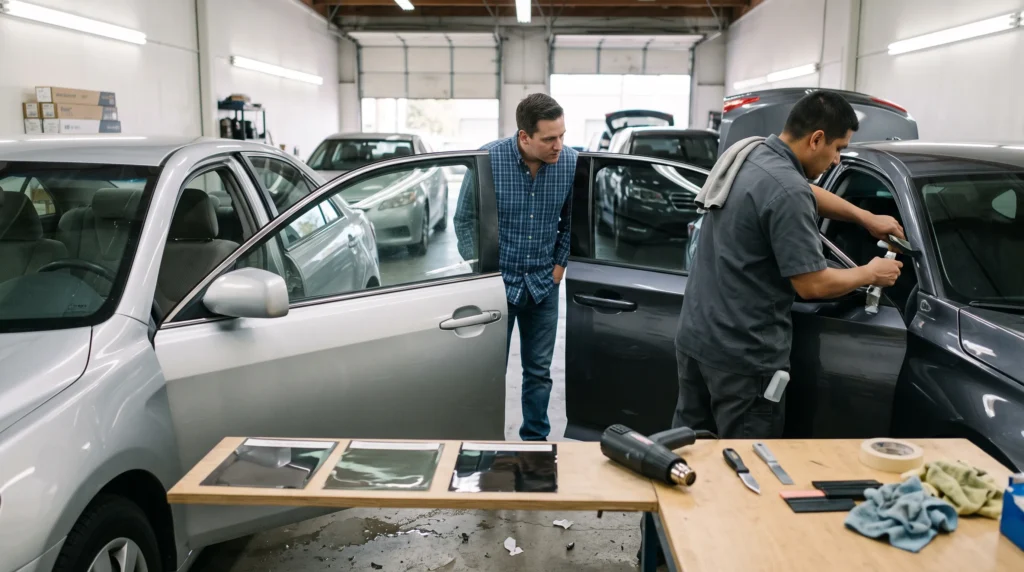
From there, you can compare film choices based on what you actually need.
Call (661) 634-5585 or visit the Dynamic Window Tint contact page for a quote and appointment.
FAQs About Cheap Window Tinting vs Quality Film
1. What is the difference between cheap window tint and better film?
The differences can include film construction, IR rejection, TSER, UV rejection, color stability, optical clarity, warranty coverage, and installation quality. Two films can look similarly dark while providing very different solar performance.
2. Does cheap window tint always turn purple?
No. Price alone does not prove a film will turn purple. Color change is tied to film construction, materials, sun exposure, and aging. Ask what film brand and series is being installed and whether the manufacturer publishes color-stability data.
3. Is ceramic tint worth comparing in Bakersfield, CA?
Yes, especially if heat-related performance matters to you. Ceramic film can provide higher IR rejection and TSER without relying only on a very dark shade. Compare the published specifications before choosing.
4. Why can two window tint quotes be so different?
The quotes may cover different film types, brands, glass areas, preparation, old tint removal, warranties, and installation work. Ask both shops for the exact film series and coverage before comparing.
5. Does darker cheap tint block more heat than lighter ceramic tint?
Not automatically. Darkness is measured by VLT. Heat-related performance is measured using figures such as IR rejection and TSER. A lighter ceramic product can publish stronger heat-related performance than a darker lower-tier film.
6. What should I ask a window tint shop before booking?
Ask for the film manufacturer, film series, VLT choices, IR rejection, TSER, UV rejection, warranty terms, installation coverage, included windows, old-film removal policy, and California front-window guidance.
7. Where can I get quality window tint in Bakersfield, CA?
Dynamic Window Tint installs Rayno automotive window film at 4609 New Horizon Blvd Suite #10, Bakersfield, CA 93313. Call (661) 634-5585 or visit the contact page to compare film options for your car, truck, SUV, Tesla, or other vehicle.
Sources
- Phantom Series Automotive Window Film
Publisher: Rayno Window Film
Publication Date: Not listed
Information referenced: Phantom S5, S7, and S9 construction, IR rejection, TSER, UV rejection, reflection, fading rate, clarity, and color-stability information. - Warranty Terms & Conditions
Publisher: Rayno Window Film
Publication Date: 2026
Information referenced: Phantom Series limited lifetime warranty, Platinum Air limited lifetime warranty, MonoCarbon warranty, manufacturing coverage, dealer installation responsibility, cure period, and film-care requirements. - Automotive Installation Process
Publisher: International Window Film Association
Publication Date: Not listed
Information referenced: Automotive film selection, glass cleaning, film measuring, cutting, preparation, and installation process. - Automotive Visual Inspection Guideline for Applied Window Film
Publisher: International Window Film Association
Publication Date: January 1, 2020
Information referenced: Film drying, water haze, installation inspection, contamination, bubbles, creases, edge lift, scratches, tears, and recommended top-edge gap. - Window Tint Prices in Bakersfield: Dyed vs Carbon vs Ceramic
Publisher: Dynamic Window Tint
Publication Date: Not listed
Information referenced: Dyed, carbon, and ceramic film differences, vehicle variables, old tint removal, Rayno film choices, heat performance, warranty considerations, and Bakersfield service. - Ceramic Tint in Bakersfield: Is the Upgrade Worth the Cost?
Publisher: Dynamic Window Tint
Publication Date: Not listed
Information referenced: Lower-cost film compared with ceramic film, Rayno S5, S7, and S9 IR rejection ranges, Bakersfield heat, and film-selection considerations. - What Does a Window Tint Warranty Actually Cover?
Publisher: Dynamic Window Tint
Publication Date: Not listed
Information referenced: Film manufacturing defects, installer responsibility, bubbling, peeling, delamination, discoloration, and warranty differences. - Window Tint Removal in Bakersfield: Why Old Tint Bubbles & Fades
Publisher: Dynamic Window Tint
Publication Date: Not listed
Information referenced: Failing tint, removal, adhesive residue, rear defroster considerations, and preparation before replacement film. - California Window Tint Laws: What Bakersfield Drivers Need to Know
Publisher: Dynamic Window Tint
Publication Date: Not listed
Information referenced: California tint rules and front-window considerations. - Contact Dynamic Window Tint
Publisher: Dynamic Window Tint
Publication Date: Not listed
Information referenced: Bakersfield address, phone number, and appointment information.
