

Window tint for electric vehicles in Bakersfield can help drivers manage cabin heat, bright sunlight, glare, and UV exposure without choosing extremely dark glass. That can matter on EVs with large windshields, expansive side windows, fixed glass roofs, and panoramic roof panels.
Tesla Model 3 and Model Y vehicles are obvious examples, but they are far from the only EVs using large areas of glass. Electric SUVs, crossovers, sedans, and trucks increasingly use panoramic roofs and open cabin designs that let plenty of sunlight inside.
The right window film should be selected around more than appearance.
EV owners should think about infrared rejection, Total Solar Energy Rejected, Visible Light Transmission, electronic-signal compatibility, existing factory glass, California tint rules, and whether a glass roof should receive film at all.
If you drive an EV around Bakersfield, CA, here is what you should know before scheduling window tint.
Table of Contents
- Why EV Window Tint Deserves Extra Thought
- Does Window Tint Help an EV Cabin With Heat?
- Why Ceramic Tint Makes Sense for Many EVs
- Will Ceramic Tint Interfere With EV Electronics?
- Do EVs Need Dark Tint for Heat Rejection?
- What About Panoramic Glass Roofs?
- Should You Tint a Tesla Glass Roof?
- What About EV Windshield Tint?
- Factory Glass vs Aftermarket Window Film
- IR Rejection vs TSER for Electric Vehicles
- Rayno Ceramic Window Film for EVs
- Can Window Tint Reduce EV Air Conditioning Use?
- Window Tint and EV Interior Protection
- California Window Tint Rules Still Apply to EVs
- What EV Owners Should Ask Before Tinting
- EV Window Tint in Bakersfield, CA
- FAQs About Window Tint for Electric Vehicles
Why EV Window Tint Deserves Extra Thought
Window tint works on electric vehicles for many of the same reasons it works on gasoline-powered cars.
The difference is often the glass.
Many newer EVs use large glass areas to create an open cabin.
You may have:
- A panoramic glass roof
- A large windshield
- Tall side windows
- Large rear glass
- Fixed roof glass
- Factory privacy glass on rear windows
More glass means more surface area exposed to sunlight.
That does not mean every piece of glass needs dark tint.
It means each glass area should be considered separately.
A driver may want ceramic film on the side windows while leaving the roof alone.
Another driver may want a lighter ceramic film on the roof because overhead brightness bothers rear passengers.
Someone else may care most about keeping the front side glass light while improving heat-related performance.
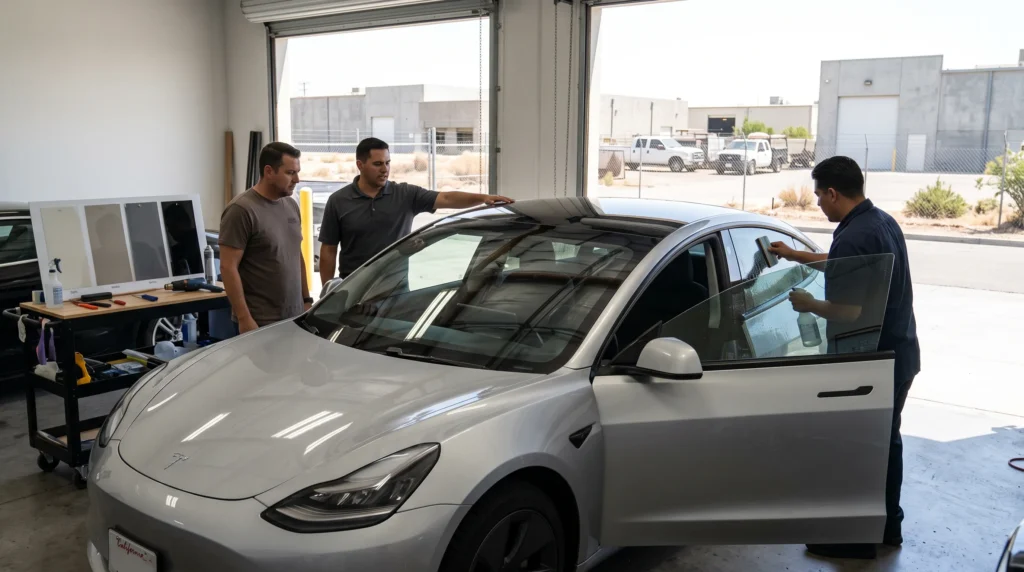
This is why window tint for electric vehicles should be planned around how the specific vehicle is used.
Does Window Tint Help an EV Cabin With Heat?
Automotive window film can reduce part of the solar energy entering through treated glass.
How much depends on the film.
Rayno publishes separate infrared rejection and Total Solar Energy Rejected figures across its automotive film lineup.
Tesla has also offered ceramic window film through its own service channels in some markets. Tesla’s current 3M Ceramic IR information describes film with up to 95% infrared rejection and up to 66% TSER depending on the product.
That gives EV owners a useful clue.
Heat-related performance is not simply about how dark the window looks.
A ceramic film can have strong solar-control figures without requiring the darkest shade available.
This can be useful in an EV where you want to keep the cabin open and bright while reducing some of the solar energy entering through the glass.
Why Ceramic Tint Makes Sense for Many EVs
Ceramic window film is commonly chosen for EVs because it can combine solar control with non-metallic construction.
Rayno describes ceramic window film as using ceramic particles and being non-metalized.
This matters for vehicles filled with electronics.
Modern EVs may use:
- Cellular connectivity
- GPS
- Bluetooth
- Wi-Fi
- Satellite communication
- Keyless access systems
- Mobile-phone connections
- Driver-assistance hardware
- Over-the-air software connections
A non-metalized ceramic film avoids one concern associated with some older metallic film constructions.
Rayno states that ceramic film does not interfere with electronic signals.
Tesla’s current information for 3M Ceramic IR also describes the nano-ceramic film as providing its performance without electronic interference.
For an EV owner, that makes film construction worth asking about before installation.
Will Ceramic Tint Interfere With EV Electronics?
Quality non-metalized ceramic window film is designed to avoid the signal-interference concerns associated with metal-based tint.
That is useful in any modern vehicle, but EV owners may pay more attention because so many vehicle functions depend on electronics and wireless connections.
Rayno describes its ceramic automotive film as non-metalized and suitable for drivers using mobile devices in the vehicle.
Still, do not assume every product sold as premium tint has the same construction.
Ask the installer:
- Is the film metallic?
- Is it ceramic?
- Is it carbon ceramic?
- Does the manufacturer describe it as signal-friendly?
- What film series is actually being installed?
Knowing the exact product matters more than a broad label such as “premium tint.”
Do EVs Need Dark Tint for Heat Rejection?
No.
One of the biggest misunderstandings about automotive tint is that darker automatically means cooler.
VLT and heat-related performance measure different things.
VLT stands for Visible Light Transmission.
A lower VLT allows less visible light through and normally looks darker.
Infrared rejection measures performance against infrared energy within the manufacturer’s stated testing range.
TSER measures Total Solar Energy Rejected.
A lighter ceramic film can provide strong infrared rejection even though it does not look nearly as dark as another film.
Tesla’s XPEL window tint page, for example, describes ceramic particle technology as providing heat rejection without relying on dark tint.
This matters for an EV owner who likes the bright, open cabin but wants better solar control.
You may not need to make every window extremely dark to change how sunlight feels inside the vehicle.
What About Panoramic Glass Roofs?
Glass roofs deserve separate attention.
They should not automatically receive the same film used on the side windows.
A panoramic roof may already use:
- Tinted glass
- Laminated glass
- UV-reducing glass
- Coated glass
- Multi-layer glass
The existing glass may already control part of the solar spectrum.
That does not necessarily mean every occupant finds the roof comfortable.
Overhead brightness and heat can still bother some people.
Before applying film to a panoramic roof, the installer should understand the vehicle and the glass.
Ask:
- Does the manufacturer already provide heat or UV treatment in the roof glass?
- Is the planned film compatible with that glass?
- How much darker will the roof become?
- How will the film change overhead visibility?
- What solar performance does the film add?
- Does the film manufacturer approve the application?
A glass roof should be considered as its own part of the tint plan.
Should You Tint a Tesla Glass Roof?
Some Tesla owners choose to tint the roof, while others leave it alone.
There is no reason every Model 3 or Model Y owner has to make the same choice.
Tesla vehicles already use treated glass, but owners may still have different preferences for brightness and solar comfort.
Dynamic Window Tint’s current Tesla Model Y window tint guide discusses the roof separately from the side and rear windows for this reason.
Think about what actually bothers you.
If the Roof Feels Too Bright
A suitable film may reduce visible light and overhead glare.
If You Like the Open Glass-Roof View
You may prefer a lighter film or no additional roof tint.
If Heat Is Your Main Concern
Ask for the film’s heat-related specifications instead of choosing by darkness.
If Rear Passengers Complain About Sunlight
Consider where the sunlight reaches them and whether the roof, side windows, or both are responsible.
The correct setup depends on your vehicle and your priorities.
What About EV Windshield Tint?
The windshield is another large glass area, but California places strict limits on windshield film.
Film technology and legal placement are separate questions.
A light ceramic film may have strong infrared rejection, but that does not automatically make full-windshield installation legal in California.
Dynamic Window Tint’s front windshield tint guide covers clear IR film and California restrictions in more detail.
EV owners should keep this distinction in mind.
You can have a film that looks nearly clear and still need to follow California rules about where material can legally be installed.
Talk with the installer about current California requirements before adding film to windshield glass.
Factory Glass vs Aftermarket Window Film
Factory glass and aftermarket window tint are not the same thing.
An EV may arrive with dark rear glass or a shaded panoramic roof.
That factory appearance does not automatically tell you the glass’s IR rejection, TSER, or other film-style specifications.
Aftermarket automotive film adds another layer to the existing glass.
Depending on the product, manufacturers may publish data for:
- VLT
- IR rejection
- TSER
- UV rejection
- Visible Light Reflection
This is one reason an installer needs to consider the existing glass before suggesting a final shade.
Adding a 20% film to clear glass will not necessarily look the same as adding that film over darker factory glass.
The finished VLT can also differ because the glass itself already transmits less than 100% of visible light.
IR Rejection vs TSER for Electric Vehicles
EV owners interested in heat often see a big infrared percentage first.
That number is useful, but it should not stand alone.
IR Rejection
IR rejection tells you how much infrared energy is rejected within the manufacturer’s stated measurement range.
Higher-performing ceramic films can publish very high IR numbers.
TSER
TSER stands for Total Solar Energy Rejected.
This looks at total solar energy rather than only the measured infrared range.
Two films may advertise similar IR numbers while showing different TSER.
That is why comparing window tint for electric vehicles should include both numbers when they are available.
Also compare products using the same manufacturer’s measurement methods whenever possible.
Rayno Ceramic Window Film for EVs
Dynamic Window Tint carries Rayno Window Film for automotive tint installations in Bakersfield, CA.
Its current vehicle tint choices include several Rayno ceramic film levels.
Rayno S5 Nano Ceramic
Dynamic Window Tint lists Rayno S5 Nano Ceramic as one of its current automotive film choices.
Rayno Phantom films use carbon ceramic technology, and S5 gives drivers an entry point into Rayno’s ceramic lineup.
This may fit an EV owner who wants ceramic construction, UV rejection, heat-related performance, and a choice of shades.
Rayno S7 Ceramic Plus
Rayno S7 Ceramic Plus provides another ceramic film level for drivers who want to compare stronger performance.
Rather than deciding from the word “ceramic,” ask to compare S5 and S7 specifications for your preferred VLT.
Rayno S9 Ceramic Supreme
Rayno S9 Ceramic Supreme is another current option at Dynamic Window Tint.
It is aimed at drivers looking farther up the Rayno ceramic lineup.
If heat-related performance is one of the main reasons you want to tint an EV, ask to compare S9 with the other ceramic choices rather than simply choosing the darkest film.
Rayno Clear Ceramic Supreme 70/90 Air Film
Dynamic Window Tint also lists a Clear Ceramic Supreme 70/90 Air Film option.
High-VLT ceramic products can interest EV owners who want to preserve a lighter appearance while still choosing film built around solar performance.
You can review current options on the Bakersfield vehicle window tint page.
Can Window Tint Reduce EV Air Conditioning Use?
Reducing solar heat entering through treated glass can reduce part of the heat load the climate-control system has to handle.
Tesla currently describes ceramic automotive window film offered through one of its service programs as reducing heat buildup and cutting air-conditioning use.
That does not mean window tint will produce a guaranteed increase in EV range.
Real-world energy use depends on many factors, including:
- Outdoor temperature
- Cabin temperature setting
- Vehicle model
- Driving speed
- Trip length
- Battery temperature management
- Preconditioning
- Sun exposure
- Parking conditions
- Amount and type of glass
- Film installed
Window tint should be viewed as a way to manage solar energy through treated glass rather than as a guaranteed range modification.
For most drivers, cabin comfort, glare, and sun exposure are more practical reasons to consider film.
Window Tint and EV Interior Protection
EV interiors can contain large touchscreens, synthetic upholstery, dashboards, trim, and other surfaces exposed to sunlight.
Window film can reduce UV passing through treated glass.
Rayno says its window films block about 99% of UVA and UVB rays.
UV reduction can help reduce one contributor to fading and material deterioration.
It is still important to keep the claim realistic.
UV is not the only cause of interior aging.
Heat, visible light, material composition, cleaning products, and normal use also play a part.
Tint can reduce UV exposure, but it cannot stop every form of interior wear.
California Window Tint Rules Still Apply to EVs
Driving an electric vehicle does not create a separate set of window tint laws.
A Tesla, Rivian, Lucid, Hyundai IONIQ, Kia EV, Ford Mustang Mach-E, Chevrolet EV, or other electric vehicle still has to follow California rules for automotive window film.
The rules differ by glass position.
Front side windows are treated differently from rear side windows.
Rear glass has different allowances.
The windshield has its own restrictions.
This matters because EV owners sometimes choose tint mainly for heat rejection rather than privacy and may assume lighter ceramic film can go anywhere.
Film performance does not override California law.
Review our California window tint laws guide for Bakersfield drivers before choosing shades for the front of the vehicle.
What EV Owners Should Ask Before Tinting
Before scheduling window tint for an electric vehicle, ask a few practical questions.
What Film Is Being Installed?
Ask for the manufacturer and series.
“Nana ceramic” or “ceramic” alone does not tell you the full performance.
What Is the IR Rejection?
If solar heat is your concern, look at the manufacturer’s published IR figure.
What Is the TSER?
Use TSER as another measurement of overall solar performance.
What Is the VLT?
Know how dark the film is and how it will interact with existing factory glass.
Is the Film Metal-Free?
This may matter if you want a product designed to avoid electronic-signal interference.
Does My Roof Need Film?
Do not automatically tint a panoramic roof just because the side windows are being done.
Discuss it separately.
How Will the Finished Tint Look Over Factory Glass?
Rear windows may already be darker than front windows.
If you want a more uniform appearance, explain that to the installer.
What Warranty Comes With the Film?
Ask what the manufacturer covers and what the installer covers.
Dynamic Window Tint provides certified installation and carries warranties on its products and services.
Does the Film Setup Follow California Law?
Ask about the windshield, front side windows, rear side windows, and back glass separately.
EV Window Tint in Bakersfield, CA
Window tint for electric vehicles in Bakersfield should be chosen around the vehicle’s glass, your driving habits, and what you actually want to change.
Some EV owners care most about heat.
Others want less glare.
Some want rear privacy.
Tesla owners with glass roofs may want less overhead brightness.
Drivers with lighter interiors may want strong UV rejection.
The film does not need to be extremely dark to provide meaningful solar-control specifications.
Ceramic film is especially worth comparing because modern non-metalized products can provide IR rejection, UV rejection, and signal-friendly construction.
Dynamic Window Tint installs automotive window film at:
4609 New Horizon Blvd Suite #10 Bakersfield, CA 93313
The shop carries Rayno Window Film and offers options including S5 Nano Ceramic, S7 Ceramic Plus, S9 Ceramic Supreme, and Clear Ceramic Supreme film.
Dynamic Window Tint works with EV owners in Bakersfield, CA and nearby areas such as Rosedale, CA, Oildale, CA, Greenfield, CA, Shafter, CA, Lamont, CA, Arvin, CA, and surrounding Kern County communities.
The shop also provides paint protection film, ceramic coating, windshield protection film, and windshield chip repair for vehicle owners looking for other protection services.
If you are deciding how to tint a Tesla or another electric vehicle, tell the installer what bothers you most about the current glass.
Is it heat?
Glare?
Privacy?
A bright glass roof?
Matching the front and rear windows?
Once the goal is clear, the film specifications become much easier to compare.
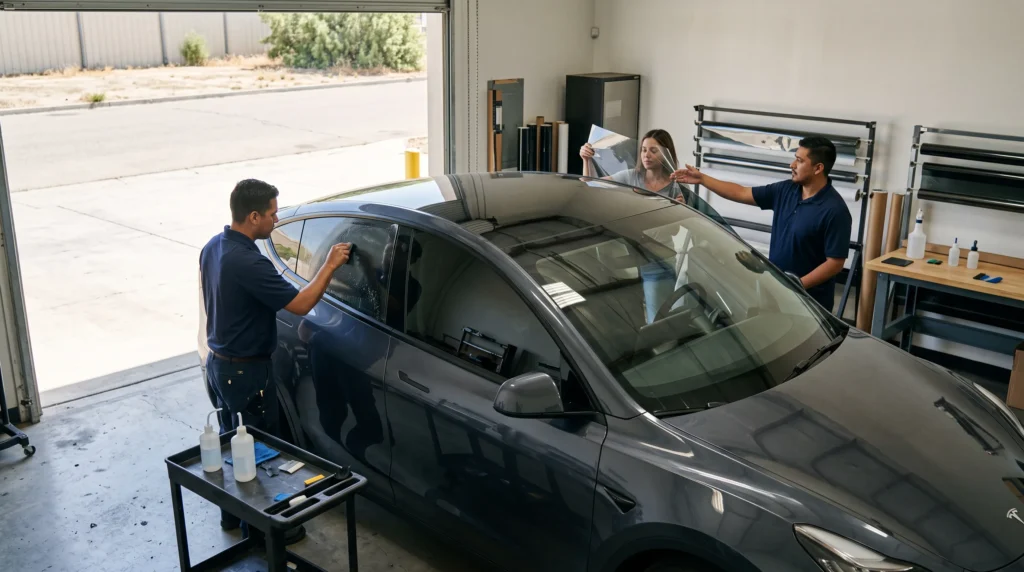
Call (661) 634-5585 or visit the Dynamic Window Tint contact page to schedule an appointment.
FAQs About Window Tint for Electric Vehicles
1. Is ceramic window tint good for electric vehicles?
Ceramic window tint can be a good choice for EVs because it can provide infrared rejection, UV rejection, and non-metalized construction. Rayno describes its ceramic films as non-metalized and designed not to interfere with electronic signals.
2. Does window tint improve EV range?
Window film can reduce part of the solar heat entering through treated glass, which may reduce the amount of cooling needed under some conditions. It should not be treated as a guaranteed range upgrade because EV energy use depends on weather, driving, climate settings, vehicle design, and many other factors.
3. Does a Tesla need window tint?
It depends on the owner. Tesla glass already has factory characteristics designed around UV and solar exposure, but some owners still choose tint for heat-related performance, glare, privacy, appearance, or reduced overhead brightness. The Model Y glass roof should be considered separately from its side windows.
4. Can ceramic tint interfere with an EV’s electronics?
Non-metalized ceramic film is designed to avoid electronic signal interference associated with metallic film. Check the exact film manufacturer and construction before installation rather than assuming every tint product works the same way.
5. Should I tint the panoramic roof on my EV?
Not automatically. Panoramic roofs may already use treated or coated glass. Whether additional film makes sense depends on the roof glass, film compatibility, overhead brightness, desired appearance, and solar performance you want.
6. Does EV window tint need to be dark to reject heat?
No. Darkness is measured through VLT, while heat-related film performance is measured using specifications such as infrared rejection and TSER. A lighter ceramic film can still provide strong solar performance.
7. Where can I get EV window tint in Bakersfield, CA?
Dynamic Window Tint installs Rayno automotive window film for Teslas and other electric vehicles at 4609 New Horizon Blvd Suite #10, Bakersfield, CA 93313. Call (661) 634-5585 or visit the contact page to discuss your EV, glass roof, tint shade, heat rejection, and film choices.
Sources
- Rayno Window Film
Publisher: Rayno Window Film
Publication Date: 2026
Information referenced: Ceramic window film construction, non-metalized film, signal compatibility, UV reduction, glare reduction, and heat-related performance. - Tesla Model Y Window Tint in Bakersfield
Publisher: Dynamic Window Tint
Publication Date: Not listed
Information referenced: Tesla Model Y glass roof, side and rear glass considerations, UV protection, brightness, heat, and Rayno film choices. - 3M Automotive Window Film for Tesla
Publisher: Tesla
Publication Date: 2026
Information referenced: Ceramic IR film, up to 66% TSER, up to 95% infrared rejection, nano-ceramic construction, electronic compatibility, and air-conditioning use. - XPEL Window Tint for Tesla
Publisher: Tesla
Publication Date: Not listed
Information referenced: Ceramic particle technology, heat rejection without relying on dark tint, UV reduction, and professional installation. - Window Tint in Bakersfield, CA
Publisher: Dynamic Window Tint
Publication Date: Not listed
Information referenced: Rayno S5 Nano Ceramic, S7 Ceramic Plus, S9 Ceramic Supreme, Clear Ceramic Supreme 70/90 Air Film, certified installation, warranties, and service areas. - Front Windshield Tint in Bakersfield: Clear IR Film Explained
Publisher: Dynamic Window Tint
Publication Date: Not listed
Information referenced: Clear IR film, VLT, infrared rejection, and California windshield-film considerations. - California Window Tint Laws: What Bakersfield Drivers Need to Know
Publisher: Dynamic Window Tint
Publication Date: Not listed
Information referenced: California tint requirements for the windshield, front side windows, rear side windows, and rear glass. - Contact Dynamic Window Tint
Publisher: Dynamic Window Tint
Publication Date: Not listed
Information referenced: Bakersfield address, phone number, and appointment information.
