

West-facing windows in Bakersfield can turn comfortable rooms into hot spots during the late afternoon. As the sun drops lower in the western sky, sunlight can enter these windows at a direct angle, bringing heat and glare deep into living rooms, bedrooms, kitchens, home offices, and spaces with sliding glass doors.
Closing blinds can help with brightness, but it also blocks your view and natural daylight. Residential window film gives Bakersfield, CA homeowners another option. The right architectural film can reduce the amount of solar energy entering through the glass while still allowing you to see outside.
The best film for west-facing windows is not always the darkest film. Solar Heat Gain Coefficient, Total Solar Energy Rejected, Visible Light Transmission, glass type, and the way you use the room all matter.
If your home feels fine in the morning but noticeably hotter after lunch, your west-facing glass may be one of the first places worth checking.
Table of Contents
- Why West-Facing Windows Get So Hot
- Why Afternoon Sun Feels Different
- Can Window Film Block Afternoon Heat?
- What Type of Film Works on West-Facing Windows?
- What Is Solar Heat Gain Coefficient?
- What Does TSER Tell You?
- Does Darker Window Film Block More Heat?
- Rayno Platinum Film for West-Facing Windows
- Rayno Trinity Film for Afternoon Sun
- What About Rayno Platinum Air 7090?
- Which West-Facing Rooms Should You Treat First?
- Window Film vs Blinds and Curtains
- Can Window Film Help With Afternoon Glare?
- Will Window Film Make the Room Too Dark?
- Check Your Glass Before Installing Film
- Residential Window Film in Bakersfield, CA
- FAQs About West-Facing Window Film
Why West-Facing Windows Get So Hot
West-facing windows receive direct sunlight later in the day.
The U.S. Department of Energy notes that controlling heat and glare can be more difficult on east-facing and west-facing windows than on north-facing and south-facing glass.
The reason comes down partly to sun angle.
In the afternoon, the sun moves lower in the western sky. That low-angle sunlight can travel directly through west-facing windows instead of being blocked easily by a roof overhang.
Inside the home, you may notice:
- A living room becoming hotter around 2 PM to 6 PM
- Bright sunlight landing across flooring
- Glare on televisions
- Glare on computer screens
- Hot areas near windows
- Bedrooms warming up before bedtime
- Furniture receiving direct afternoon sun
- A sliding glass door becoming a large source of incoming sunlight
- The need to close blinds every afternoon
West-facing windows in Bakersfield can be especially noticeable because afternoon sun arrives during the same part of the day when outdoor temperatures may already be high.
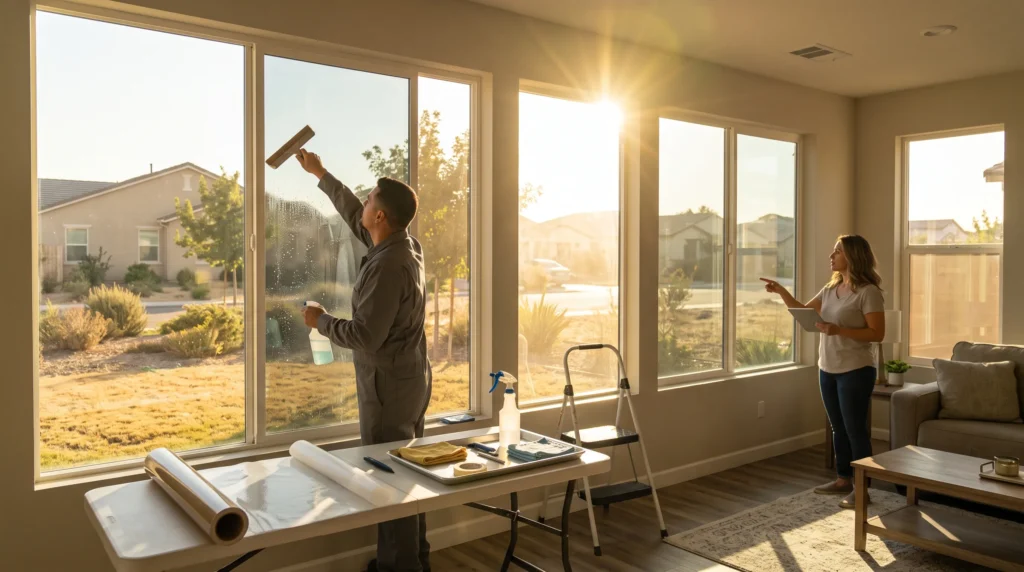
The glass then becomes another path for solar energy to enter the room.
Why Afternoon Sun Feels Different
Morning sunlight and afternoon sunlight can affect different sides of a home.
An east-facing room may receive direct sun early in the day.
A west-facing room receives that direct exposure later.
By afternoon, the outdoor temperature may already have climbed, and the western glass begins receiving direct solar exposure.
That combination can make certain rooms feel much warmer than rooms located on another side of the same house.
You might even notice that your air conditioner is running while one room still feels uncomfortable.
This does not always mean the HVAC system is the problem.
The room may simply be receiving more solar heat through its windows.
If you are unsure which rooms deserve attention first, see our guide on which rooms need window film most in a Bakersfield home.
Can Window Film Block Afternoon Heat?
Residential window film can reduce part of the solar energy entering through glass.
It does not stop all heat.
Walls, ceilings, doors, air leaks, attic temperatures, and outdoor air conditions also affect indoor temperatures.
Window film deals with one specific path: solar energy passing through your windows.
For a room with large west-facing glass, that can be a useful place to start.
Architectural film manufacturers publish measurements that help homeowners compare products.
Two of the most useful are:
- Solar Heat Gain Coefficient, or SHGC
- Total Solar Energy Rejected, or TSER
Visible Light Transmission is also worth checking because it tells you how much visible light passes through the treated glass.
The goal is not always to make a room dark.
Many homeowners want less afternoon heat while keeping a comfortable amount of daylight.
What Type of Film Works on West-Facing Windows?
A residential solar-control film is usually worth discussing when afternoon heat is the problem.
This is different from choosing film only for privacy.
A solar-control film is selected using measurements related to solar energy passing through glass.
For west-facing windows in Bakersfield, look at:
- TSER
- SHGC
- VLT
- UV rejection
- Visible light reflection
- Glass compatibility
- Film color
- Exterior appearance
- Interior appearance
A film with a lower SHGC allows less solar heat through the glass under the stated test conditions.
A film with a higher TSER rejects more total solar energy under the manufacturer’s stated testing.
Those numbers can give you more useful information than simply comparing dark and light samples.
What Is Solar Heat Gain Coefficient?
Solar Heat Gain Coefficient measures how much solar heat passes through a window system.
SHGC is expressed as a number between 0 and 1.
A lower number means less solar heat is transmitted.
The U.S. Department of Energy notes that lower SHGC products are generally suited to warm climates where reducing unwanted solar heat gain is the goal.
This measurement can be useful when comparing films for west-facing windows.
Imagine one film with an SHGC of 0.60 and another with an SHGC of 0.45 under their stated testing.
The 0.45 product allows a smaller share of solar heat through.
That does not mean SHGC should be the only number you consider.
You may also care about daylight, privacy, appearance, reflection, and how the film looks from inside the room.
What Does TSER Tell You?
TSER stands for Total Solar Energy Rejected.
It represents the portion of incoming solar energy that the filmed glass rejects under the test conditions used for the product.
If one film has a TSER of 55%, that means the stated system rejects 55% of total solar energy under those conditions.
TSER is useful because it deals with total solar energy rather than focusing on one part of the solar spectrum.
When comparing film for west-facing windows in Bakersfield, look at TSER alongside SHGC and VLT.
Why Use More Than One Number?
A film may reject a large amount of solar energy but also reduce visible light more than you want.
Another film may allow more daylight while providing a different solar-control level.
The right balance depends on the room.
A home theater may tolerate darker film.
A kitchen or living room may feel better with more natural light.
A home office may need stronger glare control.
Does Darker Window Film Block More Heat?
Not always.
This is one of the biggest mistakes homeowners make when comparing residential window film.
A darker film has a lower Visible Light Transmission number.
That tells you how much visible light passes through the film.
It does not tell you the full amount of solar energy being rejected.
A lighter architectural film may have strong solar-control properties while keeping more natural light.
That can be useful for west-facing windows in Bakersfield because homeowners often want to reduce afternoon heat without making the home feel closed off.
Instead of asking for the darkest residential tint available, ask to compare:
- VLT
- TSER
- SHGC
- Reflection
- Film color
That gives you a much better idea of how the room may look and feel after installation.
Rayno Platinum Film for West-Facing Windows
Dynamic Window Tint carries Rayno Window Film for residential applications in Bakersfield, CA.
Rayno Platinum is one architectural film family worth discussing for rooms dealing with solar heat.
Rayno currently lists two Platinum architectural film specifications.
Rayno Platinum PL-BL5099
Rayno lists the PL-BL5099 film with:
- 50% Visible Light Transmission
- 99.9% UV rejection
- 0.49 Solar Heat Gain Coefficient
- 51% Total Solar Energy Rejected
- 6.8% Visible Light Reflection
This film allows about half of visible light through while providing published solar-control performance.
That type of balance may appeal to homeowners who want to keep west-facing rooms fairly bright.
Rayno Platinum PL-BC3599
Rayno lists PL-BC3599 with:
- 35% Visible Light Transmission
- 99.9% UV rejection
- 0.45 Solar Heat Gain Coefficient
- 55% Total Solar Energy Rejected
- 6.8% Visible Light Reflection
Compared with the 50% VLT option, this film lets less visible light through and carries a lower published SHGC along with a higher TSER figure.
For a room receiving harsh afternoon sun, those differences may be worth comparing.
The right film still depends on the glass.
An installer should check the type of window before recommending a specific architectural product.
Rayno Trinity Film for Afternoon Sun
Rayno Trinity is another architectural film available for residential applications.
Rayno currently publishes these figures for Trinity:
- 50% VLT
- 99% UV rejection
- 0.49 SHGC
- 51% TSER
- 6.8% visible light reflection
Rayno also describes Trinity as helping reduce solar heat while preserving natural light.
Trinity includes glass-protection characteristics as part of its construction, so homeowners interested in both solar control and added glass retention may want to ask about it.
Do not choose Trinity simply because your windows face west.
Ask whether the product is compatible with your glass and whether its solar-control numbers match what you want from the room.
What About Rayno Platinum Air 7090?
Some homeowners want a film that changes the appearance of their windows as little as possible.
Rayno Platinum Air 7090 is a lighter nano-ceramic film Rayno lists for both automotive and architectural use.
Rayno currently publishes:
- 70% Visible Light Transmission
- 99% UV rejection
- 0.58 SHGC
- 42% TSER
- 7.3% visible light reflection
That means it allows more visible light through than the Platinum 35% and 50% products.
Its published solar-control figures are also different.
A homeowner who cares most about keeping the glass looking light may prefer to compare this type of film.
Someone dealing with a severe west-facing heat problem may want to compare it directly with stronger solar-control choices.
There is no single film that fits every west-facing window.
Which West-Facing Rooms Should You Treat First?
You do not necessarily need film on every window in the house.
Start with the rooms that give you the most trouble.
West-Facing Living Rooms
Living rooms often contain some of the largest windows in a home.
Large west-facing glass can expose sofas, flooring, televisions, artwork, and seating areas to afternoon sun.
If you find yourself closing the blinds every afternoon, the living room may be a good place to start.
Bedrooms
A west-facing bedroom may heat up late in the day.
That timing can be frustrating because the room may still feel warm when you are getting ready for bed.
Film cannot control every source of room temperature, but reducing solar gain through the glass can address one source of afternoon heat.
Home Offices
Low-angle afternoon sun can create strong glare on monitors.
You may end up closing the shades and turning on interior lights.
A suitable residential film can reduce glare while still allowing some daylight through.
Kitchens and Dining Areas
Large kitchen windows and patio doors can receive direct western sun.
These spaces often have hard surfaces that make bright light feel even stronger.
If your dining area becomes uncomfortable before dinner, check the direction of the glass.
Sliding Glass Doors
Sliding glass doors create a large area for sunlight to enter.
A west-facing patio door can receive direct sun for hours.
Because the glass area is so large, it is worth discussing whether the existing glass is compatible with the film being considered.
Window Film vs Blinds and Curtains
Window film and window coverings do different jobs.
Blinds and curtains can block visible light and help create privacy.
Film works directly on the glass and can reject part of the incoming solar energy before it enters deeper into the room.
The U.S. Department of Energy also lists shading, screens, coatings, and window treatments among methods used to manage solar gain and glare.
For some Bakersfield, CA homes, combining film with existing blinds makes sense.
During normal afternoons, you may be able to leave the blinds open and use the film for solar control.
When you want darkness or nighttime privacy, close the blinds.
This gives you more flexibility than depending on one solution for every situation.
Can Window Film Help With Afternoon Glare?
Yes, depending on the film.
Glare is one of the other common problems with west-facing glass.
Low afternoon sun can hit:
- Television screens
- Computer monitors
- Phones and tablets
- Glossy countertops
- Glass tables
- Polished flooring
A film with lower VLT can reduce some of the visible light entering through the glass.
That can make bright afternoon conditions easier to manage.
You do not always need the lowest VLT available.
Ask to see film samples and consider how much daylight you want to keep.
Will Window Film Make the Room Too Dark?
It depends on the VLT you choose.
A 70% VLT film allows more visible light through than a 50% film.
A 50% film allows more through than a 35% film.
That is why choosing film from the exterior appearance alone can lead to disappointment.
Think about the room itself.
A bright west-facing living room may still feel open with a lower VLT.
A room with small windows may become noticeably darker.
Your wall colors, flooring, furniture, window size, and surrounding shade can all change how the finished space feels.
If keeping natural light is a major concern, tell the installer.
They can discuss lighter film choices and compare those options with stronger solar-control films.
Check Your Glass Before Installing Film
Residential film should be matched to the window.
Homes may have:
- Single-pane glass
- Dual-pane glass
- Tempered glass
- Laminated glass
- Low-e glass
- Factory-tinted glass
These glass systems react to solar energy differently.
Some window configurations may have film restrictions from the glass or window manufacturer.
This is one reason residential window film should not be selected the same way as vehicle tint.
A professional installer should identify the glass and choose a film that fits the application.
If you are researching other rooms before deciding, read our guide to home window tinting in Bakersfield, CA.
Residential Window Film in Bakersfield, CA
West-facing windows in Bakersfield can create afternoon heat and glare that makes one side of the home feel very different from the other.
You do not have to cover the windows with heavy curtains all day to address the problem.
Residential solar-control film can reduce part of the solar energy entering through the glass while preserving varying levels of natural light and outward visibility.
The right choice depends on:
- Window direction
- Glass type
- Window size
- Room use
- Desired daylight
- Desired privacy
- Glare
- SHGC
- TSER
- VLT
- Exterior appearance
Dynamic Window Tint installs Rayno residential window film for homeowners in Bakersfield, CA.
The shop is located at:
4609 New Horizon Blvd Suite #10 Bakersfield, CA 93313
Homeowners from Bakersfield, CA and nearby areas such as Rosedale, CA, Oildale, CA, Greenacres, CA, Shafter, CA, Lamont, CA, Arvin, CA, and Wasco, CA can contact the team to discuss residential film.
If your west-facing rooms become uncomfortable every afternoon, tell the installer:
- Which rooms feel hottest
- Which windows face west
- What time the problem usually begins
- Whether glare is also a problem
- Whether you want to keep a bright room
- Whether privacy matters
- What type of glass you have, if known
Dynamic Window Tint is certified and carries warranties on its products and services.
Call (661) 634-5585 or visit the Dynamic Window Tint contact page to schedule an appointment.
FAQs About West-Facing Window Film
1. What is the best window film for west-facing windows?
The best film depends on your glass and how much daylight you want to keep. For afternoon heat, compare residential solar-control films using SHGC, TSER, and VLT. A lower SHGC and higher TSER can indicate stronger solar heat control under the manufacturer’s stated test conditions.
2. Does window film really reduce afternoon heat?
Residential solar-control film can reduce the amount of solar energy passing through treated glass. It will not stop all sources of heat in a room, but it can address solar gain through windows.
3. Should I choose the darkest film for west-facing windows?
Not automatically. Darker film reduces visible light, but darkness and solar heat rejection are not the same measurement. Compare TSER and SHGC along with VLT before choosing.
4. What does SHGC mean for residential window film?
SHGC stands for Solar Heat Gain Coefficient. It measures how much solar heat passes through a window system. Lower SHGC values indicate less solar heat transmission under the stated test conditions.
5. Can window film help with west-facing glare?
Yes. Residential film can reduce visible light entering through west-facing glass, which may help with afternoon glare on televisions, computer screens, flooring, and other surfaces. The amount depends on the film’s VLT.
6. Can I put window film on dual-pane or low-e windows?
Some films can be used on certain dual-pane and low-e glass systems, but compatibility must be checked before installation. Glass construction, coatings, and manufacturer requirements can affect which film should be used.
7. Where can I get film for west-facing windows in Bakersfield, CA?
Dynamic Window Tint installs Rayno residential window film in Bakersfield, CA and nearby Kern County communities. Call (661) 634-5585 or visit the contact page to discuss west-facing windows, afternoon heat, glare, privacy, and your home’s glass.
Sources
- Natural Light and Daylighting
Publisher: U.S. Department of Energy, Building Science Education
Publication Date: Current online guidance
Information referenced: Window orientation, solar gain, glare, and the difficulty of controlling heat on east-facing and west-facing windows. - Purchasing Energy-Efficient Residential Windows, Doors, and Skylights
Publisher: U.S. Department of Energy
Publication Date: Current online guidance
Information referenced: Solar Heat Gain Coefficient, visible transmittance, solar heat through glazing, and hot-climate window considerations. - Rayno Platinum Architectural Window Film
Publisher: Rayno Window Film
Publication Date: Not listed
Information referenced: Residential applications, VLT, UV rejection, SHGC, TSER, reflection, solar control, and available Platinum film specifications. - Rayno Trinity Architectural Window Film
Publisher: Rayno Window Film
Publication Date: Not listed
Information referenced: 50% VLT, 99% UV rejection, 0.49 SHGC, 51% TSER, glass retention characteristics, and residential applications. - Rayno Platinum Air 7090
Publisher: Rayno Window Film
Publication Date: Not listed
Information referenced: Architectural use, 70% VLT, 99% UV rejection, 0.58 SHGC, and 42% TSER. - Which Rooms Need Window Film Most in a Bakersfield Home?
Publisher: Dynamic Window Tint
Publication Date: Not listed
Information referenced: West-facing rooms, afternoon heat, glare, living rooms, bedrooms, home offices, and sliding glass doors. - Home Window Tinting in Bakersfield, CA
Publisher: Dynamic Window Tint
Publication Date: Not listed
Information referenced: Residential film applications, Bakersfield sunlight, solar heat, privacy, and glare. - Contact Dynamic Window Tint
Publisher: Dynamic Window Tint
Publication Date: Not listed
Information referenced: Appointment and contact information.
