

Window tinting in Delano, CA can make a real difference when your vehicle spends day after day under the San Joaquin Valley sun. Summer temperatures commonly reach the 90s, and NOAA climate records show that July and August average afternoon highs near the upper 90s in Delano. When sunlight passes through automotive glass, seats, dashboards, trim, and other interior surfaces absorb that solar energy. Choosing the right window film can reduce how much of that energy enters through the glass while also helping with glare, UV exposure, privacy, and appearance.
For drivers who commute between Delano, CA, McFarland, CA, Shafter, CA, and Bakersfield, CA, summer heat is part of everyday driving. A vehicle parked outside during work, errands, school pickups, or lunch can spend hours in direct sunlight. That makes heat rejection one of the first things worth comparing when choosing vehicle window tint.
Dynamic Window Tint installs Rayno Window Film at its Bakersfield, CA shop and backs products and services with warranties. If you are deciding which tint makes sense for a daily driver, family SUV, work truck, or weekend car, this guide explains what heat rejection means and what to look for before choosing a film.
Table of Contents
- Why Window Tinting in Delano, CA Makes Sense for Summer
- How Hot Are Delano, CA Summers?
- How Window Tint Helps With Solar Heat
- Why Darker Tint Does Not Always Mean Better Heat Rejection
- What IR Rejection Means
- What TSER Means for Window Tint
- Why Ceramic Window Tint Works Well in Valley Heat
- Choosing Tint for a Daily Driver in Delano, CA
- What About Windshield Heat?
- Window Tint for Trucks and SUVs in Delano, CA
- Window Tint and California Law
- Professional Window Tint Installation Near Delano, CA
- Other Vehicle Protection Services Worth Considering
- Schedule Window Tinting Near Delano, CA
- Frequently Asked Questions
- Sources
Why Window Tinting in Delano, CA Makes Sense for Summer
Window tinting in Delano, CA is especially useful for drivers who park outside or spend long stretches on the road during summer.
The Central Valley receives plenty of intense sun during the warmer months. A car sitting in an open parking lot can absorb solar energy through the windshield, doors, quarter glass, and rear window. Interior materials then warm up and release some of that stored heat back into the cabin.
Here is why film selection matters.
Automotive tint is not only about changing how dark a vehicle looks. Modern films can be designed to reject parts of the sun’s energy while still allowing useful visible light through the glass.
That means two films that look fairly similar can behave differently in hot weather.
Someone shopping for window tinting in Delano, CA may care about several goals:
- Less solar heat entering through the glass
- Reduced glare during daytime driving
- UV rejection
- More privacy
- A darker or cleaner exterior look
- Better comfort for children or rear passengers
- Less direct sun hitting seats and interior trim
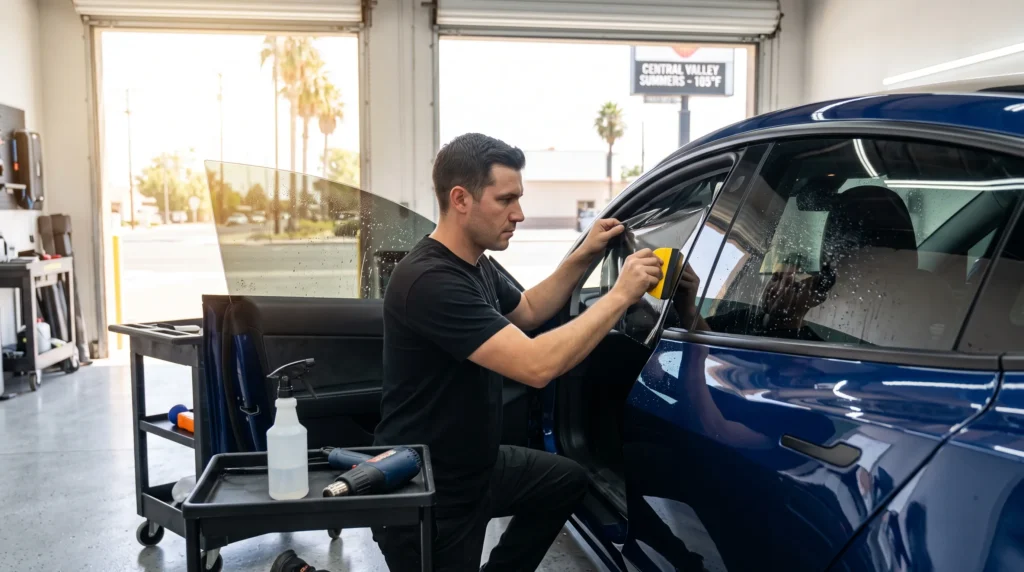
If heat is your main concern, ask about the film’s solar specifications instead of choosing from appearance alone.
How Hot Are Delano, CA Summers?
Delano, CA has the kind of summer climate where heat rejection deserves close attention.
According to the NOAA National Centers for Environmental Information 1991–2020 climate normals for Delano, the average daily maximum temperature is:
- 92.2°F in June
- 97.3°F in July
- 96.5°F in August
- 90.7°F in September
NOAA also reports an average of 29.6 days in July and 30.2 days in August with temperatures reaching at least 90°F.
Days at or above 100°F are common as well. NOAA’s normals show an average of 13.2 such days in July and 9.3 in August.
For a vehicle owner, that means summer heat is not limited to one unusual heat wave. Hot conditions can last for weeks.
What this means is simple: window tinting in Delano, CA is worth choosing with solar control in mind.
A commuter driving south toward McFarland, CA or Bakersfield, CA may spend a large part of the trip with sunlight coming through the side glass. Someone who parks at work for eight hours may return to a vehicle that has been exposed to direct sun throughout the afternoon.
Film cannot make a parked vehicle stay cold, but it can reduce the amount of solar energy transmitted through treated glass.
How Window Tint Helps With Solar Heat
Sunlight contains several forms of radiation.
Visible light is the part your eyes see. Infrared energy is associated with much of the heat people feel from sunlight. Ultraviolet radiation is another portion of the solar spectrum.
Window films can be designed to manage these parts of sunlight in different ways.
For drivers considering window tinting in Delano, CA, the useful question is not simply, “How dark is this film?”
Ask instead:
- How much visible light passes through it?
- How much infrared energy does it reject?
- How much total solar energy does it reject?
- How much UV does it reject?
- What will it look like on my factory glass?
These numbers provide a clearer picture of how a film behaves.
Why Darker Tint Does Not Always Mean Better Heat Rejection
One of the biggest misconceptions about automotive tint is that the darkest film must block the most heat.
That is not always true.
Visible Light Transmission, usually called VLT, tells you how much visible light passes through a film.
A lower VLT number generally means a darker appearance.
A higher VLT number generally means a lighter appearance.
Yet VLT does not by itself tell you how much infrared energy or total solar energy the film rejects.
This matters for window tinting in Delano, CA because you may want strong heat rejection without making every window extremely dark.
Rayno publishes separate figures for VLT, infrared rejection, UV rejection, and Total Solar Energy Rejected on its automotive films. Those separate measurements show why choosing tint only by shade leaves out part of the story.
Now here’s the thing: a driver who wants better solar control may benefit more from comparing film construction and solar specifications than simply moving to the darkest shade available.
What IR Rejection Means
IR stands for infrared.
Infrared radiation is part of the solar energy that contributes to the sensation of heat.
An automotive film with stronger infrared rejection can reduce the amount of infrared energy passing through the treated glass.
Rayno publishes infrared-rejection figures across its Phantom automotive film lines. Its Phantom Series specifications show that IR rejection varies by film series and shade.
This is useful for anyone comparing window tinting in Delano, CA.
Two films may look similar while having different IR figures. A lighter ceramic film may also reject more infrared energy than someone expects based only on its appearance.
When you talk with an installer, ask to compare actual film specifications.
What TSER Means for Window Tint
TSER stands for Total Solar Energy Rejected.
This measurement looks at a broader portion of solar energy than IR rejection alone.
Rayno describes TSER as a measurement related to how much total solar energy a film rejects. Its Phantom product charts publish TSER alongside VLT, infrared rejection, UV rejection, and visible-light reflection.
For a Delano, CA driver, TSER can be useful because it gives you another way to compare films designed for sunny conditions.
Here is why.
A high IR number may sound impressive, but IR is only one part of sunlight. Looking at TSER alongside VLT and IR can give you a fuller picture of the film.
When comparing window tinting in Delano, CA, ask to see manufacturer specifications rather than relying only on a heat-lamp demonstration or a shade sample.
Why Ceramic Window Tint Works Well in Valley Heat
Ceramic window film is popular with drivers who put heat rejection near the top of their list.
Rayno describes its Phantom automotive line as nano carbon ceramic film. The manufacturer publishes separate heat, infrared, UV, and visible-light specifications for its films.
Rayno’s newer Phantom II line is also designed around nano carbon ceramic construction and is marketed for strong infrared rejection.
For drivers shopping for window tinting in Delano, CA, ceramic film can make sense when the goal is to manage solar energy without selecting film solely by darkness.
Ceramic Tint for Commuters
If you regularly commute toward Bakersfield, CA, Shafter, CA, or other parts of Kern County, you may spend hours each week with sunlight hitting the driver’s side or passenger-side glass.
Ceramic film gives you a way to choose tint around solar specifications as well as appearance.
Ceramic Tint for Parked Vehicles
No tint can stop a parked vehicle from heating up over time.
Still, reducing incoming solar energy through the treated windows can make tint worthwhile for vehicles that spend much of the day outside.
Window tinting in Delano, CA can be especially appealing for people who park at:
- Outdoor workplaces
- Shopping centers
- Schools
- Medical offices
- Agricultural sites
- Apartment parking areas
- Open residential driveways
The amount of glass on the vehicle and the direction it faces during the day will also affect how much sunlight reaches the cabin.
Choosing Tint for a Daily Driver in Delano, CA
The right tint setup depends on how you use the vehicle.
Start by thinking about where the car spends most of the day.
If it sits outside from morning through late afternoon, solar control may matter more than appearance.
If you spend a lot of time driving before sunrise or after dark, outward visibility may weigh more heavily in your shade choice.
If you have children riding in the rear seats, rear-window glare and direct sunlight may be a bigger concern.
If you own a work truck, you may care about privacy and cabin comfort during long drives between job sites.
The real question is what you want the film to do.
When comparing window tinting in Delano, CA, tell your installer:
- Your vehicle year, make, and model
- Which windows you want tinted
- Whether factory privacy glass is already present
- Whether old film needs to be removed
- How dark you want the vehicle to look
- How much you care about heat rejection
- How often you drive at night
- Whether the vehicle is usually parked outdoors
That information makes it easier to narrow down film choices.
What About Windshield Heat?
The windshield is one of the largest pieces of glass on most vehicles.
That large glass area can expose the dashboard, front seats, steering wheel, and center console to direct sunlight.
Some modern automotive films are available in very light shades designed for drivers who want solar properties without making the windshield appear heavily tinted.
California has rules governing materials placed on windshields and front side windows, so any windshield film needs to be selected with current state law in mind.
Dynamic Window Tint can talk with you about film choices and California requirements before installation.
The shop also provides windshield protection services for drivers interested in protecting the glass itself from road wear.
Window Tint for Trucks and SUVs in Delano, CA
Trucks and SUVs are common choices for work, family use, and everyday transportation around the Central Valley.
Many of these vehicles come from the factory with privacy glass behind the front doors.
Factory privacy glass and aftermarket window film are not the same thing.
Privacy glass gets its darker appearance from the glass itself. It may not provide the same solar specifications as a ceramic film installed over the glass.
For that reason, someone looking for window tinting in Delano, CA may choose to place film over factory rear privacy glass for added solar control.
The finished shade will depend on both the existing glass and the film placed over it.
This is another reason to have the glass inspected before choosing a shade.
Window Tint and California Law
Heat rejection matters, but the finished tint also needs to fit California rules.
California Vehicle Code Section 26708 regulates material installed on vehicle windshields and windows. Rules differ depending on which window is being treated.
Front side windows and windshields are subject to tighter requirements than many rear-window applications.
If you want window tinting in Delano, CA, do not choose a shade from an old online chart and assume it applies to every window on your vehicle.
Your factory glass contributes to the finished light transmission.
Ask your installer about the current California rules and which options make sense for each part of the vehicle.
You can also review the current statute through California Legislative Information.
Professional Window Tint Installation Near Delano, CA
Film quality is only part of the job.
Good installation requires careful glass preparation, accurate film placement, clean edges, and attention around door panels, seals, rear glass, sensors, and other vehicle parts.
Poor installation may leave:
- Dirt under the film
- Creases
- Uneven edges
- Large gaps
- Peeling corners
- Contamination
- Bubbles that do not clear
Dynamic Window Tint provides window tint installation from its Bakersfield, CA shop and carries Rayno Window Film.
The shop is certified and carries warranties on products and services.
For people coming from Delano, CA, working with a shop that can explain film specifications gives you a chance to compare more than shade alone.
Ask about VLT, IR rejection, TSER, UV rejection, film construction, warranty coverage, and how each film will look on your vehicle.
Other Vehicle Protection Services Worth Considering
Drivers who spend a lot of time traveling through Kern County may want to address more than cabin heat.
Dynamic Window Tint also provides ceramic coating for vehicle surfaces and paint protection film for painted areas exposed to road contact.
These services do different jobs.
Window tint focuses on glass and solar exposure.
Paint protection film places a physical film over selected painted surfaces to help guard them from road contact.
Ceramic coating is used on exterior surfaces to make washing and routine care easier while giving the finish a slick appearance.
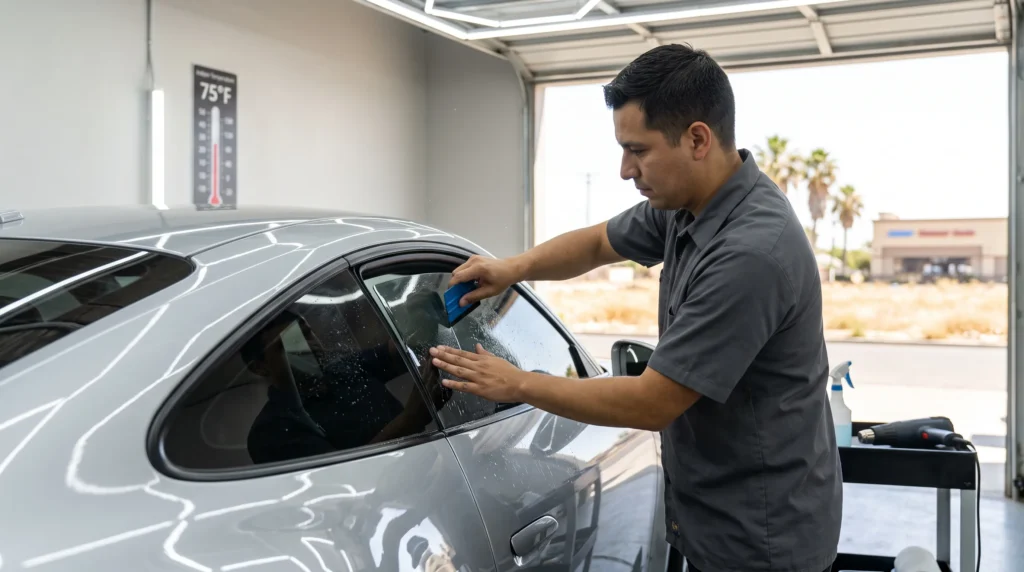
If you are already making the trip from Delano, CA to Bakersfield, CA, you can ask which services can be handled during the same shop visit.
Schedule Window Tinting Near Delano, CA
Window tinting in Delano, CA should start with the conditions your vehicle faces every day.
If your car spends hours outside during July and August, heat rejection may be worth placing near the top of your list.
If you commute long distances through Kern County, look at both solar specifications and outward visibility.
If appearance is your biggest concern, compare shades while keeping California law in mind.
Dynamic Window Tint is located at:
4609 New Horizon Blvd Suite #10
Bakersfield, CA 93313
Call (661) 634-5585 to discuss window tint options for your vehicle.
You can also use the Dynamic Window Tint contact page to request an appointment.
Tell the team your vehicle year, make, model, which windows you want tinted, and whether heat rejection is your main goal.
No generic online quote can account for every vehicle, glass layout, film choice, or existing tint. Call the shop or submit the contact form for information based on your vehicle.
Frequently Asked Questions
1. Does window tinting in Delano, CA help with summer heat?
Yes. Automotive window film can reduce the amount of solar energy passing through treated glass. The amount varies by film. When heat is your main concern, compare manufacturer figures such as TSER and infrared rejection along with VLT.
2. Is ceramic tint better for Delano, CA summers?
Ceramic film is a strong option for drivers focused on heat rejection. Rayno’s ceramic automotive films publish separate figures for visible-light transmission, infrared rejection, UV rejection, and total solar energy rejected. Those measurements let you compare heat-related properties without relying only on how dark the film looks.
3. Does darker window tint reject more heat?
Not necessarily. Darkness is usually discussed through VLT, while heat-related properties are measured separately. Two films with similar VLT can have different infrared and total-solar-energy rejection figures. Film construction matters.
4. What does IR rejection mean on window tint?
IR rejection describes how much infrared energy a film rejects. Infrared energy contributes to the heat people feel from sunlight. A higher published IR-rejection figure generally means the film rejects more of that measured infrared energy.
5. What does TSER mean?
TSER means Total Solar Energy Rejected. It describes the portion of total solar energy rejected by a glazing and film system. It is useful to look at TSER along with VLT and IR rejection when comparing automotive films for hot-weather driving.
6. Can I tint my windshield to help with heat in Delano, CA?
California regulates material placed on windshields, so the film and placement must follow current state rules. Very light automotive films may be available, but you should discuss the vehicle and current California requirements with the installer before choosing windshield film.
7. How do I schedule window tinting near Delano, CA?
Call Dynamic Window Tint at (661) 634-5585 or visit the contact page. Tell the team what vehicle you have, which windows you want tinted, and whether heat rejection is your main concern. They can discuss film choices and provide information based on your vehicle.
Sources
Summary of Monthly Normals, Delano, CA Station USC00042346
Publisher: NOAA National Centers for Environmental Information
Publication Date: March 25, 2026
Data Period: 1991–2020
Phantom Series Automotive Window Film
Publisher: Rayno Film
Publication Date: Not listed
Accessed: August 28, 2026
Phantom II Nano Carbon Ceramic Window Film
Publisher: Rayno Film
Publication Date: Not listed
Accessed: August 28, 2026
Window Tint in Bakersfield, CA
Publisher: Dynamic Window Tint
Publication Date: Not listed
Accessed: August 28, 2026
California Vehicle Code
Publisher: California Legislative Information
Publication Date: Current code database
Accessed: August 28, 2026
