

Window tint for rideshare & delivery drivers in Bakersfield can make long hours behind the wheel easier when sunlight, glare, and solar heat keep entering through the side windows. Drivers working with Uber, Lyft, food-delivery apps, grocery-delivery services, and other platforms can spend far more time in their vehicles than the average commuter.
That extra time changes how you may think about tint.
A person driving 20 minutes to work may mainly care about appearance. A rideshare or delivery driver may spend hours moving between Bakersfield, CA neighborhoods, parking lots, restaurants, stores, pickup points, and passenger destinations.
During those hours, sunlight may stay on the driver’s side of the vehicle for long stretches. Afternoon glare can make screens harder to see. Rear passengers may appreciate less direct sun. Delivery drivers may want solar control without turning the cabin too dark for nighttime work.
The right film should balance solar performance, visibility, California tint rules, and the way you use the car.
Here is what rideshare and delivery drivers should compare before choosing window tint.
Table of Contents
- Why Rideshare and Delivery Drivers Notice Sun Exposure More
- How Window Tint Can Help During Long Driving Shifts
- Why Ceramic Tint Makes Sense for High-Mileage Drivers
- VLT Matters for Day and Night Driving
- TSER and IR Rejection for Bakersfield Driving
- Does Darker Tint Mean Better Heat Rejection?
- Rayno S5 for Rideshare and Delivery Vehicles
- Rayno S7 for Drivers Spending More Time on the Road
- Rayno S9 for Stronger IR Rejection
- Front Side Windows Need Extra Attention
- Rear Window Tint for Rideshare Passengers
- Window Tint for Food and Package Delivery Drivers
- What About Factory Privacy Glass?
- Can Tint Help With Phone and Navigation Glare?
- Will Ceramic Film Affect GPS or Cell Signals?
- Windshield Tint and Rideshare Trade Dress
- California Tint Rules for Rideshare Drivers
- Think About Night Driving Before Choosing a Shade
- What High-Mileage Drivers Should Ask a Tint Shop
- Window Tint for Rideshare and Delivery Drivers in Bakersfield CA
- FAQs About Tint for Rideshare and Delivery Drivers
Why Rideshare and Delivery Drivers Notice Sun Exposure More
Time behind the wheel adds up.
A rideshare driver may spend part of the day carrying passengers and another part waiting for requests.
A food-delivery driver may move between restaurants, parking lots, apartment buildings, and homes for several hours.
A grocery-delivery driver may spend long periods driving and loading orders.
During all of that, the vehicle becomes a workplace.
Sun exposure can come through:
- Driver-side glass
- Front passenger glass
- Rear doors
- Rear glass
- Windshield
- Panoramic roof glass
The angle changes throughout the day.
Morning sun may enter through one side of the vehicle. Afternoon sun may land on the opposite side for several hours.
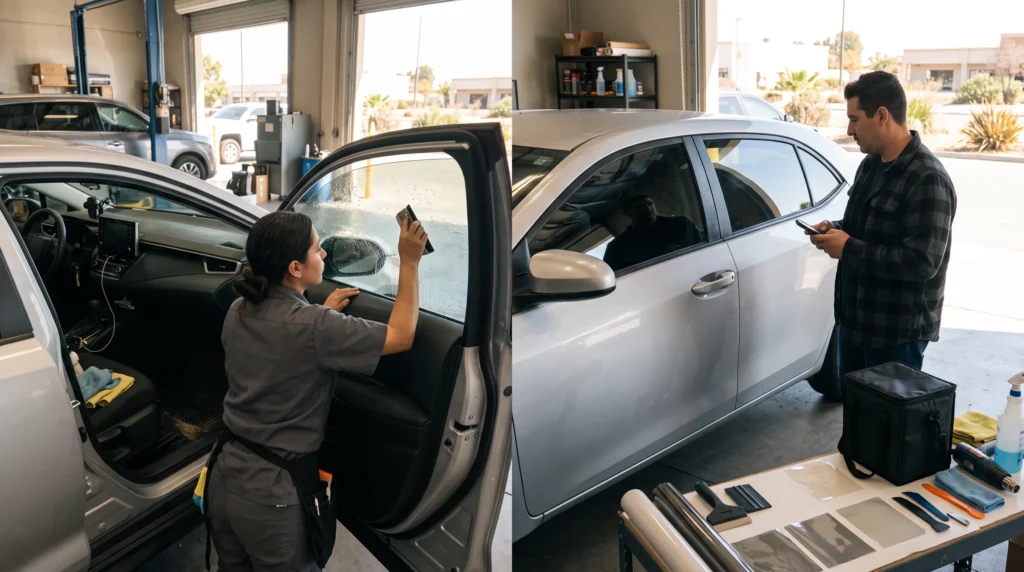
A driver who works both daytime and evening shifts needs film that makes sense under both conditions.
How Window Tint Can Help During Long Driving Shifts
Automotive window film can change several parts of the driving environment.
Depending on the film, it can reduce:
- Visible glare
- UV transmission
- Part of the solar energy entering the cabin
- Direct brightness on passengers
- Visibility into rear seating areas
It can also change the appearance of the vehicle.
For rideshare and delivery work, solar specifications may deserve more attention than simply making the windows dark.
A driver working long Bakersfield shifts may benefit from a lighter ceramic film with stronger published solar measurements rather than a very dark lower-tier film.
The right setup depends on when you drive and which windows create the most trouble.
Why Ceramic Tint Makes Sense for High-Mileage Drivers
Ceramic automotive film can be appealing for drivers who use their vehicles for work because it separates darkness from solar performance.
Rayno’s Phantom Series uses carbon and ceramic particle technology.
Rayno currently publishes separate figures for:
- Visible Light Transmission
- Total Solar Energy Rejected
- Infrared rejection
- UV rejection
- Visible Light Reflection
That lets a driver compare film by more than appearance.
A lighter ceramic shade can keep the cabin easier to see through after dark while still providing stronger IR rejection than some darker films from lower film tiers.
This can matter when your workday begins in bright afternoon sun and ends after sunset.
VLT Matters for Day and Night Driving
VLT means Visible Light Transmission.
It tells you how much visible light passes through the film.
Lower VLT means darker film.
Higher VLT means more visible light gets through.
A 5% film is extremely dark compared with a 50% film.
A rideshare or delivery driver should think about VLT in more than bright daylight.
Ask how the film will feel when:
- Looking for house numbers after sunset
- Entering dark apartment complexes
- Driving rural roads
- Checking mirrors at night
- Pulling into unlit parking lots
- Picking up passengers after dark
- Reading street signs in poorly lit areas
A dark shade may look good during the day but feel very different during a late shift.
This is one reason high-mileage drivers may prefer moderate VLT paired with a stronger ceramic film tier.
TSER and IR Rejection for Bakersfield Driving
When solar heat is one of your reasons for tinting, look at TSER and IR rejection.
TSER
TSER stands for Total Solar Energy Rejected.
It tells you how much total solar energy the tested film and glass system rejects.
Higher TSER means a larger share of total solar energy is rejected under the stated test conditions.
IR Rejection
IR rejection describes how much infrared energy the film rejects within the manufacturer’s tested wavelength range.
A high IR number can be useful, but it should not be read by itself.
Different measurements answer different questions.
Drivers comparing film for long Bakersfield shifts should look at VLT, TSER, and IR rejection together.
Does Darker Tint Mean Better Heat Rejection?
No.
This is especially useful for rideshare and delivery drivers to understand.
A film can look very dark while publishing lower IR rejection than a lighter ceramic film.
Rayno’s current Phantom specifications show this difference.
Rayno S5-05 is listed at:
- 5% VLT
- 66% TSER
- 72% IR rejection
- 99.9% UV rejection
Rayno S9-50 is listed at:
- 50% VLT
- 53% TSER
- 92% IR rejection
- 99.9% UV rejection
The S9-50 is much lighter in visible appearance, yet Rayno publishes a higher IR-rejection figure for it.
The darker S5-05 has higher TSER.
That is why a driver should not use one number as the whole decision.
Rayno S5 for Rideshare and Delivery Vehicles
Dynamic Window Tint carries Rayno Window Film for vehicle tinting in Bakersfield, CA.
Rayno Phantom S5 gives drivers several shade choices.
Rayno currently publishes:
- 53% to 72% IR rejection across listed S5 shades
- 41% to 66% TSER
- 99.9% UV rejection
- Less than 1% published fading rate
S5 may fit a driver who wants carbon ceramic film while staying lower in the Phantom lineup.
A lighter S5 film can make sense for a work vehicle that is used after dark.
A darker S5 shade may be better suited to rear glass where privacy matters more and California rules allow greater freedom.
Rayno S7 for Drivers Spending More Time on the Road
Rayno Phantom S7 publishes higher IR figures than S5 across much of the line.
Current Rayno data includes:
- 70% to 81% IR rejection
- 47% to 66% TSER
- 99.9% UV rejection
- Less than 1% published fading rate
Rayno S7-50 is listed at:
- 50% VLT
- 47% TSER
- 74% IR rejection
- 99.9% UV rejection
That may appeal to a driver who wants a lighter side-window appearance with stronger published IR performance than S5-50.
Rayno S9 for Stronger IR Rejection
Rayno Phantom S9 carries the strongest published IR figures among the current S5, S7, and S9 choices.
Rayno currently lists:
- 91% to 93% IR rejection
- 53% to 70% TSER
- 99.9% UV rejection
- Less than 1% published fading rate
S9-50 is listed at:
- 50% VLT
- 53% TSER
- 92% IR rejection
- 99.9% UV rejection
A driver spending many daytime hours on Bakersfield roads may want to compare S9 against S5 and S7 at the same VLT.
Doing that lets you compare film tiers without changing darkness at the same time.
See the current choices on the Dynamic Window Tint vehicle window tint page.
Front Side Windows Need Extra Attention
Rideshare and delivery drivers spend most of their shift beside the front side glass.
That may make those windows the first place you want film.
California rules are much tighter for front side windows than rear side glass.
California Vehicle Code Section 26708 contains a provision for clear, colorless, transparent material on front side windows when listed requirements are met.
The film itself must meet the stated light-transmission requirement, and the combined glass-and-film system must also meet applicable federal light-transmission requirements.
An installer using that provision must provide the required certification.
This means the dark shade you choose for the rear doors should not simply be copied onto the front side windows.
For a rideshare driver, staying within California requirements matters for another reason.
Uber’s current California-area vehicle pages state that window tint must be within acceptable California regulations.
Platform rules can change, so drivers should check the current requirements in their driver app as well.
Rear Window Tint for Rideshare Passengers
Rear-window film can make the cabin more comfortable for passengers sitting beside sunny glass.
That can matter on afternoon trips across Bakersfield, CA.
Rear passengers may notice:
- Direct sunlight on their face
- Bright glare
- Sunlight on phones
- Warm glass beside the seat
- Lack of daytime privacy
California gives more freedom for side windows behind the driver than it does for front side windows.
That lets rideshare drivers consider darker rear film where permitted.
Still, do not think only about passengers during daylight.
Rear-window darkness also changes your own outward view after sunset.
Choose a shade that works for the hours you actually drive.
Window Tint for Food and Package Delivery Drivers
Delivery drivers use their vehicles differently from rideshare drivers.
You may not have passengers, but you may enter and exit the car dozens of times during a shift.
You also may spend long periods with navigation running while sunlight crosses the windshield and front doors.
A delivery driver might care most about:
- Solar heat through the driver-side glass
- Phone-screen glare
- UV rejection
- Clear nighttime visibility
- Film durability
- A lighter cabin for finding packages after dark
Privacy can matter too if items are temporarily inside the vehicle.
Tint should never be treated as theft protection, though.
Do not leave high-value items visible or assume dark windows make unattended goods safe.
What About Factory Privacy Glass?
Many SUVs and crossovers used for rideshare work already have dark factory rear glass.
Factory privacy glass is not the same thing as aftermarket film.
The dark appearance may come from the glass itself.
Adding ceramic film over compatible factory privacy glass can add the properties of the chosen film.
The finished glass will also become darker.
Suppose factory glass transmits 25% of visible light and you add a 50% film.
The approximate combined VLT would be:
0.25 × 0.50 = 0.125
That is around 12.5% VLT.
For a rideshare vehicle, that may be darker than you expected.
If the rear windows already have enough privacy, ask about a lighter ceramic film rather than automatically adding a dark layer.
Can Tint Help With Phone and Navigation Glare?
Window film can reduce visible light through treated glass.
That can help when sunlight reflects across a mounted phone or dashboard display.
The phone’s location matters too.
Glare may come from:
- Driver-side glass
- Passenger-side glass
- Windshield
- Rear glass reflected in the screen
A film with lower VLT reduces more visible light than a higher-VLT film.
Do not choose an extremely dark shade solely to solve screen glare.
Changing the phone angle, mount location, or screen setting can also help.
The goal is to reduce glare without harming outward visibility.
Will Ceramic Film Affect GPS or Cell Signals?
Rayno describes its Phantom films as dye-free and metal-free.
That can appeal to rideshare and delivery drivers who depend heavily on wireless connections.
A work shift may rely on:
- GPS navigation
- Cellular data
- Bluetooth
- App notifications
- Rider calls
- Delivery updates
- Mobile payment features
Ask what exact film is being installed.
Do not assume every tint sold as “premium” or “ceramic” has the same construction.
Knowing the manufacturer and film series makes it easier to check what you are buying.
Windshield Tint and Rideshare Trade Dress
Rideshare drivers should think about windshield film and platform signage together.
Uber’s current California regulatory training says TNC drivers must display Uber trade dress in two locations while online:
- Front windshield on the passenger side
- Rear windshield on the passenger side
That means a rideshare driver’s windshield is doing several jobs.
It provides driver visibility, contains platform identification, and may also house cameras or sensors in newer vehicles.
California law also restricts material on the windshield.
Do not install a full-windshield film simply because it looks nearly clear without checking current California rules.
If you are an Uber, Lyft, or other platform driver, also confirm that required decals remain clearly visible after any glass work.
California Tint Rules for Rideshare Drivers
Rideshare drivers do not receive a separate exemption from California window-tint rules merely because the vehicle is used for work.
California Vehicle Code Section 26708 applies to windshield and window material.
The rules differ based on glass position.
Front Side Glass
Much more restricted.
Rear Side Glass
Broader allowances apply to glass behind the driver.
Rear Window
Separate exceptions apply when the vehicle has qualifying outside mirrors.
Windshield
Windshield material has its own limits and exceptions.
Review our California window tint laws guide for Bakersfield drivers when choosing shades.
Rideshare drivers should also check their current platform requirements.
Uber’s California vehicle information says window tint must remain within accepted California regulations.
Think About Night Driving Before Choosing a Shade
A rideshare or delivery vehicle can spend half its working life after sunset.
That changes the tint decision.
Imagine choosing very dark rear and side glass because it feels comfortable at 2 PM.
Now imagine using that same vehicle at 11 PM while:
- Looking for apartment numbers
- Checking mirrors
- Entering an unlit driveway
- Picking up a passenger
- Backing through a dark parking lot
The same shade may feel very different.
This is where lighter ceramic film can make sense.
You can keep more visible light while still choosing a film tier with published IR and TSER measurements.
Think about the entire shift, not only Bakersfield afternoon sun.
What High-Mileage Drivers Should Ask a Tint Shop
Drivers using their cars for work should ask a few questions before booking.
What Film Brand and Series Are You Installing?
Get the exact product name.
Dynamic Window Tint carries Rayno Window Film.
What VLT Are You Recommending?
Ask about the finished appearance and night visibility.
What Is the TSER?
Check the manufacturer’s published total solar energy rejection.
What Is the IR Rejection?
Ask for the film’s published figure.
What Is the UV Rejection?
Rayno Phantom S5, S7, and S9 currently list 99.9% UV rejection.
Is the Film Metal-Free?
This can matter to drivers relying on GPS, mobile data, and other wireless connections throughout the shift.
How Does Factory Privacy Glass Change the Result?
Do not pick rear film before considering existing glass darkness.
Does the Setup Follow California Rules?
Pay close attention to the front side windows and windshield.
What Warranty Applies?
A high-mileage work vehicle sees a lot of sun and window use.
Ask what the manufacturer covers and what the installer covers.
Can Required Rideshare Decals Remain Visible?
If your platform requires windshield identification, keep the placement clear and readable.
Window Tint for Rideshare and Delivery Drivers in Bakersfield CA
Window tint for rideshare & delivery drivers in Bakersfield should be chosen around working hours rather than appearance alone.
A high-mileage driver may spend far more time beside sunny glass than someone who only uses the car for commuting.
That makes it worth comparing:
- VLT
- TSER
- IR rejection
- UV rejection
- Factory privacy glass
- Daytime glare
- Night visibility
- California tint rules
- Platform requirements
- Film warranty
Rayno S5, S7, and S9 give drivers several levels of ceramic film to compare.
A rideshare driver may prefer stronger rear privacy for passengers while keeping the front side glass within California requirements.
A delivery driver may prefer lighter ceramic film because much of the shift takes place after dark.
A driver working long daytime hours may put more weight on TSER and IR rejection.
Dynamic Window Tint provides vehicle window tint in Bakersfield, CA using Rayno Window Film.
The shop is located at:
4609 New Horizon Blvd Suite #10 Bakersfield, CA 93313
Dynamic Window Tint works with cars, SUVs, crossovers, trucks, hybrids, electric vehicles, and other vehicles used for rideshare and delivery work.
The shop serves Bakersfield, CA and nearby communities including Rosedale, CA, Oildale, CA, Greenacres, CA, Shafter, CA, Lamont, CA, Arvin, CA, Wasco, CA, and surrounding Kern County areas.
When you schedule your appointment, mention that you use the vehicle for rideshare or delivery work.
Tell the shop:
- Which hours you normally drive
- Whether you drive after dark
- Whether rear passenger privacy matters
- Whether the vehicle has factory privacy glass
- Whether solar heat or glare is your bigger concern
- Which platform decals need to remain visible
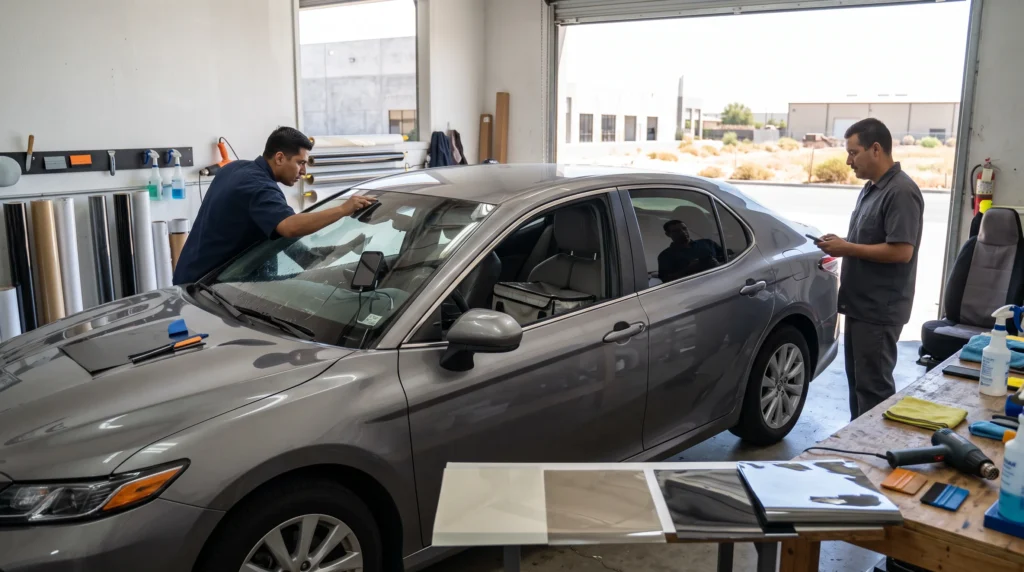
Call (661) 634-5585 or visit the Dynamic Window Tint contact page to schedule an appointment.
FAQs About Tint for Rideshare and Delivery Drivers
1. Is ceramic tint good for rideshare drivers?
Ceramic tint can be a useful choice for rideshare drivers because it lets you compare solar performance separately from darkness. Rayno Phantom film publishes VLT, TSER, IR rejection, and UV rejection across several shade levels.
2. Does a rideshare vehicle need very dark tint to stay cooler?
No. A lighter ceramic film can publish strong IR rejection. Rayno S9-50, for example, is listed at 50% VLT with 92% IR rejection and 53% TSER. Darkness and solar performance should be compared separately.
3. Can Uber or Lyft drivers have tinted windows in California?
Tint still needs to follow California law. Uber’s current California vehicle information states that window tinting must be within acceptable California regulations. Drivers should also check current platform and local requirements because those rules can change.
4. Is dark rear tint good for rideshare passengers?
Darker rear film can add daytime privacy and reduce visible brightness. It can also reduce outward visibility after dark. Rideshare drivers who work nights should consider how the finished VLT affects their own view.
5. Does ceramic tint interfere with GPS or rideshare apps?
Rayno describes its Phantom Series as metal-free. Non-metallic film avoids the metal content associated with some signal concerns. Ask for the exact film construction before installation.
6. Can delivery drivers tint over factory privacy glass?
In many vehicles, compatible aftermarket film can be installed over factory privacy glass. The finished window becomes darker, so ask about combined VLT before choosing another dark rear film.
7. Where can rideshare and delivery drivers get window tint in Bakersfield, CA?
Dynamic Window Tint installs Rayno automotive film at 4609 New Horizon Blvd Suite #10, Bakersfield, CA 93313. Call (661) 634-5585 or visit the contact page to compare film for daytime driving, nighttime visibility, passenger privacy, and solar control.
Sources
- Rayno Phantom Series
Publisher: Rayno Window Film
Publication Date: Not listed
Information referenced: Phantom S5, S7, and S9 VLT, TSER, IR rejection, UV rejection, reflection, fading rate, and carbon ceramic construction. - California Vehicle Code Section 26708
Publisher: California Legislative Information
Publication Date: Current California Vehicle Code
Information referenced: Windshield and side-window material restrictions, rear-window exceptions, front side window requirements, and driver visibility. - California Regulatory Rules and Requirements
Publisher: Uber
Publication Date: January 14, 2025
Information referenced: California TNC driver requirements, vehicle inspections, front and rear windshield trade dress, driver training, and vehicle safety. - Uber Vehicle Requirements
Publisher: Uber
Publication Date: Current online guidance
Information referenced: Vehicle condition, working windows, air conditioning, registration, insurance, and general vehicle requirements. California-area Uber pages also state that tint must meet California regulations. - California Driver Information
Publisher: Lyft
Publication Date: Current online guidance
Information referenced: California driver, vehicle, document, and state requirement information. - Window Tint in Bakersfield, CA
Publisher: Dynamic Window Tint
Publication Date: Not listed
Information referenced: Rayno automotive window film, vehicle tint services, certified installation, and warranty-backed work. - California Window Tint Laws: What Bakersfield Drivers Need to Know
Publisher: Dynamic Window Tint
Publication Date: Not listed
Information referenced: California tint rules for Bakersfield drivers, front and rear window considerations, and windshield restrictions. - Contact Dynamic Window Tint
Publisher: Dynamic Window Tint
Publication Date: Not listed
Information referenced: Bakersfield address, phone number, and appointment information.
