

Window tint medical exemptions in California do not give drivers blanket permission to install any shade they want on the windshield or front side windows. California law creates specific medical pathways, and each one has its own rules for the material, medical documentation, light transmission, placement, and use.
That distinction matters because California actually addresses two different situations.
One involves removable sun screening devices on the front side windows for a driver or front-seat passenger who needs shade because of a medical or visual condition.
The other allows qualifying clear, colorless, transparent film on the windshield, side windows, or rear windows when a licensed dermatologist certifies that a medical condition calls for protection from ultraviolet rays.
These are not interchangeable rules.
A doctor’s note does not automatically make dark front-window tint legal. A medical exemption also does not mean a driver can choose 5%, 20%, or 35% permanent film for the front viewing area.
Dynamic Window Tint provides vehicle window tint in Bakersfield, CA using Rayno Window Film. If you are considering a medical tint setup, the best place to start is with the exact California Vehicle Code language and the medical documentation that applies to your situation.
Table of Contents
- What Is a California Window Tint Medical Exemption?
- California Has Two Different Medical Tint Paths
- Medical Sun Screening Devices Under Section 26708
- Who Can Write the Medical Documentation?
- Rules for Removable Medical Sun Screens
- Can Medical Sun Screens Be Used at Night?
- The Clear Film Medical Provision
- The 88% VLT Requirement
- Why the Finished Glass Must Also Meet 70%
- Why a Dermatologist Is Required for Clear Medical Film
- Does a Medical Exemption Allow Dark Windshield Tint?
- Does a Medical Exemption Allow Dark Front Side Tint?
- What Documentation Should Stay in the Vehicle?
- What Happens if the Film Bubbles or Tears?
- Medical Tint and UV Protection
- Medical Tint Versus a Standard Windshield Strip
- What to Ask Before Installing Medical Window Film
- Schedule Window Tint in Bakersfield, CA
- Frequently Asked Questions
- Sources
What Is a California Window Tint Medical Exemption?
A California window tint medical exemption is a legal exception to the state’s normal restrictions on materials placed on certain vehicle windows.
The exemption is tied to a medical need.
California Vehicle Code Section 26708 contains the main rules.
The law does not say that a medical condition gives a driver unlimited freedom to darken the windshield or front side windows.
Instead, it creates narrow exceptions with specific requirements.
That means a qualifying driver still needs to pay attention to:
- The type of material
- Visible light transmission
- Whether the device is removable
- Whether it can be used after dark
- Who signs the medical documentation
- Where the material is installed
- Whether the document must stay in the vehicle
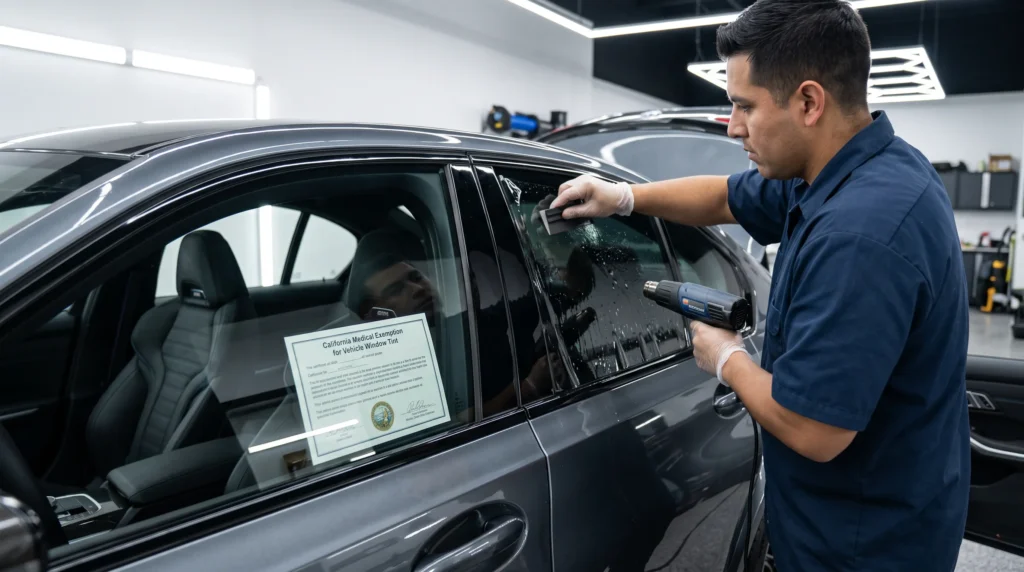
If any of those pieces are missing, the setup may not fit the medical exception.
California Has Two Different Medical Tint Paths
California’s medical rules are easier to understand when you separate them into two groups.
Path 1: Removable Sun Screening Devices
Vehicle Code Section 26708(b)(10), together with Section 26708.2, allows certain sun screening devices on the front side windows when a qualifying medical or visual condition exists.
These devices must be removable.
They also have their own color, light-transmission, open-area, and reflectivity rules.
Path 2: Clear, Colorless, Transparent Film
Vehicle Code Section 26708(e) allows qualifying clear, colorless, transparent material on the windshield, side windows, or rear windows when the stated medical and film conditions are met.
This path requires documentation from a licensed dermatologist.
The film must also meet an 88% VLT requirement, and the finished glazing must satisfy the federal standard referenced by California.
The real question is which pathway fits the medical need and the material being used.
Medical Sun Screening Devices Under Section 26708
California Vehicle Code Section 26708(b)(10) addresses sun screening devices on the side windows on either side of the vehicle’s front seat.
The driver or front-seat passenger must have medical documentation showing that the person needs to be shaded from the sun.
This part of the law can apply when:
- A driver has a medical condition that requires shade from sunlight
- A front-seat passenger has a qualifying medical condition
- A person has a visual condition requiring shade
The device itself then has to meet Section 26708.2.
This is not the same as applying a permanent dark automotive tint film to the glass.
California describes devices that can be readily removed.
Who Can Write the Medical Documentation?
The answer depends on the type of condition.
For removable sun screening devices under Section 26708(b)(10):
- A licensed physician and surgeon can certify that the person must be shaded from the sun because of a medical condition.
- A licensed optometrist can certify that the person must be shaded from the sun because of a visual condition.
The driver or front-seat passenger must have the signed letter or other document in their possession.
For the separate clear-film medical provision under Section 26708(e), the law specifically calls for a certificate signed by a licensed dermatologist.
That dermatologist must certify that the person should not be exposed to ultraviolet rays because of a medical condition that calls for clear, colorless, transparent film on the vehicle glass.
This difference is easy to miss.
A letter from one type of medical provider may fit one medical pathway but not the other.
Rules for Removable Medical Sun Screens
California Vehicle Code Section 26708.2 sets the requirements for removable medical sun screening devices.
The device must be held in place in a way that allows it to be readily removed from the window area.
The law gives examples such as:
- A frame
- Rigid material with temporary fasteners
- A flexible roller shade
If the device uses transparent material, California says it must be:
- Green
- Gray
- Neutral smoke
The transparent material must also have a luminous transmittance of at least 35%.
That means a highly darkened transparent sun screen below that threshold would not meet this part of the rule.
The law also places a reflectivity limit on the device.
Reflectivity cannot exceed 35% on either the inner or outer surface.
Can Medical Sun Screens Be Used at Night?
No.
California Vehicle Code Section 26708(b)(10) says the authorized sun screening devices cannot be used during darkness.
That is one of the clearest limits in the medical sun-screening rule.
A driver may qualify medically and still need to remove or retract the device after dark.
This requirement makes sense when you consider that the device can reduce the amount of visible light entering through the front side window.
For Bakersfield, CA drivers who travel before sunrise or return home after sunset, this means the removable medical device cannot simply remain in place around the clock.
The Clear Film Medical Provision
California Vehicle Code Section 26708(e) is different.
It addresses clear, colorless, transparent material placed on the windshield, side windows, or rear windows.
This provision is built around UV protection rather than a dark sun shade.
To qualify, several conditions must be met.
The material must:
- Have at least 88% Visible Light Transmission
- Be clear, colorless, and transparent
- Be made to help the existing glass block UVA radiation
The finished window glazing must also meet the Federal Motor Vehicle Safety Standard referenced by California.
The driver must keep the required dermatologist certificate in their possession or inside the vehicle.
This is the California rule most people are referring to when they talk about medically necessary clear windshield film.
The 88% VLT Requirement
VLT means Visible Light Transmission.
A higher VLT number means more visible light passes through.
California requires the medical clear film itself to have a minimum VLT of 88%.
That is a very light film.
It is nothing like a common 20%, 15%, or 5% privacy tint.
This rule is one reason the phrase “medical tint exemption” can be misleading when people use it online.
The medical provision does not say a qualifying patient can choose any darkness.
The material itself has to meet the 88% requirement.
If a product is listed at 70% VLT, that is below the 88% film threshold written into Section 26708(e).
Why the Finished Glass Must Also Meet 70%
California’s medical clear-film provision has another light-transmission condition.
The window glazing with the film applied must meet Federal Motor Vehicle Safety Standard No. 205, including the specified minimum light transmission of 70%.
That gives you two separate numbers to understand:
- The film itself must have at least 88% VLT.
- The completed glass-and-film combination must meet the referenced 70% minimum.
These are not the same test.
Factory automotive glass already reduces some light before any aftermarket film is applied.
That is why the finished glazing matters.
An installer should not look only at the percentage printed on the film box.
The existing window and film work together.
Why a Dermatologist Is Required for Clear Medical Film
Section 26708(e) specifically calls for a certificate signed by a licensed dermatologist.
The dermatologist must certify that the person should not be exposed to ultraviolet rays because of a medical condition that calls for clear, colorless, transparent film on the windshield, side windows, or rear windows.
This requirement is more specific than the removable sun-screening provision.
For the removable device pathway, a physician and surgeon or optometrist may provide the documentation depending on the condition.
For the clear UV-film pathway, the statute names a dermatologist.
Drivers should not assume that a general doctor’s note automatically satisfies every California medical tint provision.
Does a Medical Exemption Allow Dark Windshield Tint?
No blanket exemption allows a driver to install any dark shade across the entire windshield.
The clear medical-film provision requires:
- Clear material
- Colorless material
- Transparent material
- At least 88% VLT
- A qualifying finished glazing result
- Dermatologist certification
That is very different from installing dark ceramic tint across the windshield.
California separately allows transparent material on the topmost portion of the windshield when the requirements in Section 26708(c) are met.
That upper-strip rule is available without the medical clear-film pathway when its own conditions are satisfied.
For window tint medical exemptions in California, do not confuse a legal upper windshield strip with medically permitted clear film across the windshield.
Does a Medical Exemption Allow Dark Front Side Tint?
The removable medical sun-screening pathway can permit qualifying devices on the front side windows, but the devices must meet Section 26708.2.
Transparent devices need at least 35% luminous transmittance and must use one of the allowed colors.
They also need to be readily removable and cannot be used during darkness.
The separate clear-film medical pathway requires film with at least 88% VLT.
Neither provision is a general license to apply permanent 5%, 15%, or 20% automotive tint to the front windows.
This is why California medical tint rules should be read carefully before film is selected.
What Documentation Should Stay in the Vehicle?
The required medical documentation should stay with the driver or inside the vehicle.
For removable medical sun screening devices, Section 26708 says the driver or qualifying front-seat passenger must have the signed physician, surgeon, or optometrist letter or other document in their possession.
For the clear-film medical provision, the driver must have the dermatologist certificate in their possession or within the vehicle.
A good practice is to keep the document somewhere accessible inside the car rather than storing it at home.
Keep the original or a copy as permitted by the provider and maintain any related tint paperwork from the installer.
You may also want to keep:
- Film manufacturer information
- Film VLT specification
- Installation invoice
- Installer information
- Product warranty documents
Those records can help identify what film was installed.
What Happens if the Film Bubbles or Tears?
California addresses worn medical clear film directly.
Section 26708(e) says that if the material tears, bubbles, or becomes worn in a way that prevents clear vision, it must be removed or replaced.
That is especially relevant because the windshield and front windows are part of the driver’s main viewing area.
Do not keep driving indefinitely with medical film that has become hazy, badly bubbled, torn, or distorted.
Have the film inspected.
Dynamic Window Tint carries warranties on its products and services, and Rayno publishes warranty terms for qualifying automotive films.
If your film develops a problem, contact the installer rather than trying to peel or scrape the material yourself.
Medical Tint and UV Protection
The clear-film medical provision is closely tied to UV protection.
California says the material must be designed and manufactured to help the existing glass block harmful ultraviolet A rays.
That is why the law requires clear, high-VLT material rather than dark privacy tint.
A driver with a medical need may want UV protection without reducing outward visibility much.
Modern window films can have strong UV-rejection properties even when they appear very light.
Dynamic Window Tint carries Rayno Window Film, and Rayno publishes UV-rejection specifications across several automotive film families.
If you are selecting film for a medical reason, the film still needs to satisfy California’s specific requirements.
A high UV-rejection number alone is not enough if the film falls below the required VLT threshold.
Medical Tint Versus a Standard Windshield Strip
A medical clear-film installation and a standard windshield strip serve different legal purposes.
California Vehicle Code Section 26708(c) permits transparent material on the topmost part of the windshield when:
- The bottom edge meets the state’s 29-inch seat-based measurement
- The material is not red or amber
- It does not contain prohibited opaque lettering
- It does not create excess reflected glare
That rule does not require medical documentation.
The medical clear-film provision, by contrast, can apply to the windshield, side windows, or rear windows when the UV-related medical conditions are met.
For someone who mainly wants help with high-angle sunlight near the top of the windshield, a legal strip may be the relevant rule.
For someone with a medical need tied to UV exposure, Section 26708(e) may be the rule to discuss.
What to Ask Before Installing Medical Window Film
Before scheduling medical window tint, gather the information first.
Ask your medical provider which legal pathway applies to your condition.
Then ask the tint shop:
- Does this film meet the required VLT?
- Is the film clear, colorless, and transparent?
- What is the published UV-rejection figure?
- What will the completed glass VLT be?
- Does the finished glazing meet the California requirement?
- Which windows can receive the film?
- What warranty comes with the product?
- What paperwork will I receive?
If you are considering a removable medical sun-screening device rather than film, ask whether the product meets Section 26708.2.
That includes:
- Ready removal
- Allowed color
- At least 35% luminous transmittance for transparent material
- No more than 35% reflectivity
- No use during darkness
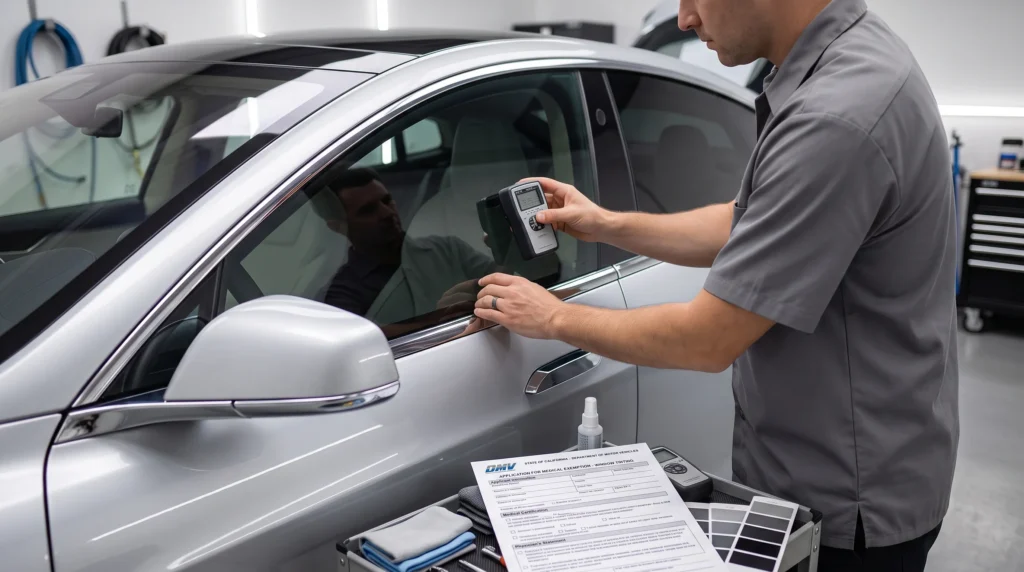
The safest approach is to match the medical documentation, material, and installation to the same section of California law.
Schedule Window Tint in Bakersfield, CA
Window tint medical exemptions in California are narrower than many drivers expect.
California provides one pathway for removable front side-window sun screening devices when a physician, surgeon, or optometrist provides the required documentation.
It provides another pathway for clear, colorless, transparent UV film when a licensed dermatologist certifies the medical need.
The requirements are not the same.
For clear medical film, the material must have at least 88% VLT, and the completed glazing must satisfy the referenced federal standard, including at least 70% light transmission.
For removable medical sun screens, the device needs to follow Section 26708.2 and cannot be used during darkness.
Dynamic Window Tint provides window tint in Bakersfield, CA and carries Rayno Window Film.
Dynamic Window Tint is located at:
4609 New Horizon Blvd Suite #10 Bakersfield, CA 93313
Call (661) 634-5585 to discuss your vehicle and the film specifications you need.
You can also visit the Dynamic Window Tint contact page to schedule an appointment.
Dynamic Window Tint serves Bakersfield, CA and nearby communities including Rosedale, CA, Oildale, CA, Shafter, CA, Wasco, CA, Lamont, CA, Arvin, CA, Greenacres, CA, and other Kern County areas.
If your request involves a medical exemption, tell the shop before installation.
Bring the medical documentation that applies to your situation and ask the installer to review the film specifications with you.
Call (661) 634-5585 or use the contact form for information based on your vehicle and requested film.
Frequently Asked Questions
1. Can I get a medical exemption for window tint in California?
California has medical exceptions for certain sun screening devices and qualifying clear, colorless, transparent film. The requirements depend on which provision you use. A medical condition does not provide unlimited permission for dark windshield or front-window tint.
2. What doctor can write a California window tint medical exemption?
For removable front side-window sun screening devices, California allows documentation from a licensed physician and surgeon for a medical condition or a licensed optometrist for a visual condition. For the separate clear UV-film provision, the statute calls for certification from a licensed dermatologist.
3. How dark can medical window tint be in California?
The clear-film medical provision requires the film itself to have at least 88% Visible Light Transmission. The finished glass-and-film system must also meet the referenced federal minimum of 70%. The removable sun-screening provision has separate rules, including at least 35% luminous transmittance for transparent devices.
4. Can I tint my entire windshield with a medical exemption?
California’s clear-film medical provision can apply to the windshield when every stated condition is met, including clear, colorless, transparent material, at least 88% VLT, qualifying finished glazing, UVA-blocking design, and dermatologist certification. It does not allow unrestricted dark windshield tint.
5. Can I use a medical sun screen at night?
No. California Vehicle Code Section 26708 says medical sun screening devices authorized under the removable-device provision cannot be used during darkness.
6. Do I need to carry my medical tint paperwork in the car?
Yes. The applicable California provisions require the medical document to be in the driver’s possession or within the vehicle, depending on the exemption being used. Keeping the documentation accessible in the vehicle is a sensible practice.
7. Where can I ask about medical window film in Bakersfield, CA?
Dynamic Window Tint provides automotive window tint at 4609 New Horizon Blvd Suite #10, Bakersfield, CA 93313. Call (661) 634-5585 or use the contact page. Bring the applicable medical documentation and ask the team to discuss film VLT, UV performance, and California requirements before installation.
Sources
California Vehicle Code Section 26708
Publisher: State of California law reproduced by Justia
Publication Date: Amended by Stats. 2025, Ch. 417, Sec. 5, effective January 1, 2026
Information referenced: Medical sun-screening exception, physician and optometrist documentation, nighttime restriction, clear medical film, 88% VLT requirement, 70% finished-glazing requirement, dermatologist certification, UVA requirement, and worn-film replacement requirement.
California Vehicle Code Section 26708.2
Publisher: State of California law reproduced by Justia
Publication Date: Current code
Information referenced: Removable medical sun-screen device requirements, allowed transparent colors, 35% luminous-transmittance requirement, open-area rules for nontransparent devices, and 35% reflectivity limit.
California Highway Patrol HPH 82.7, Chapter 5
Publisher: California Highway Patrol
Publication Date: Current CHP-hosted manual
Information referenced: Medical sun-screening devices, physician and optometrist documentation, nighttime restriction, removable-device requirements, allowed colors, and luminous-transmittance limits.
Window Tint in Bakersfield, CA
Publisher: Dynamic Window Tint
Publication Date: Not listed
Accessed: August 28, 2026
Information referenced: Automotive window tint service, Rayno Window Film, warranty-backed work, Bakersfield location, service areas, and contact information.
Dynamic Window Tint Contact Page
Publisher: Dynamic Window Tint
Publication Date: Not listed
Accessed: August 28, 2026
Information referenced: Appointment and quote request path.
