

Window tint for classic cars can help Bakersfield, CA owners reduce UV exposure, solar heat, and glare reaching vintage upholstery, dashboards, door panels, carpets, and trim. That matters when an older vehicle still has original materials that cannot simply be replaced with parts from a dealership.
A classic car also calls for a different tint conversation than a late-model commuter.
You may want solar protection without changing the period-correct appearance. Your vehicle may have clear glass, vent windows, quarter glass, curved rear glass, old seals, or glass that has survived for decades. Some owners want nearly clear ceramic film. Others want a mild charcoal shade that looks natural on the car.
The goal is not to turn every classic into a dark-tinted modern vehicle.
The goal is to decide how much sunlight you want to manage while respecting the car’s glass, interior, appearance, and California window-film rules.
For collectors and weekend drivers in Bakersfield, CA, Rosedale, CA, Oildale, CA, and nearby Kern County communities, that balance can make window film worth considering.
Table of Contents
- Why Window Tint for Classic Cars Deserves a Different Approach
- How Valley Sun Affects Vintage Interiors
- Why UV Is Only Part of Interior Fading
- Can Window Film Help Protect a Classic Car Interior?
- Does Classic Car Tint Need to Look Dark?
- Why Lighter Ceramic Tint Can Fit a Vintage Car
- Rayno S5 for Classic Cars
- Rayno S7 for Vintage Vehicles
- Rayno S9 for Stronger IR Rejection
- What VLT Means on a Classic Car
- Why TSER Matters for Vintage Interiors
- Original Glass Needs Care Before Tinting
- Vent Windows Quarter Glass and Curved Rear Glass
- What About Old Window Seals and Felt Channels?
- Can Tint Be Removed Later?
- California Tint Rules for Classic Cars
- Which Classic Cars Benefit Most From Window Film?
- Questions to Ask Before Tinting a Vintage Vehicle
- Classic Car Window Tint in Bakersfield CA
- FAQs About Window Tint for Classic Cars
Why Window Tint for Classic Cars Deserves a Different Approach
Window tint for classic cars should start with the vehicle rather than the shade chart.
An older car may have glass and interior materials that have already survived decades of use.
That can include:
- Original vinyl seats
- Cloth inserts
- Leather upholstery
- Painted dashboards
- Wood trim
- Plastic gauge surrounds
- Original carpeting
- Headliners
- Door cards
- Package trays
- Steering wheels
- Vintage gauges
Some of those parts are easy to replace.
Others are rare, restored, reproduction-only, or no longer made.
The glass may also differ from modern vehicles.
A 1960s coupe can have small vent windows and curved rear glass. A 1970s sedan may have large clear side windows. A vintage pickup may use flat side glass but old rubber seals and felt channels.
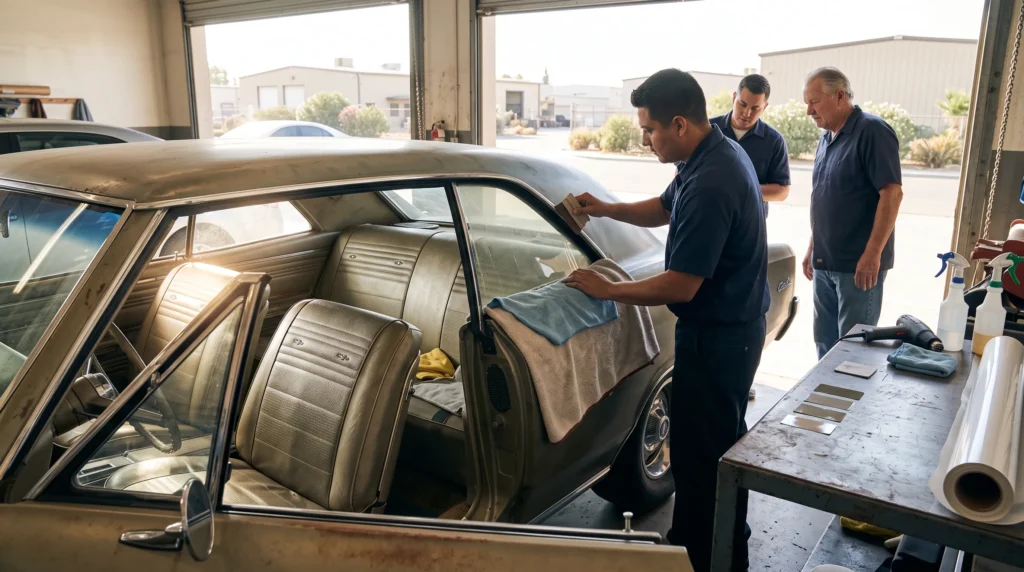
Film needs to fit that particular vehicle.
How Valley Sun Affects Vintage Interiors
Sunlight contains ultraviolet radiation, visible light, and infrared energy.
All three can matter inside an older vehicle.
The Library of Congress explains that UV and infrared radiation can contribute to deterioration of collection materials. It also notes that visible light can cause damage even when UV and IR have been reduced.
A classic-car interior is not a museum display, but the same general light-damage principle helps explain why sunlight can affect old materials over time.
An original dashboard that has spent decades near a windshield may already show:
- Fading
- Dryness
- Cracking
- Uneven color
- Brittle surfaces
Seats and carpets may show lighter areas where direct sunlight repeatedly lands.
A car parked outdoors in Bakersfield, CA may receive many hours of strong sunlight, and the glass allows some of that solar energy into the cabin.
Window film can reduce selected parts of that incoming energy.
Why UV Is Only Part of Interior Fading
It is tempting to say UV causes all fading.
That would be too simple.
UV contributes to material deterioration, but visible light and heat also play roles.
The Library of Congress notes that visible light remains capable of damaging light-sensitive materials even after UV and infrared energy have been reduced.
Material aging can also depend on:
- Dye type
- Fabric construction
- Leather finish
- Vinyl composition
- Existing age
- Previous sun exposure
- Cabin temperature
- Cleaning products
- Moisture
- Storage conditions
Window film cannot stop aging.
It can reduce selected forms of solar exposure through treated glass.
That distinction matters when you are caring for an original interior.
Can Window Film Help Protect a Classic Car Interior?
Yes, suitable automotive window film can reduce UV transmission and part of the solar energy entering through treated glass.
Rayno currently lists 99.9% UV rejection across the Phantom S5, S7, and S9 automotive lines.
Those films also publish IR rejection and Total Solar Energy Rejected figures.
This gives classic-car owners several measurements to compare.
If preservation is your main concern, look at:
- UV rejection
- IR rejection
- TSER
- VLT
- Film color
- Interior reflection
- Exterior reflection
Do not make the choice from darkness alone.
A lighter ceramic film may fit a restored vehicle better than dark tint while still carrying strong published solar specifications.
Does Classic Car Tint Need to Look Dark?
No.
Many classic-car owners do not want dark windows.
A blacked-out look may fit some restomod builds, but it can clash with a stock restoration.
A lighter film can keep the glass looking closer to the period appearance.
This is useful on cars where the clear greenhouse is part of the design.
Think about cars from eras when:
- Windshields were more upright
- Pillars were thin
- Side glass was large
- Vent windows were common
- Interiors were meant to be visible through the glass
A mild film shade can reduce part of the solar load without dramatically changing that look.
Why Lighter Ceramic Tint Can Fit a Vintage Car
Ceramic film separates solar performance from darkness better than choosing tint by appearance alone.
Rayno Phantom S9-50, for example, is listed at 50% VLT with 92% IR rejection and 53% TSER.
That means about half of visible light transmission remains while the film still carries strong published infrared performance.
A 50% film will look much lighter than a 5%, 15%, or 20% film.
For a vintage car, that may matter.
You may want:
- A lighter cabin appearance
- Better outward visibility at night
- A more original exterior look
- Less obvious tint
- Strong UV rejection
- Reduced solar heat
That is why classic-car owners should compare film technology before assuming dark glass is required.
Rayno S5 for Classic Cars
Dynamic Window Tint carries Rayno Window Film for automotive tint installations.
Rayno Phantom S5 uses carbon ceramic technology and comes in several VLT levels.
Current Rayno specifications list:
- 99.9% UV rejection
- Less than 1% published fading rate
- IR rejection from 53% to 72% across listed shades
- TSER from 41% to 66% across listed shades
A lighter S5 shade can suit an owner who wants ceramic film without dramatically darkening the glass.
Rayno lists S5-50 at:
- 50% VLT
- 56% IR rejection
- 41% TSER
- 99.9% UV rejection
That can give a vintage-car owner a lighter-looking film to compare.
Rayno S7 for Vintage Vehicles
Rayno Phantom S7 provides another ceramic level.
Current Rayno specifications list:
- 99.9% UV rejection
- Less than 1% published fading rate
- 70% to 81% IR rejection
- 47% to 66% TSER
Rayno lists S7-50 at:
- 50% VLT
- 74% IR rejection
- 47% TSER
- 99.9% UV rejection
This can make S7 worth comparing when you want to keep a lighter appearance while adding stronger published infrared rejection than S5-50.
A darker S7 shade is also available if the vehicle’s style and your privacy goals call for it.
Rayno S9 for Stronger IR Rejection
Rayno Phantom S9 carries stronger published IR figures across its current shade range.
Current Rayno data lists:
- 91% to 93% IR rejection
- 53% to 70% TSER
- 99.9% UV rejection
- Less than 1% published fading rate
S9-50 is listed at:
- 50% VLT
- 92% IR rejection
- 53% TSER
- 99.9% UV rejection
For a collector who wants lighter glass with strong published IR performance, that combination may be worth comparing.
The darkest film is still not automatically the right film.
Consider the car’s appearance and how you use it.
What VLT Means on a Classic Car
VLT means Visible Light Transmission.
A 50% film allows more visible light through than a 20% film.
A 20% film allows more than a 5% film.
Lower VLT normally creates a darker appearance.
Classic cars often look very different with dark tint because many were designed before dark factory privacy glass became common on passenger vehicles.
Before choosing VLT, ask yourself:
- Do I want the interior visible from outside?
- Do I want a stock-looking appearance?
- Do I show the car?
- Do I use it mainly during daylight?
- Do I take it on evening cruises?
- Does it have a black interior that already looks dark?
- Does the car have large clear rear glass?
A sample held against the actual glass can tell you more than looking at film on a modern SUV.
Why TSER Matters for Vintage Interiors
TSER stands for Total Solar Energy Rejected.
It describes how much total solar energy is rejected by the tested glass-and-film system.
IR rejection is useful too, but TSER gives you another way to compare film performance.
A classic vehicle with no modern climate-control system may make this even more noticeable.
Older air-conditioning systems may not cool like a late-model vehicle.
Some classics have no air conditioning at all.
Reducing part of the solar load through treated side and rear glass may make time inside the cabin more comfortable.
It does not turn the car into a modern insulated vehicle.
It simply reduces part of the solar energy entering through those windows.
Original Glass Needs Care Before Tinting
Before applying window film to a vintage vehicle, inspect the glass.
Old automotive glass may have:
- Scratches
- Chips
- Pitting
- Hard-water marks
- Wiper scratches
- Old adhesive
- Delamination
- Edge damage
Film can make some existing glass defects easier to notice.
The installer should also determine whether the window surface can accept film.
If the glass is deeply scratched or deteriorated, replacing or repairing the glass may need discussion before tint.
Rare original glass deserves careful handling.
Tell the shop when preserving original glass matters to you.
Vent Windows Quarter Glass and Curved Rear Glass
Classic vehicles often have glass shapes rarely seen on new cars.
Vent Windows
Small triangular vent windows can require individual film pieces.
The hinges, latches, weatherstripping, and narrow glass area make this a different job from tinting a modern frameless door window.
Quarter Glass
A coupe may have fixed or movable quarter windows.
Access can be tight, especially when original trim surrounds the glass.
Curved Rear Glass
Some classics have deeply curved back glass.
Film needs to be shaped to fit the curve.
The shape of the rear window can affect how the installation is approached.
Split or Multi-Piece Glass
Some older vehicles use glass configurations that differ from modern one-piece windows.
An installer should inspect the car before deciding how the film will be cut and fitted.
What About Old Window Seals and Felt Channels?
Old rubber and felt matter.
A classic car may still have original weatherstripping or replacement seals that have been in place for years.
Door-window channels can hold:
- Dirt
- Dust
- Old rubber particles
- Felt fibers
- Grease
- Debris
That material can transfer toward the glass during installation.
Worn seals can also rub against film edges as the window moves.
If your classic has deteriorated window felts, loose seals, or glass that rattles in the channel, mention it before tinting.
Replacing badly worn window hardware before the tint appointment can sometimes make sense.
Do not assume a film installer can fix old regulators, seals, or window tracks as part of the tint job.
Can Tint Be Removed Later?
Automotive film can be removed, which may appeal to owners who do not want a permanent change to a collectible vehicle.
Removal still calls for care.
Old film can leave adhesive.
Glass with defroster lines needs extra caution.
Original rear glass may contain printed elements that should not be scraped aggressively.
If you think you may return the vehicle to clear glass later, tell the installer.
Also keep your paperwork so you know what film was installed.
California Tint Rules for Classic Cars
A classic vehicle does not automatically receive different California tint rules just because it is old.
California Vehicle Code Section 26708 controls material applied to windshields and vehicle windows.
Current California law provides exceptions for side windows behind the driver and for rear windows when qualifying outside mirrors are present.
Front side windows are much more restricted.
Section 26708 allows clear, colorless, transparent material on front side windows when several requirements are met. The film itself must have at least 88% VLT, and the glass with film must meet Federal Motor Vehicle Safety Standard No. 205, including the stated 70% light-transmittance requirement.
The installer must also supply the required certificate when using that provision.
The windshield has separate restrictions.
This matters for classic cars because an owner may prefer a uniform mild tint around the entire cabin.
The legal treatment for the front side windows may differ from what you can use behind the driver.
Review the setup before film is installed.
Which Classic Cars Benefit Most From Window Film?
Window tint for classic cars can make sense on many types of vintage vehicles.
Classic Muscle Cars
Cars with large front, side, and rear glass can expose dashboards, seats, and package trays to direct sun.
A lighter ceramic tint can help manage solar exposure without hiding the interior.
Vintage Trucks
Older pickups often have upright glass and cabins with little space between the occupants and windows.
A suitable film can reduce glare and solar exposure through treated glass.
Classic Luxury Cars
Vintage luxury vehicles may have leather, wood, cloth, or soft-touch materials that owners want to preserve.
Keeping a lighter film appearance may also fit the car’s styling.
Restomods
Restomods give owners more freedom with appearance.
A darker ceramic film may fit a car with modern wheels, upgraded air conditioning, fuel injection, and other newer equipment.
Survivor Cars
A survivor with original paint and interior may call for a more restrained approach.
A lighter film may fit the preservation goal better.
Weekend Cruisers
A car that comes out mainly for sunny weekend trips can still receive plenty of direct sunlight during the hours it is on the road.
Questions to Ask Before Tinting a Vintage Vehicle
Before scheduling window tint for classic cars, ask the shop about the vehicle rather than only asking for a shade.
Have You Looked at the Glass?
The installer should know whether the car has vent windows, curved glass, worn seals, or damage.
What Film Series Will Be Used?
Ask for the manufacturer and exact film.
Dynamic Window Tint carries Rayno Window Film.
What VLT Fits the Look I Want?
Tell the shop whether the car is restored, original, modified, or shown at events.
What Are the UV and IR Figures?
If interior preservation and solar comfort matter, compare the published data.
What Is the TSER?
Use TSER alongside the IR figure.
Can I Keep a Light Appearance?
Ask to compare higher-VLT ceramic products.
Are My Front Windows Legal With This Film?
California treats the front side windows differently from the rear glass.
Does the Old Glass Need Work First?
Mention scratches, chips, old film, failing seals, or hard-water marks.
What Warranty Comes With the Film?
Dynamic Window Tint provides warranty-backed products and services.
Classic Car Window Tint in Bakersfield CA
Window tint for classic cars can help reduce UV exposure, glare, and solar energy reaching vintage interiors without forcing every owner into a dark modern tint appearance.
The better approach starts with the car.
Look at:
- Interior condition
- Glass condition
- Window seals
- Vent windows
- Quarter glass
- Rear-glass shape
- Desired VLT
- UV rejection
- IR rejection
- TSER
- California law
- Nighttime visibility
- The look you want to preserve
For many vintage vehicles, lighter ceramic film can be worth comparing because it keeps more visible light while still offering published solar-control figures.
Dynamic Window Tint provides vehicle window tint in Bakersfield, CA using Rayno Window Film.
The shop is located at:
4609 New Horizon Blvd Suite #10 Bakersfield, CA 93313
Dynamic Window Tint works with cars, trucks, SUVs, weekend vehicles, collector cars, and other automotive glass.
The shop serves Bakersfield, CA and nearby communities including Rosedale, CA, Oildale, CA, Greenacres, CA, Shafter, CA, Lamont, CA, Arvin, CA, Wasco, CA, and other Kern County areas.
If you own a restored coupe, vintage pickup, muscle car, survivor, or restomod, tell the shop what matters most to you before choosing the film.
Maybe you want the interior to stay visible.
Maybe you want less afternoon heat.
Maybe protecting old upholstery matters more than privacy.
Maybe you want a darker restomod appearance.
Those answers help narrow the film choice.
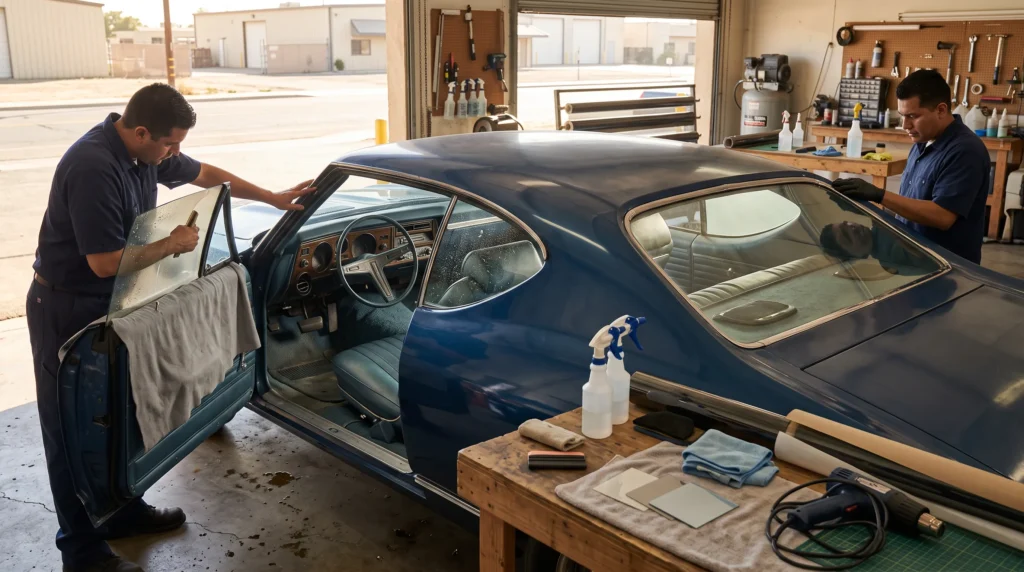
Call (661) 634-5585 or visit the Dynamic Window Tint contact page to schedule an appointment.
FAQs About Window Tint for Classic Cars
1. Is window tint safe for classic-car glass?
It can be installed on many classic vehicles, but the glass should be inspected first. Old glass may have scratches, chips, delamination, worn seals, or other conditions that affect the job. Tell the installer if the glass is original or difficult to replace.
2. Can I tint a classic car without making it look modern?
Yes. Higher-VLT ceramic film can keep more visible light and create a much lighter appearance than dark privacy tint. Rayno offers 50% VLT Phantom films that classic-car owners can compare when they want a restrained look.
3. Does classic-car window tint help protect vintage upholstery?
Automotive film can reduce UV transmission and part of the solar energy entering through treated windows. Rayno currently lists 99.9% UV rejection across Phantom S5, S7, and S9. UV is not the only cause of fading, so film cannot guarantee that old upholstery will never discolor.
4. Does darker tint protect a classic interior better?
Not automatically. Darkness is measured by VLT. UV rejection, IR rejection, and TSER are separate measurements. A lighter ceramic film can have strong solar specifications while preserving a clearer appearance.
5. Is ceramic tint good for a car with no air conditioning?
Ceramic film can reduce part of the solar energy entering through treated glass. That may help reduce how much direct solar heat reaches occupants and interior surfaces. It will not make a non-air-conditioned classic feel like a modern climate-controlled car.
6. Can window tint be removed from a collectible car later?
Yes, automotive film can be removed. Removal should be done carefully, especially on rare glass, old adhesive, or rear glass with printed defroster or antenna elements.
7. Where can I get classic-car window tint in Bakersfield, CA?
Dynamic Window Tint installs Rayno automotive film at 4609 New Horizon Blvd Suite #10, Bakersfield, CA 93313. Call (661) 634-5585 or visit the contact page to discuss your vintage vehicle, glass condition, interior, preferred appearance, and film choices.
Sources
- Phantom Series Automotive Window Film
Publisher: Rayno Window Film
Publication Date: Not listed
Information referenced: Phantom S5, S7, and S9 VLT, UV rejection, IR rejection, TSER, reflection, fading rate, carbon ceramic construction, and color stability. - Limiting Light Damage
Publisher: Library of Congress
Publication Date: Not listed
Information referenced: UV, infrared energy, heat, visible light, and their relationship to deterioration of light-sensitive materials. - California Vehicle Code Section 26708
Publisher: California Legislative Information
Publication Date: Amended 2025, effective January 1, 2026
Information referenced: Front side window film, rear side windows, rear glass, windshield material, VLT requirements, and installer certification. - Window Tint in Bakersfield, CA
Publisher: Dynamic Window Tint
Publication Date: Not listed
Information referenced: Rayno Window Film, S5, S7, S9, lighter ceramic options, certified service, warranty-backed products, shop address, and local service areas. - How to Choose a Window Tint Shop in Bakersfield
Publisher: Dynamic Window Tint
Publication Date: Not listed
Information referenced: Certified installation, Rayno Window Film, warranty-backed service, vehicle-film selection, Bakersfield service area, and business information. - Contact Dynamic Window Tint
Publisher: Dynamic Window Tint
Publication Date: Not listed
Information referenced: Bakersfield address, phone number, vehicle tint service, and appointment information.
