

Why purple window tint happens usually comes down to the materials inside older or lower-grade dyed film. Automotive tint can begin as black, charcoal, or smoke-colored, then slowly shift toward purple, brown, gray, or another uneven shade after years of sunlight and heat exposure.
That color change is more than an appearance issue.
Fading can make one window look different from another, leave a vehicle looking older, and signal that the film is no longer holding its original color the way it did when new.
For Bakersfield, CA drivers, long periods of sun exposure can make film quality worth thinking about before installation. A vehicle that spends most workdays outside receives repeated exposure through the glass, especially during the warmer parts of the year.
The good news is that purple tint is not something every automotive film is expected to develop.
Film construction matters.
Traditional dyed films rely on dye for color. Carbon films use carbon particles, while modern ceramic and carbon ceramic films can use different materials to provide color, solar performance, and long-term stability.
Dynamic Window Tint provides window tint in Bakersfield, CA and carries Rayno Window Film, including carbon and carbon ceramic choices designed to resist the color fading commonly associated with older dyed tint.
Table of Contents
- What Causes Purple Window Tint?
- Why Dyed Window Tint Can Change Color
- Why Bakersfield Sun Can Be Hard on Old Tint
- Does Purple Tint Mean the Film Is Bad?
- Why Some Windows Turn Purple Before Others
- Purple Tint Versus Faded Tint
- Can Carbon Tint Turn Purple?
- Can Ceramic Tint Turn Purple?
- How Rayno MonoCarbon Handles Color Fading
- How Rayno Phantom Ceramic Film Handles Color
- Does Cheap Tint Fade Faster?
- Does Installation Affect Tint Color?
- Can Cleaning Products Turn Tint Purple?
- Can Purple Window Tint Be Repaired?
- When Old Window Tint Should Be Removed
- How Professional Tint Removal Works
- How to Avoid Purple Window Tint
- What to Ask Before Choosing New Tint
- Schedule Window Tint Replacement in Bakersfield
- Frequently Asked Questions
- Sources
What Causes Purple Window Tint?
Why purple window tint happens is usually tied to color fading inside older dyed film.
Traditional dyed window film gets much of its dark appearance from dye.
Over time, sunlight can break down those color components.
Rayno explains that traditional dyed films are affected by UV exposure and humidity and can experience fading and discoloration.
As parts of the original dark color fade at different rates, the remaining color can take on a purple appearance.
That is why an old film may start as black and later look:
- Purple
- Reddish-purple
- Brown
- Gray
- Washed out
- Uneven from one window to another
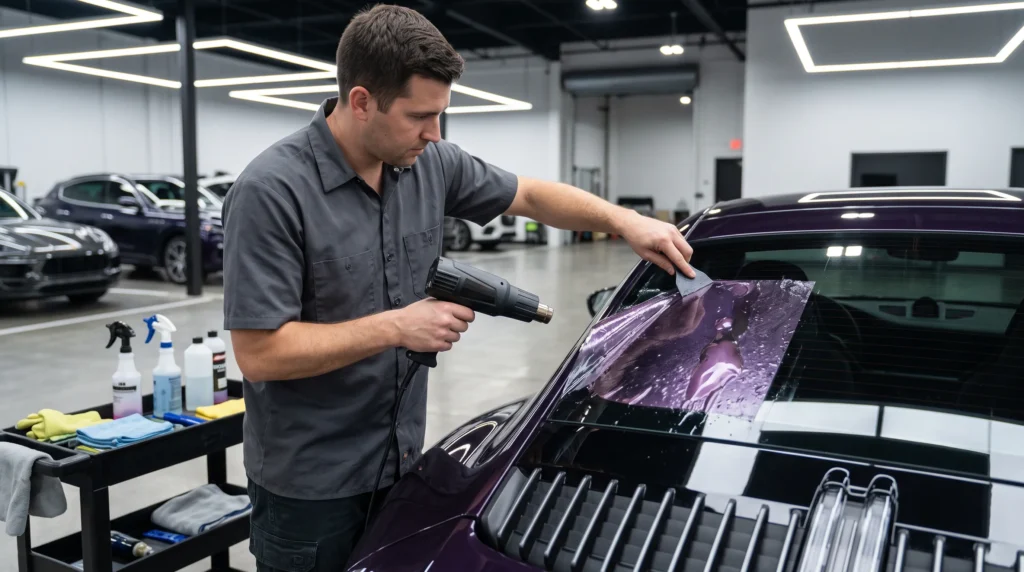
The film itself is still on the glass, but its original color has changed.
Why Dyed Window Tint Can Change Color
Dyed film uses coloring agents to create shade.
Those dyes can be exposed to years of:
- Sunlight
- UV radiation
- Heat
- Temperature changes
- Moisture
- Daily vehicle use
The exact lifespan depends on the product and conditions.
Some dyed films hold color better than others.
Still, dyed construction has historically been more associated with fading and purple discoloration than higher-grade carbon or ceramic alternatives.
Rayno compares its MonoCarbon product with dyed films and reports a large difference in color stability during its own accelerated-weathering testing.
According to Rayno, competitor dyed films in its comparison faded by as much as 8.6% after 1,000 hours of testing, while MonoCarbon faded by less than 1%.
Manufacturer testing does not mean every real-world vehicle will age at the same rate.
It does show why film construction deserves attention when long-term color is one of your concerns.
Why Bakersfield Sun Can Be Hard on Old Tint
Bakersfield, CA is not gentle on a vehicle that sits outdoors regularly.
Cars can spend hours parked:
- In uncovered employee lots
- In driveways
- At schools
- At shopping centers
- At job sites
- Near warehouses
- In apartment parking areas
That repeated exposure gives older tint plenty of time in direct sunlight.
The rear glass can be especially exposed because it often receives strong sun and may contain large areas of film.
If the film is already aging, heat and sunlight can make fading, bubbling, adhesive failure, or color change easier to notice.
Purple window tint in Bakersfield is often seen on older vehicles where the film has been installed for years.
Does Purple Tint Mean the Film Is Bad?
Purple tint usually means the film has lost its original color stability.
That does not always mean the film is about to fall off the window that day.
It does mean the material is no longer looking the way it was designed to look.
Other signs may appear around the same time, such as:
- Bubbling
- Peeling edges
- Cloudiness
- Scratches
- Adhesive distortion
- Uneven darkness
- Poor rear-window visibility
When purple color is combined with bubbling or haziness, replacement may make more sense than continuing to live with the film.
There is no practical way to restore faded dye back to its original shade.
Once the material itself has changed color, replacement is the normal answer.
Why Some Windows Turn Purple Before Others
Tint does not always age evenly across the entire vehicle.
One window may look purple while another still looks fairly dark.
Several things can contribute to that difference.
Sun Direction
One side of the vehicle may receive more direct sunlight where it is normally parked.
Glass Angle
Rear glass can sit at a different angle from side windows and receive a different amount of solar exposure.
Film Age
If some windows were tinted at a different time, the film may not be the same age.
Film Type
A previous owner may have installed different films on different windows.
Replacement Glass
A repaired door or replaced rear window may have been tinted later with another product.
This is why uneven tint color does not always mean the vehicle originally had one uniform installation.
Purple Tint Versus Faded Tint
Purple tint is a type of fading or discoloration, but faded tint does not always become purple.
Old film can also become:
- Brownish
- Gray
- Lighter than before
- Patchy
- Uneven
Color change depends on the dyes and film construction.
The main point is the same.
The tint is no longer maintaining its intended appearance.
If you compare two side windows and one looks black while the other looks purple, the difference is probably not your imagination.
The films may be aging at different rates.
Can Carbon Tint Turn Purple?
Carbon tint is made differently from traditional dyed tint.
Rayno’s MonoCarbon uses carbon particles instead of dyes.
Rayno says MonoCarbon contains no dyes and no metals.
Carbon is used to create the film’s dark appearance, which removes the dye-fading mechanism associated with traditional dyed products.
Rayno reports less than 1% fading for MonoCarbon in its current published material.
That does not mean any film on any vehicle will look unchanged forever.
Film can still experience damage, scratches, adhesive trouble, or other aging.
The advantage is that true carbon film is not depending on conventional dye for its black color.
That can make it a stronger choice for drivers concerned about purple discoloration.
Can Ceramic Tint Turn Purple?
A properly made dye-free ceramic or carbon ceramic film is also designed to avoid the color-fading problem associated with traditional dyed film.
Rayno’s Phantom line uses carbon ceramic construction.
The manufacturer says the film is dye-free and metal-free and publishes a fading rate of less than 1%.
Its current Phantom S5, S7, and S9 specifications all list less than 1% fading.
That makes ceramic tint worth comparing for Bakersfield, CA drivers who care about both solar performance and long-term appearance.
Ceramic construction can also provide higher infrared-rejection figures than basic dyed film, depending on the product.
How Rayno MonoCarbon Handles Color Fading
Rayno MonoCarbon is a two-ply carbon automotive film.
The company states that it uses carbon rather than dye and reports less than 1% fading.
Rayno also publishes a color-durability comparison.
In its 1,000-hour weathering test, MonoCarbon remained under 1% fading while the dyed films in the comparison reached higher fading levels.
Rayno says the carbon particles provide a stable dark shade without depending on dyes.
For someone trying to avoid purple window tint, that construction is worth knowing about.
MonoCarbon may fit a driver who wants:
- Carbon construction
- No dyes
- No metals
- Dark appearance
- Better published color stability than traditional dyed film
- A step below ceramic in the film lineup
Dynamic Window Tint carries Rayno Window Film and can explain which carbon and ceramic choices fit your vehicle.
How Rayno Phantom Ceramic Film Handles Color
Rayno Phantom uses carbon ceramic film construction.
Rayno says the ceramic particles in its Phantom line are individually encapsulated to improve durability and color stability.
The current Phantom S5, S7, and S9 product table lists less than 1% fading across the available shades.
Phantom also publishes separate figures for:
- VLT
- IR rejection
- TSER
- UV rejection
- Visible light reflection
That means a driver can compare both color stability and solar performance.
If your old vehicle has purple tint and you are replacing it, moving to a dye-free carbon ceramic product is one way to avoid repeating the same material choice.
Does Cheap Tint Fade Faster?
Price alone does not tell you exactly how a film will age.
The film brand, construction, installation, warranty, and testing matter more than simply labeling something cheap or expensive.
Still, very low-cost tint can sometimes achieve its price by using simpler materials, lighter adhesive systems, shorter warranties, or less stable color technology.
This is why buying window tint based only on the lowest quote can be risky.
Ask what film is actually being installed.
Two shops may both say “window tint,” but they may be quoting very different products.
A useful comparison should include:
- Manufacturer
- Film series
- Film construction
- Warranty
- VLT
- Fading data
- UV rejection
- IR rejection
- TSER
Those details give you a better picture of what you are buying.
Does Installation Affect Tint Color?
Installation quality can affect how tint looks, but purple color is usually tied more directly to film aging and color stability.
Poor installation can cause other problems, such as:
- Contamination under film
- Uneven edges
- Creases
- Adhesive trouble
- Peeling
- Bubbles
Those issues can make old film look worse, but they are not the same thing as dye turning purple.
A high-grade film installed poorly can still have installation problems.
A low-grade film installed neatly can still fade later.
Good results require both a suitable film and careful installation.
Can Cleaning Products Turn Tint Purple?
Harsh cleaning can damage tint, but purple discoloration is more commonly tied to film fading rather than one normal cleaning session.
Aggressive cleaners, abrasive pads, or scraping can damage the film surface.
They may cause:
- Scratches
- Cloudiness
- Edge damage
- Surface wear
That is different from the gradual purple shift associated with aged dyed film.
After tint installation, follow the film maker’s and installer’s care instructions.
Use a soft microfiber cloth and a cleaner approved for automotive film.
Avoid abrasive pads and sharp tools.
Can Purple Window Tint Be Repaired?
Purple tint generally cannot be repaired back to its original color.
The color change is happening inside the film.
Polishing it will not restore the dye.
Cleaning it will not restore the original black shade.
Adding another film over old purple tint is not a good solution either.
The old material should normally be removed before new tint is applied.
Placing new film over failing tint can leave:
- Old adhesive underneath
- Uneven appearance
- Bubbles
- Poor bonding
- Visible defects
The better path is usually removal, glass cleaning, and installation of fresh film.
When Old Window Tint Should Be Removed
Purple color is one reason to remove tint.
Other signs include:
- Bubbling
- Peeling
- Severe scratches
- Cloudiness
- Adhesive failure
- Distorted visibility
- Torn film
- Uneven appearance
Rear-window film can deserve extra attention when bubbling or distortion interferes with visibility.
If the tint is only slightly faded but remains clear, replacement may not feel urgent.
If it is badly purple, bubbled, or difficult to see through, scheduling removal makes more sense.
Dynamic Window Tint works with older film and can inspect the glass before new tint is installed.
How Professional Tint Removal Works
Removing old window film can take more care than simply grabbing a corner and pulling.
The film may separate from the adhesive.
Old adhesive can remain on the glass.
Rear windows may contain defroster lines that should be treated carefully.
Professional removal normally involves softening and lifting the old film, then cleaning the remaining adhesive without unnecessarily damaging the glass or related components.
Once the old material is gone, the glass needs to be prepared before the new film goes on.
This gives the replacement film a clean surface.
If you have a vehicle with severely bubbled or purple rear tint, tell the shop about it when requesting an appointment.
How to Avoid Purple Window Tint
The best time to avoid purple tint is before new film is installed.
Choose Film That Does Not Depend on Traditional Dye
Carbon and dye-free carbon ceramic films can avoid the same dye-fading mechanism associated with older products.
Ask About Published Fading Data
Rayno publishes less than 1% fading for both MonoCarbon and Phantom films.
Ask what color-stability information is available for any film you are considering.
Ask About the Warranty
A warranty can tell you whether the manufacturer stands behind problems such as color change.
Rayno’s current automotive warranty states that qualifying film should maintain its specified color without fading to purple under the stated conditions.
Use a Trained Installer
Good film still needs proper installation.
Follow Aftercare Instructions
Avoid abrasive cleaning and picking at film edges.
Compare More Than Darkness
A dark shade does not tell you what materials are inside the film.
Two 20% films can use very different construction.
What to Ask Before Choosing New Tint
If you are replacing purple window tint in Bakersfield, ask the installer a few direct questions.
- Is this film dyed, carbon, or ceramic?
- Does it contain conventional dye?
- What fading rate does the manufacturer publish?
- What warranty covers discoloration?
- Does the warranty address purple fading?
- What UV rejection does the film provide?
- What IR and TSER figures are published?
- Which shade fits California law on this window?
- Will my old film need complete removal first?
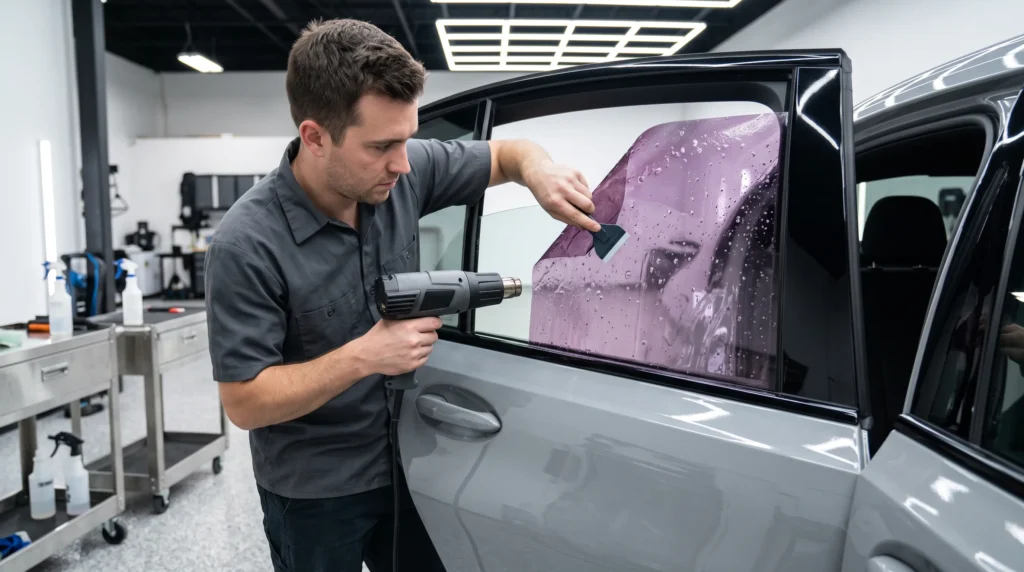
Those questions can tell you far more than asking only how dark the tint will look.
Schedule Window Tint Replacement in Bakersfield
Why purple window tint happens usually comes back to fading inside older dyed film.
Years of sunlight can break down color components until a once-black film becomes purple, brown, gray, or uneven.
For Bakersfield, CA drivers, choosing film with published color-stability data can help reduce the chance of dealing with the same problem again.
Rayno’s current MonoCarbon product uses carbon instead of dyes and reports less than 1% fading.
Rayno Phantom uses dye-free carbon ceramic construction and also publishes less than 1% fading across its current S5, S7, and S9 lines.
Dynamic Window Tint provides window tint in Bakersfield, CA and can remove old failing film before installing a new product.
Dynamic Window Tint is located at:
4609 New Horizon Blvd Suite #10 Bakersfield, CA 93313
Call (661) 634-5585 if your current tint has turned purple, bubbled, faded, or started peeling.
You can also visit the Dynamic Window Tint contact page to schedule an appointment.
The shop serves Bakersfield, CA and nearby communities including Rosedale, CA, Oildale, CA, Shafter, CA, Wasco, CA, Lamont, CA, Arvin, CA, Greenacres, CA, and other Kern County areas.
Tell the team:
- Vehicle year
- Make
- Model
- Which windows have purple film
- Whether the film is bubbling or peeling
- Whether rear defroster lines are present
- Whether you want carbon or ceramic replacement film
The shop can inspect the old tint, discuss removal, and provide a quote for the replacement work.
Frequently Asked Questions
1. Why does old window tint turn purple?
Older dyed film can turn purple when the coloring materials fade after repeated exposure to sunlight, UV, heat, and environmental conditions. As darker color components break down, a purple shade can become more visible.
2. Does purple tint mean I need to replace it?
Purple color means the film has lost its original appearance. If the film is also bubbling, peeling, cloudy, or affecting visibility, replacement is worth considering. The purple color itself cannot normally be cleaned or polished away.
3. Does carbon window tint turn purple?
True carbon film does not depend on conventional dye for its dark color. Rayno MonoCarbon uses carbon with no dyes and reports less than 1% fading in its published testing, making it less prone to the purple-fading problem associated with traditional dyed film.
4. Can ceramic window tint turn purple?
Quality dye-free ceramic or carbon ceramic film is made to resist color change better than traditional dyed tint. Rayno’s Phantom carbon ceramic films list less than 1% fading across the current S5, S7, and S9 products.
5. Can I install new tint over purple tint?
Removing the old film first is the better approach. New tint should be installed on properly prepared glass rather than over old fading, bubbling, or adhesive-damaged film.
6. Does a window tint warranty cover purple fading?
Some manufacturer warranties do. Rayno’s current automotive warranty states that qualifying film should maintain its specified color without fading to purple under the warranty terms. Coverage still depends on the film, registration, installation, and other stated conditions.
7. Where can I replace purple window tint in Bakersfield, CA?
Dynamic Window Tint provides window tint removal and replacement at 4609 New Horizon Blvd Suite #10, Bakersfield, CA 93313. Call (661) 634-5585 or use the contact page to discuss your vehicle and request a quote.
Sources
MonoCarbon Automotive Window Film
Publisher: Rayno Film
Publication Date: Not listed
Accessed: August 28, 2026
Information referenced: Carbon construction, no dyes, no metals, less than 1% fading, color-durability testing, UV rejection, and comparison with dyed film.
Phantom Series Automotive Window Film
Publisher: Rayno Film
Publication Date: Not listed
Accessed: August 28, 2026
Information referenced: Dye-free carbon ceramic construction, encapsulated ceramic particles, less than 1% fading, S5/S7/S9 specifications, UV rejection, IR rejection, and color stability.
Phantom II Automotive Window Film
Publisher: Rayno Film
Publication Date: Not listed
Accessed: August 28, 2026
Information referenced: Nano carbon ceramic construction, less than 1% fading, UV rejection, film thickness, and color-stability claims.
Window Tint Removal in Bakersfield: Why Old Tint Bubbles & Fades
Publisher: Dynamic Window Tint
Publication Date: Not listed
Accessed: August 28, 2026
Information referenced: Purple tint as a sign of older dyed-film breakdown, tint fading, bubbling, peeling, removal, replacement, Bakersfield sun exposure, and local service areas.
Window Tint in Bakersfield, CA
Publisher: Dynamic Window Tint
Publication Date: Not listed
Accessed: August 28, 2026
Information referenced: Automotive window-tint service, Rayno Window Film, warranty-backed work, Bakersfield shop information, service areas, and contact information.
Dynamic Window Tint Contact Page
Publisher: Dynamic Window Tint
Publication Date: Not listed
Accessed: August 28, 2026
Information referenced: Appointment and quote request path.
