

Skylight and transom window film can help Bakersfield, CA homeowners deal with a source of solar heat that is easy to overlook: glass positioned high above eye level. Skylights, clerestory windows, and transom windows can bring natural light deep into a home, but they can also expose rooms to hours of direct sunlight.
You may notice the problem even when your regular windows have curtains or blinds.
A skylight over a kitchen can send bright sunlight onto countertops and flooring. A tall transom above a living room window can bring glare into the room long after the lower blinds are closed. High glass near a vaulted ceiling can also be difficult to cover with ordinary window treatments.
Residential window film gives homeowners another way to manage these areas.
The right architectural film can reduce solar energy, UV exposure, and visible glare while allowing natural light to continue entering the home.
For Bakersfield homes dealing with bright overhead glass, the first question should not be, “How dark should the film be?”
Start by looking at the glass, the direction it faces, and the solar-control specifications of the film.
Table of Contents
- Why Skylights Can Bring So Much Heat Into a Home
- What Are Transom and Clerestory Windows?
- Can Window Film Reduce Skylight Heat?
- How Window Film Helps High Transom Windows
- What Does SHGC Mean for Skylight Film?
- Why TSER Matters for Overhead Glass
- Does Skylight Film Have to Be Dark?
- Rayno Platinum Film for Skylights and Transoms
- Rayno Platinum Air 7090 for a Lighter Appearance
- Rayno Trinity for High Residential Glass
- Can Window Film Reduce Skylight Glare?
- Can Film Help Protect Floors and Furniture?
- Skylight Film vs Shades and Blinds
- Which Rooms Benefit Most From Skylight Film?
- Check the Glass Before Installing Film
- Should Every Skylight Use the Same Film?
- Skylight and Transom Window Film in Bakersfield, CA
- FAQs About Skylight and Transom Window Film
Why Skylights Can Bring So Much Heat Into a Home
Skylights are designed to bring daylight into spaces where traditional wall windows may not provide enough light.
That can make a room feel open and bright.
The same location that gives a skylight access to sunlight can also expose the glass to direct solar energy.
The U.S. Department of Energy uses Solar Heat Gain Coefficient, or SHGC, to describe how much solar heat passes through glazing. Lower SHGC means less solar heat passes through the glass system.
That measurement becomes useful when you are dealing with overhead or high-positioned glass.
A skylight may receive sunlight during hours when a vertical window is partially shaded by:
- Roof overhangs
- Patio covers
- Neighboring structures
- Trees
- Exterior walls
Overhead glass may have fewer sources of shade.
Depending on the roof design and direction of the skylight, sunlight can reach the glass for long periods.
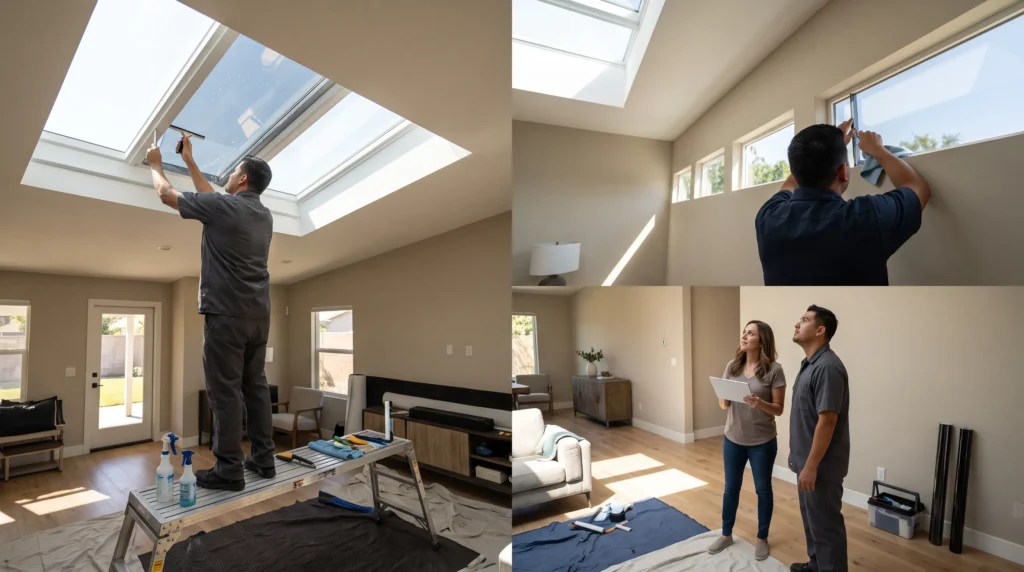
In Bakersfield, CA, that can make a skylight one of the places where homeowners notice solar heat most clearly.
What Are Transom and Clerestory Windows?
Not every high window is technically a skylight.
Homes may also have transom or clerestory windows.
Transom Windows
A transom is usually a window positioned above another window or door.
You may see one above:
- A front entry door
- French doors
- Large living room windows
- Sliding patio doors
- Interior doorways
These windows are often added to bring more daylight into a room.
Clerestory Windows
Clerestory windows sit high on a wall, often close to the ceiling.
They are common in rooms with:
- Vaulted ceilings
- Tall exterior walls
- Open floor plans
- Contemporary architecture
Like skylights, these windows can be difficult to reach with curtains or blinds.
That makes architectural window film worth considering when heat or glare becomes a problem.
Can Window Film Reduce Skylight Heat?
Residential solar-control film can reduce part of the solar energy passing through compatible glass.
The amount depends on the film and the glazing system.
This distinction matters.
A skylight is not automatically a good candidate for every architectural film.
Some skylights use:
- Tempered glass
- Laminated glass
- Insulated dual-pane units
- Low-e coatings
- Factory-tinted glazing
- Acrylic
- Polycarbonate
Film designed for architectural glass should be matched to the actual skylight material.
Once the glazing is identified, you can compare solar-control measurements such as:
- SHGC
- TSER
- VLT
- UV rejection
- Visible light reflection
- Solar absorptance
For Bakersfield homeowners, this gives you a better way to choose than simply looking for the darkest film.
How Window Film Helps High Transom Windows
High transom and clerestory windows can create a different problem.
You may already have blinds on the normal windows below them.
The upper glass remains uncovered.
Sunlight can continue entering through those high windows even after you close the lower blinds.
This can create:
- Bright areas near the ceiling
- Glare across televisions
- Sunlight on furniture
- Hot areas in open living spaces
- Direct light on floors
- Bright patches on walls
- Heat near lofts and upstairs spaces
Because film is applied directly to compatible glass, it does not depend on you reaching a shade every afternoon.
That can be useful for windows that are 10, 15, or more feet above the floor.
What Does SHGC Mean for Skylight Film?
SHGC stands for Solar Heat Gain Coefficient.
It is expressed between 0 and 1.
Lower numbers indicate less solar heat passing through the glazing under the stated conditions.
The U.S. Department of Energy explains that tints and low-e coatings can affect SHGC and notes that lower solar-gain products are used where reducing unwanted heat is the goal.
For skylight and transom window film, SHGC gives you one number to compare when heat is the main concern.
Imagine two compatible films.
Film A has an SHGC of 0.58.
Film B has an SHGC of 0.45.
Film B allows a smaller portion of solar heat through under the stated test conditions.
That does not mean Film B automatically belongs on every skylight.
Film B may also reduce visible daylight more than Film A.
You need to compare SHGC with VLT.
Why TSER Matters for Overhead Glass
TSER stands for Total Solar Energy Rejected.
A higher TSER figure means the tested glass-and-film system rejects a larger share of total incoming solar energy.
This is another useful measurement for overhead glass.
Do not confuse TSER with UV rejection.
UV rejection tells you about ultraviolet radiation.
VLT tells you about visible light.
SHGC describes solar heat passing through the glazing system.
TSER deals with total solar energy rejected.
Looking at these measurements together gives you a clearer picture of what the film is designed to do.
Does Skylight Film Have to Be Dark?
No.
A common assumption is that stopping heat means making a skylight very dark.
That is not always necessary.
Architectural films are available with different Visible Light Transmission levels.
A higher VLT keeps more natural daylight.
A lower VLT reduces more visible light.
The right level depends on why the skylight exists in the first place.
If the skylight was installed to brighten a dark hallway, you may want to preserve more light.
If a large skylight over a living room creates strong glare, a lower VLT may make more sense.
This is where film specifications become useful.
You can compare solar-control performance without choosing entirely by appearance.
Rayno Platinum Film for Skylights and Transoms
Dynamic Window Tint uses Rayno Window Film for residential window tinting in Bakersfield, CA.
Rayno Platinum is an architectural window film line made for residential and commercial applications.
Rayno currently publishes two Platinum specifications worth comparing when solar heat and glare are concerns.
Rayno Platinum PL-BL5099
Rayno lists PL-BL5099 with:
- 50% Visible Light Transmission
- 99.9% UV rejection
- 0.49 SHGC
- 51% TSER
- 6.8% Visible Light Reflection
A 50% VLT means the film keeps a fair amount of natural light compared with darker film choices.
For high transom windows, that can help preserve the bright architectural look of the room while changing the amount of solar energy passing through compatible glass.
Rayno Platinum PL-BC3599
Rayno lists PL-BC3599 with:
- 35% Visible Light Transmission
- 99.9% UV rejection
- 0.45 SHGC
- 55% TSER
- 6.8% Visible Light Reflection
This option allows less visible light through than the 50% film.
It also carries a lower published SHGC and higher published TSER.
For overhead glass creating strong solar heat or glare, it may be worth comparing these two options.
The glass still needs to be checked before deciding.
See more residential options on our residential window tint service page.
Rayno Platinum Air 7090 for a Lighter Appearance
Some homeowners want skylights to continue looking almost clear.
Rayno Platinum Air 7090 offers a lighter appearance and is listed by Rayno for automotive and architectural use.
Rayno states that Platinum Air 7090 has 70% VLT.
That means it allows considerably more visible light through than a 35% or 50% film.
A lighter film may appeal to homeowners who have skylights mainly because they want natural daylight.
There is a tradeoff.
A lighter film can have different solar-control specifications from darker architectural options.
If your main complaint is severe overhead heat rather than appearance, compare the film’s solar measurements before choosing.
Rayno Trinity for High Residential Glass
Rayno Trinity is another architectural film designed for residential and commercial spaces.
Its current published specifications include:
- 50% VLT
- 99% UV rejection
- 0.49 SHGC
- 51% TSER
- 6.8% Visible Light Reflection
Trinity also adds glass-retention properties.
That may interest homeowners with large panes or high glass where keeping broken glass together is another concern.
Still, film should never be selected only because a window is high off the floor.
Glass construction comes first.
Once compatibility is confirmed, you can compare solar performance and other film characteristics.
Can Window Film Reduce Skylight Glare?
Yes, the right film can reduce visible light entering through the glass.
That can help with glare.
Overhead glare may show up in ways homeowners do not immediately connect to the skylight.
You may notice:
- A television becoming hard to see
- A laptop screen reflecting sunlight
- Bright light across a kitchen island
- Harsh light at a dining table
- Bright patches moving across flooring
- Sunlight hitting your eyes while sitting on a sofa
Look at VLT when glare is one of your main complaints.
A lower VLT allows less visible light through.
Do not go darker than you need.
The skylight may be providing useful daylight during other parts of the day.
Can Film Help Protect Floors and Furniture?
Sunlight entering from above can reach areas that wall windows may not.
A skylight may expose:
- Hardwood flooring
- Rugs
- Sofas
- Dining tables
- Cabinets
- Artwork
- Upholstery
- Bedding
Rayno Platinum currently lists 99.9% UV rejection for its architectural films.
Rayno Trinity lists 99% UV rejection.
Reducing UV exposure through treated glass can help limit one source of sun-related fading.
UV is not the only cause of fading.
Visible light, heat, material type, dyes, and other environmental conditions also play a role.
Window film should not be treated as a guarantee that furnishings will never fade.
Skylight Film vs Shades and Blinds
Skylight shades can work well, but they solve the problem differently.
A shade physically covers the opening.
Film stays on the glass.
Skylight Shades
A shade can provide:
- Strong light control
- Darkness when closed
- Privacy
- A way to open the skylight view again later
The downside is that operating high shades can require motors, extension poles, or controls.
Skylight Window Film
Film can provide:
- Ongoing solar control
- Glare reduction
- UV reduction
- Continued daylight
- No daily opening and closing
The downside is that film does not give you an instant fully open or fully covered setting.
Some homes may benefit from both.
Film can handle solar exposure throughout the day while a shade provides extra darkness when wanted.
Which Rooms Benefit Most From Skylight Film?
Different rooms experience overhead sunlight in different ways.
Kitchens
Skylights are common in kitchens because they bring natural light into the center of the room.
The downside can be bright midday or afternoon sun on:
- Countertops
- Islands
- Cabinetry
- Floors
- Dining areas
Film may help reduce solar load and glare without giving up all of that daylight.
Living Rooms
Large skylights in vaulted living rooms can create broad patches of direct sunlight.
High clerestory windows can cause the same issue.
If your living room becomes uncomfortable during one part of the day, look at where the sunlight is entering.
Bedrooms
A skylight can make a bedroom bright early in the day.
It may also contribute to heat before bedtime depending on its direction and sun exposure.
Film can reduce visible light and solar energy to different degrees depending on the product.
Bathrooms
Bathrooms sometimes use skylights to bring in natural light without sacrificing privacy.
A lighter solar-control film may help with heat and UV exposure while keeping the space bright.
Hallways and Stairwells
High windows are common around stairs and entry areas.
They may be difficult to cover because of their height.
Film can be installed directly on compatible glass without requiring daily access to a shade.
Home Offices
A skylight or high transom can create screen glare even when it is not directly in front of the desk.
Reducing visible light through the problem glass may make the workspace easier to use.
Check the Glass Before Installing Film
This is one of the most important steps with skylights.
Not every skylight uses the same material.
Some are glass.
Others use acrylic or polycarbonate.
Glass skylights may also have multiple panes or factory coatings.
Before installing film, determine whether the opening uses:
- Single-pane glass
- Dual-pane insulated glass
- Tempered glass
- Laminated glass
- Low-e glass
- Factory-tinted glass
- Acrylic
- Polycarbonate
Architectural window film intended for glass should not automatically be installed on plastic glazing.
Even with glass, the film must be compatible with the complete glazing system.
Solar absorptance matters because film changes how incoming solar energy is absorbed, reflected, and transmitted.
This is one reason professional film selection matters more on skylights than simply ordering a dark sheet online.
Should Every Skylight Use the Same Film?
No.
Two skylights in the same home may have very different exposure.
A north-facing roof opening may receive different direct sunlight than a west-facing opening.
One room may need strong glare reduction.
Another may need to stay bright.
The glass may also differ if parts of the home were remodeled at different times.
Before choosing film, consider:
- What direction does the glass face?
- What time does the room feel hottest?
- Is heat or glare the bigger problem?
- How much daylight do you want to keep?
- Is privacy part of the goal?
- What type of glass or glazing is installed?
- Is the skylight single-pane or insulated?
- Does it have a low-e coating?
Those answers can change which film makes sense.
Skylight and Transom Window Film in Bakersfield, CA
Skylight and transom window film can help homeowners deal with solar heat and glare coming from glass that ordinary blinds may not reach.
For Bakersfield, CA homes, overhead and high-positioned glass may deserve attention when a room becomes noticeably warmer or brighter during sunny parts of the day.
The right film can help manage:
- Solar heat
- Overhead glare
- UV exposure
- Bright high windows
- Natural daylight
- Daytime privacy on certain glass
The goal should not be to cover every skylight with the darkest film possible.
Start with glass compatibility.
Then compare SHGC, TSER, VLT, UV rejection, and reflection.
Dynamic Window Tint provides residential window tint in Bakersfield, CA using Rayno Window Film.
The shop is located at:
4609 New Horizon Blvd Suite #10 Bakersfield, CA 93313
Dynamic Window Tint serves homeowners in Bakersfield, CA and nearby communities such as Rosedale, CA, Oildale, CA, Lamont, CA, Shafter, CA, Arvin, CA, and Wasco, CA.
The shop is certified and carries warranties on products and services.
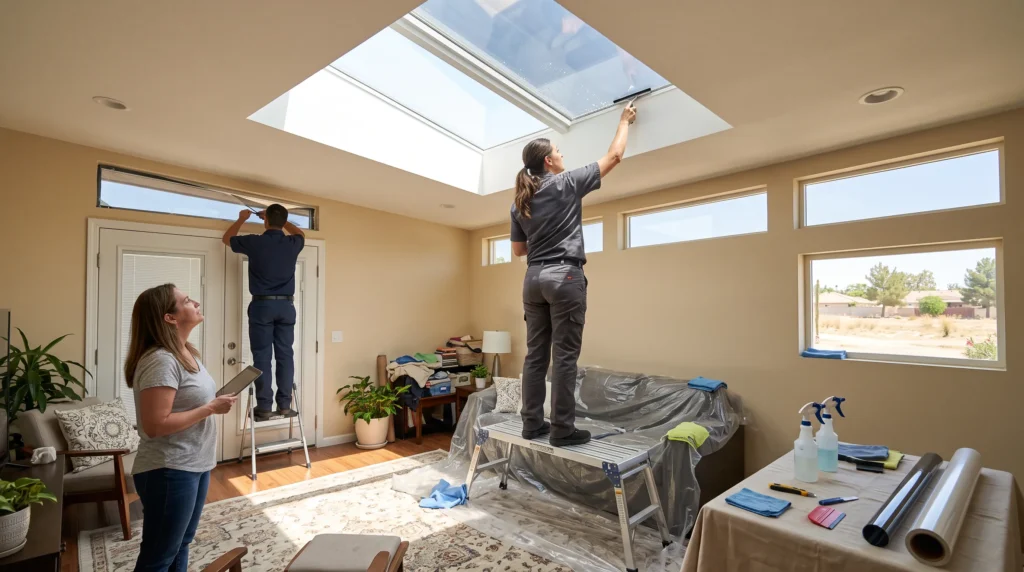
If you have skylights, high transom windows, clerestory glass, or other hard-to-reach windows that bring too much heat or glare into your home, call (661) 634-5585 or visit the Dynamic Window Tint contact page to schedule an appointment.
FAQs About Skylight and Transom Window Film
1. Can window film be installed on skylights?
Window film can be installed on some glass skylights, but the glazing must be checked first. Skylights may use tempered glass, laminated glass, insulated glass, low-e coatings, acrylic, or polycarbonate. The film must be compatible with the material and glazing system.
2. Does skylight film reduce heat?
Solar-control window film can reduce part of the solar energy passing through compatible skylight glass. When heat is the main concern, compare SHGC and TSER between suitable architectural films.
3. Will skylight window film make my room dark?
Not necessarily. Architectural films come in different VLT levels. A higher VLT keeps more natural light, while a lower VLT reduces more visible light. Choose based on how much daylight you want to preserve.
4. Can window film reduce glare from a skylight?
Yes. Film with a lower VLT can reduce visible light passing through the glass, which may help with glare on televisions, computer screens, flooring, countertops, and seating areas.
5. Can window film go on transom windows?
Many glass transom and clerestory windows can use architectural film when the film is compatible with the glazing. Film can be useful on high windows that are difficult to cover with ordinary blinds or curtains.
6. What window film works for a hot skylight?
There is no single film that fits every skylight. Compare compatible films using SHGC, TSER, VLT, UV rejection, reflection, and solar absorptance. The skylight material and existing coatings need to be checked first.
7. Where can I get skylight and transom window film in Bakersfield, CA?
Dynamic Window Tint provides residential window film for homeowners in Bakersfield, CA. Call (661) 634-5585 or visit the contact page to discuss skylights, high windows, overhead heat, glare, and your home’s glass.
Sources
- Purchasing Energy-Efficient Residential Windows, Doors, and Skylights
Publisher: U.S. Department of Energy
Publication Date: Current online guidance
Information referenced: Skylights and glazing, Solar Heat Gain Coefficient, solar heat transmission, low-e coatings, tints, and hot-climate glazing considerations. - Rayno Platinum Architectural Window Film
Publisher: Rayno Window Film
Publication Date: Not listed
Information referenced: Residential applications, 35% and 50% VLT film specifications, UV rejection, SHGC, TSER, visible light reflection, solar absorptance, glare reduction, and solar control. - Rayno Trinity Architectural Window Film
Publisher: Rayno Window Film
Publication Date: Not listed
Information referenced: 50% VLT, 99% UV rejection, 0.49 SHGC, 51% TSER, visible light reflection, and glass-retention characteristics. - Rayno Platinum Air 7090
Publisher: Rayno Window Film
Publication Date: Not listed
Information referenced: Architectural use, light appearance, 70% VLT, UV reduction, and solar-control properties. - Rayno Architectural Window Film
Publisher: Rayno Window Film
Publication Date: 2026
Information referenced: Home window film, solar heat, glare, UV reduction, natural light, and Rayno architectural film choices. - Residential Window Tint in Bakersfield, CA
Publisher: Dynamic Window Tint
Publication Date: Not listed
Information referenced: Bakersfield residential window tint services, Rayno Window Film, glare reduction, privacy, certified installation, and warranty-backed products and services. - Contact Dynamic Window Tint
Publisher: Dynamic Window Tint
Publication Date: Not listed
Information referenced: Bakersfield business address, phone number, residential service, and appointment information.
