

Rayno Window Film in Bakersfield gives homeowners and business owners several ways to manage solar heat, glare, UV exposure, privacy, and glass breakage without replacing every window. Rayno’s architectural lineup includes solar-control film, lighter nearly clear film, glass-retention products, thicker security film, and switchable privacy film.
That range matters because a west-facing living room does not have the same problem as a storefront, conference room, office building, or glass entry door.
One property owner may want less afternoon heat while keeping the outdoor view.
Another may want to cut glare on office monitors.
A retail business may care about protecting merchandise from UV exposure.
Another business may be more concerned about holding broken glass together after an impact.
For homes and businesses in Bakersfield, CA, the first step is figuring out what the glass needs to do. From there, Rayno’s architectural film lines can be compared using measurements such as Visible Light Transmission, Solar Heat Gain Coefficient, Total Solar Energy Rejected, UV rejection, and Visible Light Reflection.
Here is what Rayno currently offers for residential and commercial glass.
Table of Contents
- What Is Rayno Architectural Window Film?
- What Problems Can Rayno Window Film Address?
- Rayno Platinum for Homes and Businesses
- Rayno Platinum 50 Percent VLT
- Rayno Platinum 35 Percent VLT
- Rayno Platinum Air 7090 for a Lighter Appearance
- Rayno Trinity for Solar Control and Glass Retention
- Rayno Rescue Security Film
- Rayno Smart Film for Switchable Privacy
- Which Rayno Film Works for Bakersfield Homes?
- Which Rayno Film Works for Bakersfield Businesses?
- How Rayno Film Can Reduce Glare
- How Rayno Film Can Address Solar Heat
- How Rayno Film Handles UV Exposure
- Can Rayno Film Add Privacy?
- Does Architectural Film Have to Look Dark?
- What SHGC TSER VLT and VLR Mean
- Film Compatibility Comes Before Film Selection
- Rayno Architectural Film Warranty Basics
- Rayno Window Film in Bakersfield CA
- FAQs About Rayno Window Film
What Is Rayno Architectural Window Film?
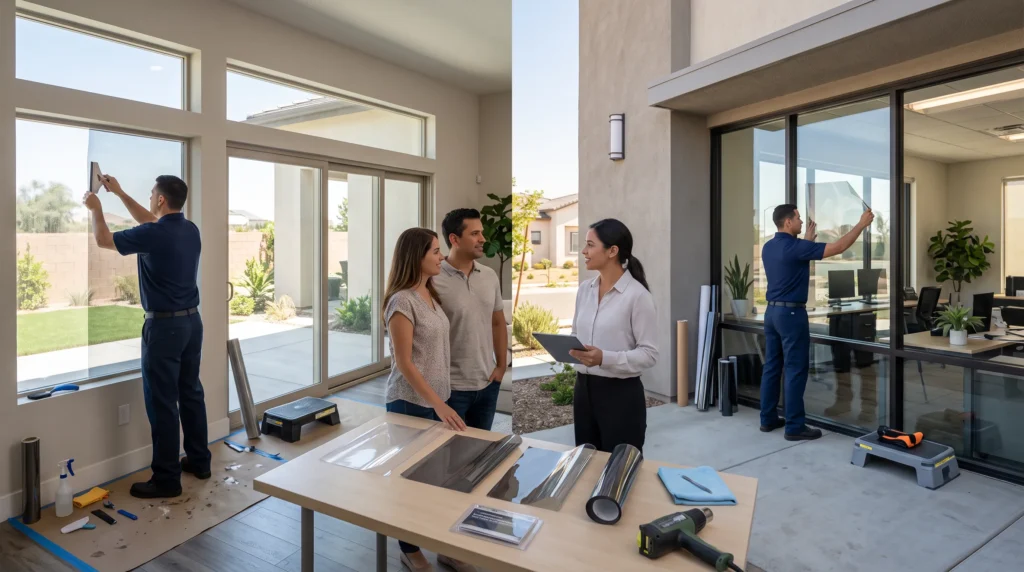
Rayno makes architectural film for building glass.
That means the product line is intended for places such as:
- Houses
- Apartments
- Condominiums
- Office buildings
- Storefronts
- Public buildings
- Glass doors
- Meeting rooms
- Commercial spaces
Architectural film is different from automotive tint.
A house window, insulated glass unit, storefront pane, and vehicle side window have different construction and installation requirements.
Rayno’s current architectural lineup includes:
- Platinum
- Platinum Air 7090
- Trinity
- Rescue
- Smart Film
Each line is built around a different use.
Platinum centers on solar control.
Platinum Air 7090 provides a lighter appearance.
Trinity combines solar performance with added glass retention.
Rescue focuses more heavily on holding glass together after breakage and resisting penetration.
Smart Film switches between clear and frosted states for controllable privacy.
What Problems Can Rayno Window Film Address?
Rayno Window Film in Bakersfield can be considered when glass is causing problems such as:
- Strong afternoon sunlight
- Bright television glare
- Computer screen glare
- Hot areas beside windows
- Direct sun on furniture
- Direct sun on flooring
- Daytime privacy concerns
- Bright conference rooms
- Storefront glare
- Glass-breakage concerns
The right product depends on which problem matters most.
If solar heat is the concern, compare SHGC and TSER.
If glare is the concern, compare VLT.
If you want a lighter appearance, look at a higher-VLT product.
If holding broken glass together matters, look at Trinity or Rescue.
If you need privacy that can change throughout the day, Smart Film belongs in a different conversation from ordinary solar-control tint.
Rayno Platinum for Homes and Businesses
Rayno Platinum is one of the brand’s main architectural solar-control lines.
Rayno lists Platinum for both residential and commercial spaces.
That includes:
- Houses
- Apartments
- Condominiums
- Offices
- Curtain-wall buildings
- Public buildings
The current Platinum lineup includes a 50% VLT film and a 35% VLT film.
Both publish 99.9% UV rejection.
Both also have a listed Visible Light Reflection of 6.8%.
The difference becomes more noticeable in visible light and solar measurements.
This gives a homeowner or business owner two levels to compare rather than choosing only from a generic “light” or “dark” description.
Rayno Platinum 50 Percent VLT
Rayno lists Platinum PL-BL5099 with:
- 50% Visible Light Transmission
- 99.9% UV rejection
- 6.8% Visible Light Reflection
- 0.49 Solar Heat Gain Coefficient
- 51% Total Solar Energy Rejected
A 50% VLT means the filmed glass keeps more visible daylight than the 35% Platinum option.
That can fit spaces where natural light matters.
A homeowner might consider this type of film for:
- Living rooms
- Dining rooms
- Kitchens
- Home offices
- Patio doors
A business might compare it for:
- Office windows
- Waiting rooms
- Conference rooms
- Storefront glass
- Employee work areas
The amount of daylight you keep matters just as much as the amount you reduce.
Rayno Platinum 35 Percent VLT
Rayno currently lists Platinum PL-BC3599 with:
- 35% Visible Light Transmission
- 99.9% UV rejection
- 6.8% Visible Light Reflection
- 0.45 Solar Heat Gain Coefficient
- 55% Total Solar Energy Rejected
This film allows less visible light through than the 50% product.
Its published SHGC is also lower and its TSER is higher.
That may fit windows dealing with stronger sun or glare.
Think about:
- West-facing living rooms
- Large sunny patio doors
- Bright office windows
- Glass near computer workstations
- Storefronts with strong afternoon exposure
The darker appearance may also change daytime privacy.
Film selection should still begin with the glass type and room use.
Rayno Platinum Air 7090 for a Lighter Appearance
Some homeowners and businesses do not want their windows to look heavily tinted.
Rayno Platinum Air 7090 gives them another option.
Rayno lists Platinum Air 7090 for both automotive and architectural glass.
Current specifications include:
- 70% Visible Light Transmission
- 99% UV rejection
- 7.3% Visible Light Reflection
- 0.58 Solar Heat Gain Coefficient
- 42% Total Solar Energy Rejected
The 70% VLT keeps more visible light than the 35% and 50% Platinum products.
That can suit spaces where maintaining a brighter appearance carries a lot of weight.
A homeowner may want it in:
- A darker living room
- A home office with only one window
- A hallway
- A room where the outdoor view matters
A business may want it where darker glass does not fit the property’s appearance.
The tradeoff is that its published solar measurements differ from the darker Platinum products.
This is why film should be chosen from specifications rather than appearance alone.
Rayno Trinity for Solar Control and Glass Retention
Rayno Trinity takes a different approach.
It combines solar-control characteristics with added glass retention.
Rayno currently lists Trinity at:
- 50% Visible Light Transmission
- 99% UV rejection
- 6.8% Visible Light Reflection
- 0.49 Solar Heat Gain Coefficient
- 51% Total Solar Energy Rejected
Rayno also describes Trinity as strengthening glass and helping hold damaged glass together after certain impacts.
That may interest property owners who want more than glare and solar control.
Possible locations include:
- Large home windows
- Glass doors
- Apartments
- Condominiums
- Offices
- Large commercial windows
Trinity is not the same product as Rayno Rescue.
If stronger security-film construction is the main goal, Rescue deserves a separate look.
Rayno Rescue Security Film
Rayno Rescue is built around glass protection.
The current line includes several clear films with different thicknesses.
Rayno lists Rescue products with VLT levels from 86% to 90% across the published lineup.
The products also list 99% UV rejection.
Rayno describes the Rescue line as helping hold broken glass together and increasing resistance to penetration from impacts.
Current product choices include:
- RE-CL04
- RE-CL08
- RE-CL12
- RE-CL18
The thicker products publish higher tensile-strength figures.
Rayno says its testing with 4 mil Rescue film made standard glass up to eight times more resistant to penetration in the test setup.
This type of film may be considered for:
- Glass entry doors
- Storefronts
- Offices
- Display glass
- Public buildings
- Homes with large glass areas
- Buildings where broken-glass retention matters
Security film should not be described as making glass unbreakable.
Glass can still break.
The film’s role is to add another layer that can help keep broken pieces together and increase resistance to penetration under tested conditions.
Rayno Smart Film for Switchable Privacy
Rayno Smart Film is very different from ordinary tinted window film.
It can switch between clear and frosted states.
That creates privacy on demand.
Rayno describes Smart Film as using an electrical system that lets the film change from clear to opaque.
This may fit spaces such as:
- Conference rooms
- Meeting rooms
- Office partitions
- Private offices
- Showrooms
- Interior glass
- Residential spaces where switchable privacy is wanted
Smart Film can also work as a projection surface.
Rayno currently states that Smart Film blocks 99% of UV rays and 65% of infrared rays.
Its main reason for consideration, though, is usually controllable privacy.
A conference room could remain visually open during normal office hours and become frosted during a private meeting.
A homeowner could use switchable film in a space where permanent frosted glass is not wanted.
Smart Film is a different installation from ordinary solar-control film, so the property and electrical requirements need to be considered first.
Which Rayno Film Works for Bakersfield Homes?
There is no single Rayno product that belongs on every home window.
Start with the room.
West-Facing Living Rooms
Compare films using SHGC, TSER, and VLT.
Rayno Platinum 35% or 50% may be worth discussing depending on how much daylight you want to keep.
Sliding Glass Doors
Large patio doors can bring plenty of sunlight into one room.
A lower SHGC and higher TSER may matter when afternoon solar heat is the concern.
If keeping a bright backyard view carries more weight, a lighter film may fit better.
Home Offices
Computer glare can make VLT especially relevant.
A home office may benefit from less visible light without needing a heavily darkened window.
Bedrooms
Privacy, glare, and sunlight may all matter.
Keep in mind that reflective or tinted film should not be treated as guaranteed nighttime privacy.
Curtains or blinds remain useful after dark.
Skylights and High Windows
Glass compatibility becomes especially important.
Skylights may use laminated, insulated, coated, acrylic, or other glazing.
Do not assume ordinary architectural film belongs on every overhead window.
Which Rayno Film Works for Bakersfield Businesses?
Commercial window film often starts with the way the building is used.
Offices
Bright windows can create screen glare.
Platinum can be considered when solar heat and visible brightness need to be reduced.
Storefronts
Storefronts may have large panes exposed to sunlight for much of the day.
Business owners may care about:
- Glare
- UV exposure
- Interior heat
- Merchandise exposure
- Daytime privacy
- Exterior appearance
Conference Rooms
Standard solar film may work when glare and heat are the problem.
Rayno Smart Film may be worth discussing when switchable privacy is the bigger concern.
Glass Doors and Entry Areas
Trinity or Rescue may be worth comparing when broken-glass retention matters in addition to normal window-film benefits.
Waiting Rooms and Reception Areas
A lighter film can help keep the room bright while changing glare and solar exposure.
You can learn more about local options on the commercial and residential window tint page.
How Rayno Film Can Reduce Glare
Glare is strongly tied to visible light.
That makes VLT one of the first numbers to compare.
Lower VLT means less visible light passes through the treated glass.
A 35% film reduces more visible light than a 50% film.
A 50% film reduces more than a 70% film.
Glare can become a problem around:
- Televisions
- Desktop monitors
- Laptops
- Conference-room displays
- Reception desks
- Retail checkout areas
- Glass tables
- Polished floors
Do not choose a darker film than the space needs.
Look at when the glare occurs and which windows cause it.
How Rayno Film Can Address Solar Heat
When solar heat is the reason you are shopping for film, compare more than VLT.
Two useful measurements are SHGC and TSER.
Rayno Platinum PL-BC3599, for example, currently lists a 0.45 SHGC and 55% TSER.
Platinum PL-BL5099 lists a 0.49 SHGC and 51% TSER.
Platinum Air 7090 lists a 0.58 SHGC and 42% TSER.
These differences give property owners a way to compare how the products handle solar energy under the stated testing.
The darker-looking product is not the only detail that matters.
How Rayno Film Handles UV Exposure
Rayno’s current Platinum films list 99.9% UV rejection.
Platinum Air 7090 lists 99%.
Trinity lists 99%.
Rescue lists 99%.
Reducing UV passing through treated glass can help reduce one source of fading and sun exposure.
UV is not the only cause of fading.
Visible light, heat, dyes, material construction, age, and environmental conditions also affect furnishings and merchandise.
Window film should not be sold as a guarantee that flooring, furniture, artwork, fabrics, or retail products will never fade.
Can Rayno Film Add Privacy?
Some film choices can make it harder to see through glass during daylight.
The effect depends on:
- Film VLT
- Reflection
- Outdoor brightness
- Indoor brightness
- Glass type
Daytime privacy can be stronger when the outside is brighter than the inside.
At night, interior lights may reverse that relationship.
That is why ordinary solar film should not be treated as automatic nighttime privacy.
If controllable privacy is the goal, Rayno Smart Film provides a different approach by switching between clear and frosted states.
Does Architectural Film Have to Look Dark?
No.
Rayno’s lineup ranges from 35% VLT solar film to products above 80% VLT in the Rescue line.
Platinum Air 7090 is listed at 70% VLT.
That gives property owners choices when they want less visible change.
This can matter on:
- Front-facing house windows
- Offices with architectural glass
- Storefronts
- Properties where exterior appearance matters
- Rooms that already receive limited daylight
Tell the installer how much visual change you are comfortable with before choosing a product.
What SHGC TSER VLT and VLR Mean
Film specification sheets use several abbreviations.
Here is what they mean.
VLT
Visible Light Transmission tells you how much visible light passes through.
Higher VLT means more visible daylight.
SHGC
Solar Heat Gain Coefficient describes the portion of solar heat passing through the glazing system.
Lower numbers mean less solar heat passes through under the stated conditions.
TSER
Total Solar Energy Rejected tells you how much total solar energy is rejected.
Higher TSER means more solar energy is rejected under the stated testing.
VLR
Visible Light Reflection tells you how much visible light is reflected.
This can affect how reflective the glass appears.
These measurements help you compare films without relying only on a sample’s color.
Film Compatibility Comes Before Film Selection
Not every architectural film belongs on every window.
Residential and commercial glass may include:
- Single-pane glass
- Dual-pane insulated glass
- Laminated glass
- Tempered glass
- Low-e coatings
- Factory tint
- Specialty glazing
Film changes the way solar energy interacts with glass.
The exact glass construction needs to be considered before installation.
Rayno’s current warranty terms also include conditions tied to glazing type and approved film-to-glass combinations.
This is another reason to have the glass inspected rather than ordering film solely from an online specification chart.
Rayno Architectural Film Warranty Basics
Rayno currently offers warranty coverage for several architectural products when installation and registration requirements are met.
Its current terms list residential and commercial coverage for Platinum, Rescue, and Trinity.
Rayno states:
- Residential applications receive a limited lifetime warranty
- Commercial applications receive 12 years of coverage from installation
The current terms also include conditions and exclusions.
Rayno states that architectural film warranty coverage does not apply to dual-pane windows under its general warranty terms.
It also states that covered films are intended for interior-side installation.
Warranty registration must be completed within Rayno’s stated period.
Ask your installer:
- Which Rayno film is being used
- Whether your glass qualifies
- What the manufacturer covers
- What the installer covers
- Whether registration is required
- What paperwork you should keep
Dynamic Window Tint carries warranties on its products and services.
Rayno Window Film in Bakersfield CA
Rayno Window Film in Bakersfield gives homeowners and businesses more than one approach to building glass.
Rayno Platinum can address solar heat, glare, UV exposure, and daylight.
Platinum Air 7090 provides a lighter appearance.
Trinity combines solar-control specifications with added glass retention.
Rescue is built around security and broken-glass retention.
Smart Film gives homes and businesses switchable clear-to-frosted privacy.
The right choice starts with the property.
Ask:
- Which windows are causing the problem?
- What direction do they face?
- Is heat or glare the bigger concern?
- How much daylight do you want to keep?
- Do you need daytime privacy?
- Do you need switchable privacy?
- Does holding broken glass together matter?
- What type of glazing is installed?
Dynamic Window Tint offers commercial and residential window tint in Bakersfield, CA using Rayno Window Film.
The shop is located at:
4609 New Horizon Blvd Suite #10 Bakersfield, CA 93313
Dynamic Window Tint works with homeowners and businesses in Bakersfield, CA and nearby communities including Rosedale, CA, Oildale, CA, Greenacres, CA, Shafter, CA, Lamont, CA, Arvin, CA, Wasco, CA, and surrounding Kern County areas.
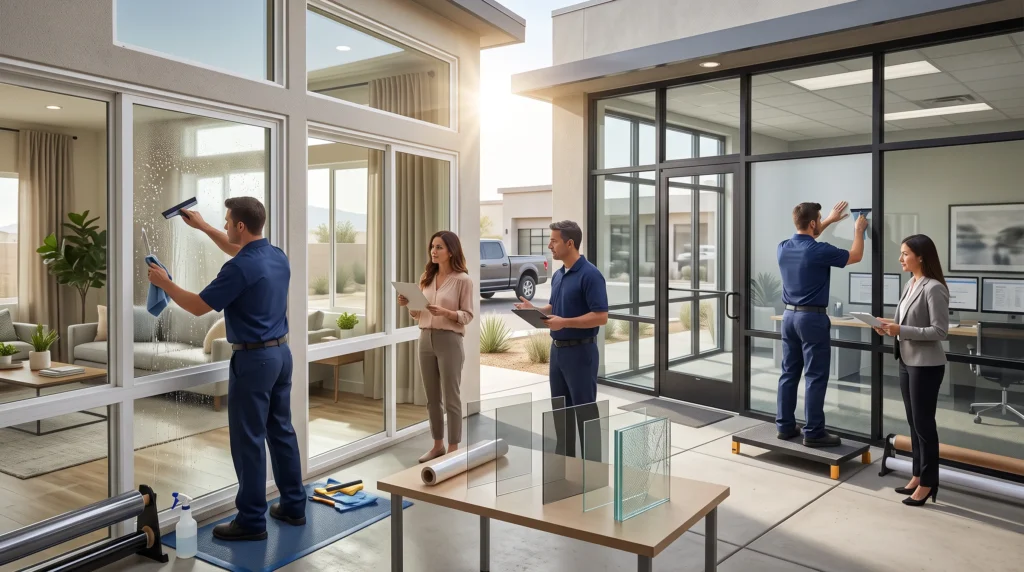
If your living room gets too hot, your office monitors are difficult to see, or your storefront has large sunny windows, call (661) 634-5585 or visit the Dynamic Window Tint contact page to schedule an appointment.
FAQs About Rayno Window Film
1. Does Rayno make window film for homes?
Yes. Rayno offers architectural window films for houses, apartments, condominiums, and other residential spaces. Current lines include Platinum, Platinum Air 7090, Trinity, Rescue, and Smart Film.
2. Does Rayno make commercial window film?
Yes. Rayno lists architectural applications for office buildings, storefront-style glass, public buildings, apartments, commercial spaces, and other building glass. Product selection depends on whether the property needs solar control, privacy, glare reduction, or added glass retention.
3. Which Rayno film is good for heat control?
Rayno Platinum is built around architectural solar control. Current specifications list the 35% Platinum product at 0.45 SHGC and 55% TSER, while the 50% product is listed at 0.49 SHGC and 51% TSER. Glass compatibility should be checked before film selection.
4. Does Rayno offer a lighter home window film?
Yes. Rayno Platinum Air 7090 currently lists 70% VLT, 99% UV rejection, 0.58 SHGC, and 42% TSER. It keeps more visible daylight than Rayno’s 35% and 50% Platinum products.
5. Does Rayno make security window film?
Yes. Rayno Rescue is a clear security-film line made in several thicknesses. It is designed to help hold broken glass together and increase resistance to penetration from impacts under tested conditions.
6. Does Rayno offer switchable privacy film?
Yes. Rayno Smart Film can switch between clear and frosted states using electrical power. It can be used for meeting rooms, offices, interior glass, showrooms, and other spaces where privacy needs to change.
7. Where can I get Rayno Window Film in Bakersfield, CA?
Dynamic Window Tint offers Rayno Window Film for homes and businesses at 4609 New Horizon Blvd Suite #10, Bakersfield, CA 93313. Call (661) 634-5585 or visit the contact page to discuss your glass, sunlight, glare, privacy, and film choices.
Sources
- Architectural Window Film
Publisher: Rayno Window Film
Publication Date: 2026
Information referenced: Rayno’s current architectural film lineup, residential and commercial applications, solar film, UV reduction, privacy, and available product lines. - Rayno Platinum Architectural Window Film
Publisher: Rayno Window Film
Publication Date: Not listed
Information referenced: Residential and commercial applications, 35% and 50% VLT films, UV rejection, SHGC, TSER, VLR, solar control, glare, and published testing. - Rayno Platinum Air 7090
Publisher: Rayno Window Film
Publication Date: Not listed
Information referenced: Architectural use, 70% VLT, 99% UV rejection, 7.3% VLR, 0.58 SHGC, and 42% TSER. - Rayno Trinity Architectural Window Film
Publisher: Rayno Window Film
Publication Date: Not listed
Information referenced: 50% VLT, 99% UV rejection, 0.49 SHGC, 51% TSER, glass retention, residential use, and commercial use. - Rayno Rescue Security Window Film
Publisher: Rayno Window Film
Publication Date: Not listed
Information referenced: Clear security film, film thicknesses, UV rejection, tensile strength, broken-glass retention, impact testing, and residential and commercial applications. - Rayno Smart Film
Publisher: Rayno Window Film
Publication Date: Not listed
Information referenced: Switchable clear-to-frosted privacy, projection use, electrical operation, 99% UV reduction, 65% infrared reduction, and office and residential applications. - Rayno Warranty Terms and Conditions
Publisher: Rayno Window Film
Publication Date: 2026
Information referenced: Architectural warranty periods, residential limited lifetime coverage, commercial 12-year coverage, glazing conditions, interior installation requirements, and warranty limitations. - Rayno Warranty Registration
Publisher: Rayno Window Film
Publication Date: 2026
Information referenced: Architectural product registration, lot identification, and Rayno registration process. - Commercial & Residential Window Tint in Bakersfield
Publisher: Dynamic Window Tint
Publication Date: Not listed
Information referenced: Bakersfield home and business window-film services, Rayno Window Film, solar heat, glare, privacy, UV reduction, warranties, and certified service. - Contact Dynamic Window Tint
Publisher: Dynamic Window Tint
Publication Date: Not listed
Information referenced: Bakersfield address, phone number, and appointment information.
