

Table of Contents
- Auto Tint vs Home Tint: What Bakersfield Customers Should Know
- What Auto Tint Is Designed to Do
- What Home Tint Is Designed to Do
- Auto Tint vs Home Tint for Heat Control
- Auto Tint vs Home Tint for Glare
- Auto Tint vs Home Tint for Privacy
- Why Vehicle Glass and Home Glass Need Different Film
- Legal Rules: Cars Have Different Limits Than Homes
- Can You Use Auto Tint on Home Windows?
- Can You Use Home Tint on Car Windows?
- How to Choose the Right Tint for Your Project
- Schedule Auto Tint or Home Tint in Bakersfield, CA
- FAQs About Auto Tint vs Home Tint
- Sources
Auto Tint vs Home Tint: What Bakersfield Customers Should Know
Auto tint vs home tint is a common question for Bakersfield customers who want less heat, less glare, more privacy, and better comfort. Both types of window film go on glass, but they are not the same product and should not be treated the same way.
Auto tint is made for vehicle glass. Home tint is made for residential windows. Each one has a different job, different glass surface, different legal concerns, different film construction, and different installation process.
At Dynamic Window Tint, we install both vehicle window tint and residential window tint for Bakersfield, CA customers. Our shop is located at 4609 New Horizon Blvd Suite #10, Bakersfield, CA 93313, and we serve Bakersfield, CA, Lamont, CA, Shafter, CA, Arvin, CA, Rosedale, CA, Oildale, CA, Wasco, CA, and nearby Kern County areas.
Here is why auto tint vs home tint matters. The wrong film can lead to poor performance, poor appearance, glass stress, warranty problems, or tint that does not meet California vehicle rules. The right film can make your vehicle or home feel more comfortable and look cleaner.
For help choosing the right film, call (661) 634-5585 or visit https://dynamicwindowtintca.com/contact-us.
What Auto Tint Is Designed to Do
Auto tint is made for cars, trucks, SUVs, Teslas, Cybertrucks, RVs, boats, and other vehicles. It is designed to handle curved glass, roll-down windows, rear defroster lines, tight trim, and daily driving.
Auto tint is often chosen for:
- Heat rejection
- Glare reduction
- UV protection
- Privacy
- Vehicle appearance
- Rear passenger comfort
- Cleaner styling
- Interior protection
- Better daily driving feel
The International Window Film Association says automotive window film can reduce glare, add privacy, and shield occupants from harmful UV rays. That is one reason many Bakersfield drivers ask about tint before summer heat gets intense.
Auto tint also has to deal with movement. Side windows roll up and down. Doors open and close. Rear windows may have defroster lines. Vehicles vibrate on the road. The film has to stay clean, clear, and bonded through daily use.
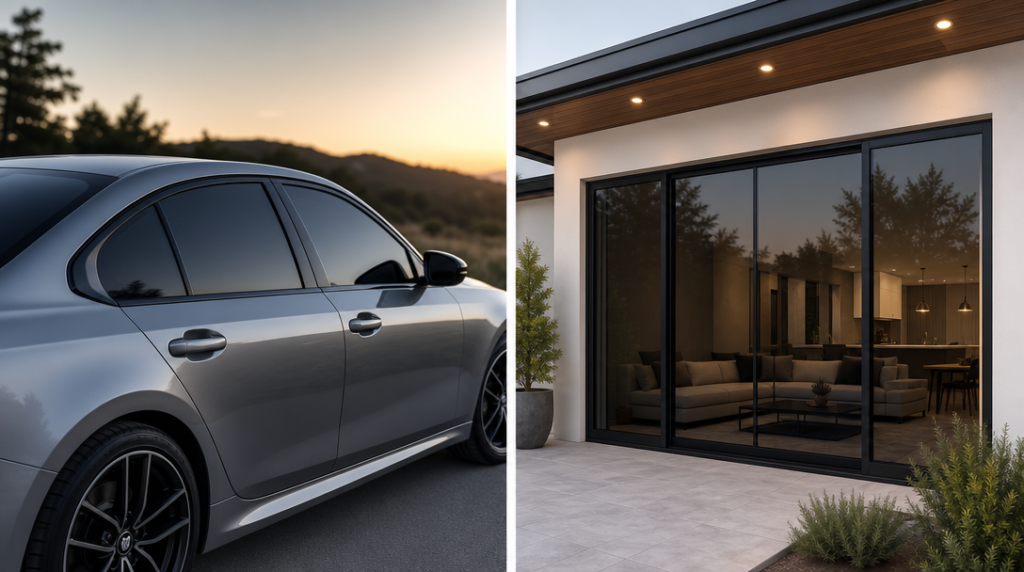
Bottom line, auto tint is made for moving glass, curved glass, and legal driving visibility.
What Home Tint Is Designed to Do
Home tint is made for residential window glass. It is usually installed on fixed windows, sliding glass doors, patio doors, bathroom windows, entry glass, bedroom windows, living room windows, and home office windows.
Home tint is often chosen for:
- Heat control
- Glare reduction
- UV protection
- Daytime privacy
- Furniture protection
- Flooring protection
- Hot room comfort
- Bathroom privacy
- Street-facing window privacy
- Less reliance on closed blinds
The U.S. Department of Energy’s Building America Solution Center says window attachments can reduce cooling and heating energy use, improve comfort, reduce glare, increase privacy, add security, and help homes handle extreme heat events.
What this means for Bakersfield homeowners is simple. Home tint is usually about making rooms more comfortable and more usable. If a living room gets too hot, a home office has screen glare, or a bedroom faces the street, residential window film can help.
The real question is not only whether you want darker glass. The better question is which film fits the room, the glass type, and the problem you want to solve.
Auto Tint vs Home Tint for Heat Control
Auto tint vs home tint often starts with heat control. Bakersfield, CA has long hot seasons. According to WeatherSpark, Bakersfield’s hot season lasts from June 8 to September 20, with average daily high temperatures above 91°F.
That heat affects both vehicles and homes, but not in the same way.
Auto Tint for Heat
Auto tint helps reduce the heat you feel through vehicle glass. This can make daily driving more comfortable, especially during commutes, school pickup, job site parking, errands, and long drives.
Ceramic auto tint is often a strong choice because it can reject infrared heat without needing to be extremely dark. This matters for front side windows where California rules limit how dark the tint can be.
Auto tint can help with:
- Hot side glass
- Bright road glare
- Rear passenger comfort
- Heat buildup while parked
- Cabin comfort during driving
- Large glass areas on Teslas and SUVs
Home Tint for Heat
Home tint helps reduce solar heat gain through windows. This can make hot rooms feel better and may help reduce cooling strain, depending on the home, glass, shade, HVAC system, and daily habits.
Home tint can help with:
- West-facing windows
- South-facing windows
- Sliding glass doors
- Hot living rooms
- Warm bedrooms
- Bright home offices
- Patio doors that get direct sun
Here’s what matters. Auto tint fights cabin heat in a vehicle. Home tint fights room heat in a building. The goal is similar, but the film and glass setup are different.
Auto Tint vs Home Tint for Glare
Glare is another major reason people compare auto tint vs home tint. Bakersfield sun can be harsh on the road and inside the home.
Auto Tint for Glare
Auto tint can reduce glare while driving. This can make bright roads, low-angle sun, and light bouncing off other vehicles easier to handle.
Drivers may notice glare from:
- Morning sun
- Late afternoon sun
- Other windshields
- Road surfaces
- Side mirrors
- Headlights at night
- Large glass roofs
A balanced tint setup can help without making the windows too dark for safe night driving.
Home Tint for Glare
Home tint can reduce glare on TVs, laptops, tablets, phones, and office screens. It can also make living rooms, kitchens, and bedrooms feel less harsh during sunny hours.
Home glare often shows up on:
- Computer monitors
- TVs
- Kitchen counters
- Glass tables
- Framed pictures
- White walls
- Tile or glossy flooring
Now here’s the thing. Closing blinds blocks glare, but it also blocks the view and natural light. Window film can reduce glare while keeping the room open and brighter than heavy coverings.
Auto Tint vs Home Tint for Privacy
Auto tint vs home tint also differs when it comes to privacy.
Auto Tint Privacy
Auto tint can make it harder to see into a vehicle, especially on rear windows. Drivers often choose tint for rear-seat privacy, cargo privacy, and a cleaner look.
Privacy can be helpful for:
- Kids in the back seat
- Work gear
- Sports equipment
- Shopping bags
- Tools
- Rideshare vehicles
- SUVs and trucks
Front side windows must still follow California rules, so privacy on front glass has limits.
Home Tint Privacy
Home tint can help with daytime privacy on street-facing windows, bathrooms, entry glass, sliding doors, and rooms near neighbors. The right privacy film depends on when privacy is needed.
Some films help more during the day when it is brighter outside. Frosted or decorative films can give privacy day and night, depending on the setup.
Home privacy film can help with:
- Bathroom windows
- Front doors
- Sidelights
- Bedroom windows
- Home offices
- Living rooms facing the street
- Garage windows
- Sliding patio doors
The catch is that privacy changes with lighting. If it is dark outside and bright inside, some reflective films may not give the same privacy. A tint professional can explain what to expect.
Why Vehicle Glass and Home Glass Need Different Film
Vehicle glass and home glass are different, so they need different film.
Vehicle glass may be tempered, laminated, curved, small, steep, framed by trim, or built into roll-down doors. It also has to handle vibration, daily movement, and frequent temperature changes from parking in sun and using air conditioning.
Home glass is usually larger, flatter, and fixed in a frame. It may be single-pane, dual-pane, tempered, annealed, low-E, or part of an insulated glass unit. The wrong film on the wrong home glass can create stress or performance problems.
What this means is simple. Auto tint and home tint are not interchangeable. Each film is made for a different glass type and a different use.
A trained installer should consider:
- Glass type
- Glass size
- Direction of sun exposure
- Film absorption
- Heat stress risk
- Frame type
- Vehicle legal limits
- Room comfort goals
- Desired privacy
- Warranty guidance
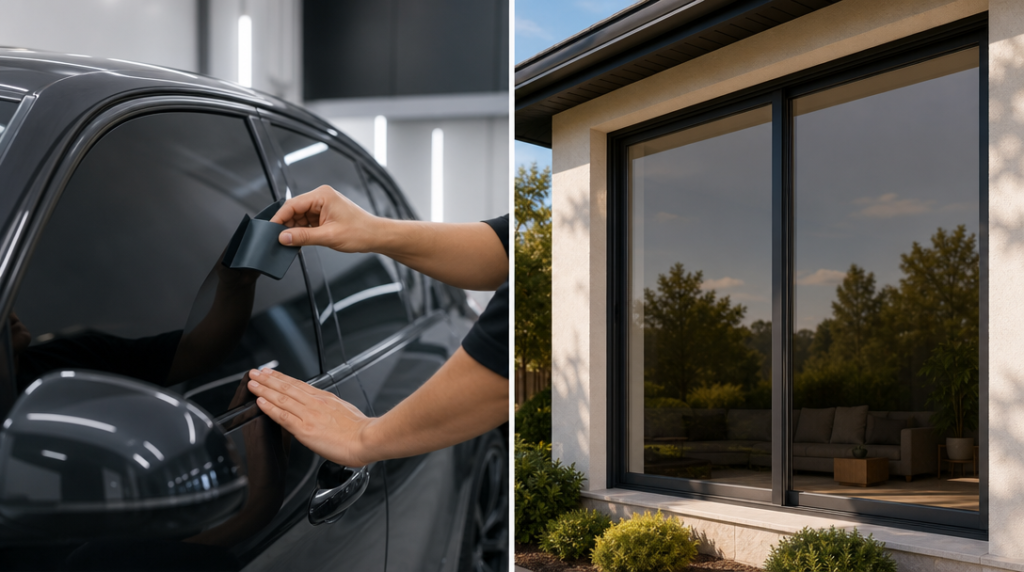
Bottom line, choosing the right film is not only about shade. It is about matching the film to the glass.
Legal Rules: Cars Have Different Limits Than Homes
One of the biggest differences in auto tint vs home tint is the law.
Vehicle tint in California is regulated because driver visibility matters. California Vehicle Code Section 26708 covers rules for material applied to vehicle windows and clear driver vision.
Front side windows have stricter limits than rear side windows and rear glass. Windshield tint also has strict placement rules. That means a film shade that looks good may not be legal on the front side windows of a car.
For vehicles, the shop should explain:
- Front side window limits
- Rear side window options
- Rear glass rules
- Mirror requirements
- Windshield strip rules
- Factory glass effect on final VLT
- Legal film choices
Home tint does not follow the same vehicle tint rules. A homeowner has more flexibility with privacy, decorative film, solar film, and security film. That said, home glass still needs the right film for the window type and warranty concerns.
Here is why this matters for Bakersfield customers. A dark film may be fine for a bathroom window, but it may not be legal for a front car window. A film that works on a vehicle may not be right for a large home window.
Can You Use Auto Tint on Home Windows?
You should not use auto tint on home windows unless a trained installer confirms it is safe and appropriate, which is usually not the standard choice. Auto tint is made for vehicles, not residential glass systems.
Auto film may not be designed for:
- Large flat residential panes
- Insulated glass units
- Certain low-E windows
- Long-term home sun exposure
- Heat stress on building glass
- Residential warranty needs
- Decorative or privacy goals
A home window film should be chosen for the room, glass type, sun direction, and desired outcome. Solar film, decorative film, privacy film, or security film may all be options depending on the home.
Let’s break it down. A bedroom window, bathroom window, living room window, and sliding patio door each need different thinking. The film needs to fit the glass and the job.
If your home feels too hot or too bright, ask about residential window tint rather than asking for auto tint on house glass.
Can You Use Home Tint on Car Windows?
You should not use home tint on car windows. Home film is not made for vehicle glass, roll-down windows, curved rear glass, or California vehicle tint rules.
Car windows need film that can handle:
- Curved glass
- Roll-down motion
- Door seals
- Rear defroster lines
- Vehicle vibration
- Tight trim
- Legal VLT limits
- Night visibility
- Automotive appearance
- Driver safety
A home film may not shrink, shape, or perform correctly on car glass. It may also create legal issues if used on a vehicle.
What this means is simple. Use automotive film for vehicles. Use residential film for homes. A professional tint shop can help you choose the right product for each glass surface.
Dynamic Window Tint installs both, which makes it easier to get the right recommendation instead of trying to force one film into the wrong job.
How to Choose the Right Tint for Your Project
The easiest way to compare auto tint vs home tint is to start with your goal.
Choose Auto Tint If You Want
- A cooler vehicle cabin
- Less glare while driving
- Rear-seat privacy
- A cleaner vehicle look
- Legal front-window tint options
- UV protection for passengers
- Ceramic tint for Bakersfield heat
- Tint for a Tesla, Cybertruck, RV, boat, car, truck, or SUV
Choose Home Tint If You Want
- Less heat in sunny rooms
- Less glare on screens
- Daytime privacy
- Bathroom privacy
- Protection for furniture and floors
- More comfort in west-facing rooms
- A better living room or home office setup
- Decorative, solar, privacy, or security film
Ask These Questions Before Booking
- Is this for a vehicle or home?
- Which windows are causing the problem?
- Is heat, glare, privacy, or style the main goal?
- Do I need ceramic film?
- Do I need decorative or frosted film?
- Does California law affect this window?
- Does my home glass need a specific film type?
- Do I want daytime privacy or full privacy?
- Do I want a lighter look or darker look?
Next steps are simple. Tell Dynamic Window Tint what you want the glass to do, and the team can help match the film to the job.
Schedule Auto Tint or Home Tint in Bakersfield, CA
Auto tint vs home tint comes down to glass type, film type, and the problem you want solved. Vehicles need automotive film that fits California rules and daily driving. Homes need residential film that fits the glass, room, sun exposure, and privacy needs.
Dynamic Window Tint installs both vehicle and home window tint in Bakersfield, CA and nearby areas.
Our shop is located at:
Dynamic Window Tint
4609 New Horizon Blvd Suite #10
Bakersfield, CA 93313
Phone: (661) 634-5585
Business hours:
- Monday through Wednesday: 8 AM to 5 PM
- Friday through Saturday: 8 AM to 5 PM
- Sunday: 8 AM to 2 PM
Dynamic Window Tint has 225 reviews and a 5-star rating. We are certified and carry warranties on all products and services.
We serve Bakersfield, CA, Lamont, CA, Shafter, CA, Arvin, CA, Rosedale, CA, Oildale, CA, Wasco, CA, and nearby Kern County communities.
Our services include:
- Window tinting
- Vehicle window tint
- Tesla window tint
- Cybertruck window tint
- Residential window tint
- Commercial window tint
- Windshield protection film
- Windshield chip repair
- Ceramic coating
- Paint protection film
Call (661) 634-5585 or visit https://dynamicwindowtintca.com/contact-us to schedule auto tint or home tint in Bakersfield, CA.
FAQs About Auto Tint vs Home Tint
1. What is the main difference between auto tint and home tint?
Auto tint is made for vehicle glass, curved windows, roll-down windows, and California tint rules. Home tint is made for residential glass, room comfort, privacy, glare control, and solar heat reduction.
2. Can I use auto tint on home windows?
It is usually not the right choice. Home windows need film matched to residential glass type, sun exposure, and room goals. Use residential window film for house glass.
3. Can I use home tint on car windows?
No. Home tint is not made for vehicle glass, roll-down windows, curved rear windows, or California vehicle tint rules. Cars need automotive window film.
4. Which tint is better for heat?
Both can help with heat when the right film is used. Auto ceramic tint can help reduce heat inside a vehicle. Residential solar film can help reduce solar heat gain in hot rooms.
5. Does home tint have legal limits like car tint?
Home tint does not follow the same California vehicle tint laws. Vehicles have rules because driver visibility matters. Homes have more flexibility, but the film still needs to fit the glass type.
6. Is ceramic tint only for vehicles?
Ceramic technology is common in automotive tint, but residential films can also be made for heat rejection and solar control. The right film depends on the glass and project.
7. Where can I get auto tint or home tint in Bakersfield, CA?
Call Dynamic Window Tint at (661) 634-5585 or visit https://dynamicwindowtintca.com/contact-us. The shop installs vehicle, residential, and commercial window tint in Bakersfield, CA and nearby areas.
Sources
- Automotive Window Film, International Window Film Association, Publication Date: Not listed, accessed July 22, 2026.
- Benefits of Window Film, International Window Film Association, Publication Date: Not listed, accessed July 22, 2026.
- Window Attachments for Solar Control and Energy Efficiency, U.S. Department of Energy Building America Solution Center, Publication Date: 2022, accessed July 22, 2026.
- Windows, U.S. Department of Energy, Publication Date: Not listed, accessed July 22, 2026.
- California Vehicle Code Section 26708, California.Public.Law, Published July 21, 2026, accessed July 22, 2026.
- Average Weather in Bakersfield, California, WeatherSpark, Publication Date: Not listed, accessed July 22, 2026.
- Dynamic Window Tint, Dynamic Window Tint, Publication Date: Not listed, accessed July 22, 2026.
- Window Tint in Bakersfield, CA, Dynamic Window Tint, Publication Date: Not listed, accessed July 22, 2026.
- Residential Window Tint in Bakersfield, CA, Dynamic Window Tint, Publication Date: Not listed, accessed July 22, 2026.
- Commercial Window Tint in Bakersfield, CA, Dynamic Window Tint, Publication Date: Not listed, accessed July 22, 2026.
- Tesla Window Tint in Bakersfield, CA, Dynamic Window Tint, Publication Date: Not listed, accessed July 22, 2026.
- Cybertruck Window Tint in Bakersfield, CA, Dynamic Window Tint, Publication Date: Not listed, accessed July 22, 2026.
- Contact Dynamic Window Tint, Dynamic Window Tint, Publication Date: Not listed, accessed July 22, 2026.
