

Window Tint and Glare become closely connected when your Bakersfield, CA commute puts a low morning sun directly in your field of view. Sunrise can create harsh light through side glass, bright reflections from other vehicles, and changing glare as you turn onto different streets.
Early-morning glare presents a different tint problem from afternoon cabin heat.
You want enough visible-light reduction to make bright conditions easier to handle, but you still need good visibility before sunrise, in shadows, during cloudy mornings, and after dark. Choosing extremely dark film just because morning glare bothers you can create another problem once light levels drop.
This is where Visible Light Transmission, or VLT, becomes one of the first window-film measurements to compare.
The International Window Film Association explains that glare occurs when light in the field of vision exceeds what the eyes can comfortably adapt to. The group also notes that comparing VLT can give drivers a useful way to compare glare reduction between films.
For Bakersfield commuters, a good tint plan balances glare reduction, outward visibility, solar performance, California law, and the hours you normally spend behind the wheel.
Table of Contents
- Why Early-Morning Sun Creates So Much Glare
- How Window Tint Can Reduce Driving Glare
- Why VLT Matters for Morning Commutes
- Does Darker Tint Always Reduce More Glare?
- Why Night Visibility Belongs in the Tint Decision
- Side Window Glare vs Windshield Glare
- What About a Windshield Tint Strip?
- Can Clear or Light Ceramic Film Help With Glare?
- Rayno S5 for Morning Commuters
- Rayno S7 for Morning Commuters
- Rayno S9 for Morning Commuters
- Glare Reduction vs Heat Rejection
- Why TSER Still Matters for Valley Drivers
- How Factory Privacy Glass Changes the Decision
- Glare From Side Mirrors and Other Vehicles
- What Commuters Should Consider Before Choosing Film
- California Tint Rules for Front Windows
- Choosing Tint for a Commute That Starts Before Sunrise
- Window Tint for Morning Glare in Bakersfield CA
- FAQs About Window Tint and Glare
Why Early-Morning Sun Creates So Much Glare
Morning sunlight sits low near the horizon.
That low angle can place bright light directly in front of a driver instead of sending sunlight mainly down onto the roof and hood.
Glare can also change quickly.
You might leave home while the sky is still dim and then encounter bright sunlight minutes later.
Trees, buildings, overpasses, and other vehicles can create repeated transitions between shade and direct light.
You may also see glare reflected from:
- Windshields ahead of you
- Chrome trim
- Vehicle paint
- Side mirrors
- Wet pavement
- Glass buildings
- Road signs
- Polished vehicle surfaces
The International Window Film Association describes glare as a loss of visual performance caused by light levels that exceed what the eyes can adapt to comfortably.
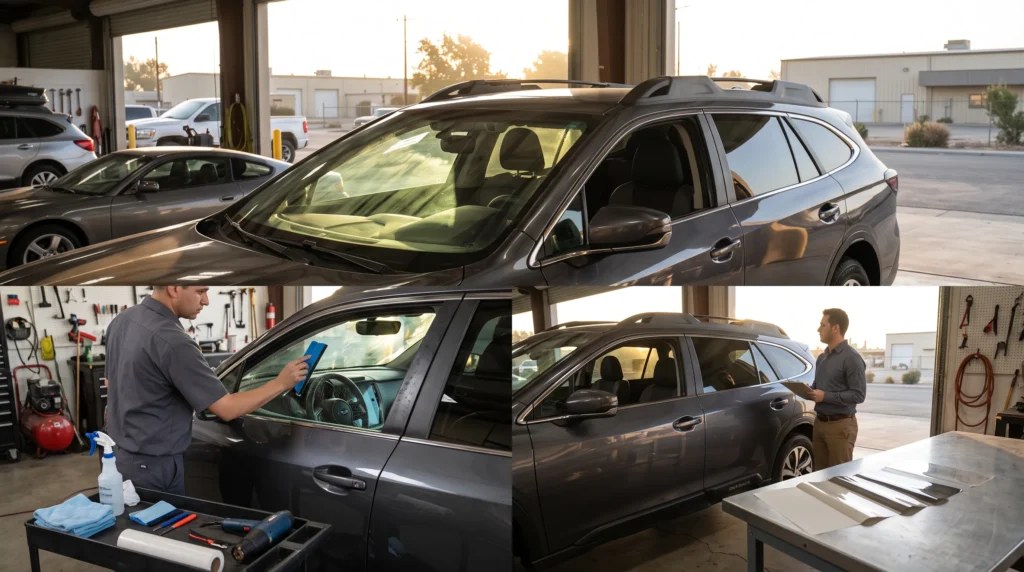
Window film can reduce visible light through treated glass, but film should be chosen without sacrificing the visibility you need during darker parts of the commute.
How Window Tint Can Reduce Driving Glare
Automotive window film reduces part of the visible light passing through treated glass.
How much depends heavily on VLT.
A darker film with lower VLT allows less visible light through.
That can reduce brightness from side windows and rear glass.
This may help when morning sunlight enters from:
- The driver-side window
- The front passenger window
- Rear side glass
- Rear glass
Film can be especially useful when glare comes from the side rather than directly through the center of the windshield.
A driver traveling through Bakersfield, CA may notice that sunlight changes sides as the route turns.
One section of the commute may put bright sun near the driver’s door.
Another turn may place it through the passenger-side glass.
Treating compatible side windows with a suitable film can reduce those brightness changes.
Why VLT Matters for Morning Commutes
VLT means Visible Light Transmission.
The International Window Film Association explains that higher VLT allows more visible light through, while lower VLT produces darker glass.
Think of a few common film levels.
50% VLT
A 50% film keeps much of the cabin visually bright.
This can appeal to commuters who drive before sunrise or after dark.
35% VLT
A 35% film reduces more visible light.
It can offer stronger visible-light reduction while still allowing considerably more light through than very dark tint.
20% VLT
A 20% film creates a noticeably darker window.
It may suit eligible rear glass where privacy and glare reduction carry more weight.
5% VLT
A 5% film is extremely dark.
Very little visible light passes through.
A shade this dark can change nighttime visibility considerably and is not a normal choice for California front side glass.
The right VLT depends on which window is being tinted and when you drive.
Does Darker Tint Always Reduce More Glare?
Lower VLT generally reduces more visible light through the treated glass.
That can reduce glare.
Still, choosing the darkest film possible is not always a good answer for an early-morning commuter.
Your commute may begin while it is still dark.
You may drive through shaded streets.
You may return home after sunset.
You may need to check side mirrors while turning onto a poorly lit road.
The same dark film that feels comfortable when the sun is directly beside you can feel very different before dawn.
This is why the International Window Film Association says VLT gives drivers a useful relative comparison for glare, while also noting that glare itself involves more than one factor.
Choose enough visible-light reduction for the problem without forgetting the darker hours when the same glass still needs to be seen through.
Why Night Visibility Belongs in the Tint Decision
Morning commuters often think about sunrise.
They should also think about the minutes before sunrise.
If your workday starts early, you may leave home under streetlights and reach the highway before daylight has fully developed.
Very dark side glass can make it harder to see:
- Cyclists
- Pedestrians
- Curbs
- Driveway edges
- Vehicles without bright lights
- Objects beside the road
- Dark parking areas
Rear tint can also change what you see through side and rear glass after dark.
A good commuter tint plan considers the darkest part of your driving schedule as well as the brightest.
Side Window Glare vs Windshield Glare
These problems need to be separated.
Side Window Glare
Side-window film can reduce visible light entering from the left or right.
This is where ordinary automotive tint is often most useful for glare.
Windshield Glare
Direct sunrise through the windshield is more complicated.
California law restricts material applied to windshields.
A legal side-window film does not solve every case of direct windshield glare.
You may still need to use:
- The factory sun visor
- Sunglasses suited for driving
- A legal windshield strip
- A clean windshield inside and out
- Good wiper blades when weather affects visibility
Do not use side-window tint as proof that full-windshield dark tint is a good idea.
The law treats the windshield differently.
What About a Windshield Tint Strip?
California Vehicle Code Section 26708 allows transparent material on the topmost portion of the windshield when listed conditions are met.
California describes placement using the position of the bottom edge of the material.
The bottom edge must be at least 29 inches above the undepressed driver’s seat under the measurement method set out in the statute.
The law also places conditions on color, lettering, and reflection.
That wording is more precise than the common phrase “top four inches.”
A windshield strip may help with some higher-angle light.
It cannot eliminate every case of low sunrise glare near the horizon because the sun may sit well below the area covered by the strip.
If direct windshield glare is your main problem, discuss legal options before applying any material.
Can Clear or Light Ceramic Film Help With Glare?
A lighter film can reduce some visible light, but it will not reduce glare as much as a much darker film solely through VLT.
Its advantage is balance.
A commuter may want to keep the cabin light and preserve nighttime visibility while gaining ceramic-film solar properties.
Rayno’s Phantom lineup offers 50% VLT choices across S5, S7, and S9.
Those three films have similar listed visible-light transmission but different published TSER and infrared figures.
That means you can choose a film tier based on solar performance without automatically making the glass darker.
Rayno S5 for Morning Commuters
Dynamic Window Tint carries Rayno Window Film for automotive tint installations in Bakersfield, CA.
Rayno Phantom S5 comes in several VLT levels.
Current Rayno specifications list:
- 5% to 50% VLT choices
- 41% to 66% TSER across listed shades
- 53% to 72% IR rejection
- 99.9% UV rejection
- Less than 1% published fading rate
Rayno S5-50 is listed at:
- 50% VLT
- 41% TSER
- 56% IR rejection
- 99.9% UV rejection
A lighter S5 shade can appeal to someone who wants ceramic film but drives regularly before sunrise.
Rayno S7 for Morning Commuters
Rayno Phantom S7 publishes higher IR numbers than S5 across much of the lineup.
Current Rayno specifications list:
- 47% to 66% TSER
- 70% to 81% IR rejection
- 99.9% UV rejection
- Less than 1% published fading rate
Rayno S7-50 is listed at:
- 50% VLT
- 47% TSER
- 74% IR rejection
- 99.9% UV rejection
This is useful when you want to compare two films at a similar darkness.
S5-50 and S7-50 both list 50% VLT, yet their published solar figures differ.
Rayno S9 for Morning Commuters
Rayno Phantom S9 carries Rayno’s strongest current published IR figures among the S5, S7, and S9 choices.
Current specifications list:
- 53% to 70% TSER
- 91% to 93% IR rejection
- 99.9% UV rejection
- Less than 1% published fading rate
Rayno S9-50 is listed at:
- 50% VLT
- 53% TSER
- 92% IR rejection
- 99.9% UV rejection
For a driver trying to keep a lighter appearance, comparing S9-50 with S7-50 and S5-50 shows how film tier and darkness can be separate decisions.
Review current choices on the Dynamic Window Tint vehicle window tint page.
Glare Reduction vs Heat Rejection
Glare and solar heat are related to sunlight, but they are not the same measurement.
When glare bothers you, VLT carries a lot of weight because glare involves visible light.
When solar heat bothers you, look at TSER and IR rejection.
Imagine two drivers.
The first driver says:
“The morning brightness through my side window makes me squint.”
That person should pay close attention to VLT and legal front-window limits.
The second says:
“The glass does not look especially bright, but I feel sun heating my arm during the drive.”
That person should also compare TSER and IR rejection.
Many Bakersfield commuters experience both problems.
Why TSER Still Matters for Valley Drivers
TSER means Total Solar Energy Rejected.
It describes the share of total solar energy rejected under the stated testing.
The International Window Film Association explains that TSER can be used to describe automotive film solar performance.
This makes TSER useful when your morning commute continues after sunrise and the cabin starts receiving stronger solar energy.
IR rejection is worth checking too, but it measures a different portion of the solar spectrum.
Do not compare a 92% IR figure directly with a 53% TSER figure as though one replaces the other.
They answer different questions.
How Factory Privacy Glass Changes the Decision
Many trucks, SUVs, and crossovers already have dark factory glass behind the driver.
Adding film over that glass can make the finished window much darker.
Suppose factory privacy glass transmits about 25% of visible light.
Add 50% film and the approximate combined VLT becomes:
0.25 × 0.50 = 0.125
That is about 12.5% VLT.
For a driver commuting before sunrise, that could be much darker than expected.
If your rear glass already provides enough privacy, ask about lighter ceramic film when solar performance is your goal.
You do not have to add another very dark layer simply because the vehicle is being tinted.
Glare From Side Mirrors and Other Vehicles
Not every bright reflection comes directly through an untreated window.
Light can bounce from other vehicles into your side mirrors.
It can also reflect from the road and enter from changing directions.
Window film may reduce the intensity of some light passing through treated side glass, but it cannot remove every source of glare.
Keep your:
- Windshield clean
- Side glass clean
- Mirrors clean
- Wiper blades in usable condition
A hazy interior windshield can scatter bright morning light and make glare appear worse.
Film works better as part of a clear-visibility setup than as an attempt to compensate for dirty glass.
What Commuters Should Consider Before Choosing Film
Before selecting Window Tint and Glare film for a morning commute, think through your actual route.
Ask yourself:
What Time Do I Leave?
Do you start before sunrise or after daylight?
Where Does the Glare Enter?
Is it through the windshield, driver window, or passenger window?
Do I Drive Home After Dark?
If yes, nighttime visibility deserves extra weight.
Is Heat Also a Problem?
Compare TSER and IR rejection along with VLT.
Does My Vehicle Have Factory Privacy Glass?
The finished rear VLT can become much darker after film is added.
Do I Want Privacy?
A lower VLT may fit eligible rear glass if privacy is part of the goal.
How Much Exterior Appearance Do I Want to Change?
Some drivers want dark glass.
Others want a lighter factory-style look.
What Does California Allow on That Window?
Front glass and rear glass do not have the same rules.
California Tint Rules for Front Windows
California Vehicle Code Section 26708 places tight restrictions on front-window film.
The current statute allows clear, colorless, transparent material on the front side windows when several conditions are met.
The material must have at least 88% visible light transmittance.
The window glazing with the material applied must meet Federal Motor Vehicle Safety Standard No. 205, including the stated minimum light transmittance of 70%.
The law also requires the material to be designed to increase protection from UVA rays and requires certification identifying the installing company and film manufacturer.
California gives broader allowances to side windows behind the driver.
Rear-window exceptions also apply when the vehicle has qualifying outside mirrors on both sides.
The law matters when glare is your reason for tinting because the driver’s immediate side glass may be the exact window you want darker.
A film that feels comfortable is not automatically a legal front-window setup.
Review our California window tint laws guide for Bakersfield drivers before choosing front glass film.
Choosing Tint for a Commute That Starts Before Sunrise
A driver leaving home at 5:30 AM has a different tint decision from someone who drives only at noon.
You may experience:
- Darkness when you leave home
- Low light during the first part of the trip
- Sunrise near the horizon
- Bright glare minutes later
- Stronger solar heat as the morning continues
That wide range of light makes balance especially useful.
A moderate or light ceramic film may fit better than an extremely dark shade if you need to see clearly during the first part of the trip.
Eligible rear windows can still use darker film when privacy is wanted.
The vehicle does not need the same VLT on every piece of glass.
Window Tint for Morning Glare in Bakersfield CA
Window Tint and Glare should be considered together when your daily drive includes low morning sun.
For Bakersfield, CA commuters, start with the direction of the glare and the hours you drive.
If the brightness comes through side glass, compare VLT.
If solar heat is also part of the problem, compare TSER and IR rejection.
If your commute begins before sunrise, think carefully before choosing very dark film.
If your SUV or truck already has dark privacy glass, consider how additional film changes the finished VLT.
If glare comes directly through the windshield, remember that California places separate restrictions on windshield material.
Dynamic Window Tint provides automotive window tint in Bakersfield, CA using Rayno Window Film.
The shop is located at:
4609 New Horizon Blvd Suite #10 Bakersfield, CA 93313
Dynamic Window Tint works with commuters from Bakersfield, CA and nearby areas including Rosedale, CA, Oildale, CA, Shafter, CA, Lamont, CA, Arvin, CA, Wasco, CA, and surrounding Kern County communities.
When scheduling, tell the shop that morning glare is one of your concerns.
Also explain:
- What time you leave for work
- Whether you drive before sunrise
- Which side of the vehicle gets the glare
- Whether you drive after dark
- Whether the vehicle has factory privacy glass
- Whether cabin heat is also bothering you
- How dark you want the vehicle to look
Dynamic Window Tint is certified and carries warranties on its products and services.
Call (661) 634-5585 or visit the Dynamic Window Tint contact page to schedule an appointment.
FAQs About Window Tint and Glare
1. Does window tint help with early-morning sun glare?
Window film can reduce visible light entering through treated glass, which may reduce glare from bright side sunlight. The amount of visible-light reduction depends heavily on VLT. Direct glare through the windshield requires separate consideration because California restricts windshield film.
2. What VLT is good for morning commuters?
There is no single VLT that fits every driver. Someone driving before sunrise may prefer lighter glass than someone who drives only during daylight. Consider visibility after dark, glare level, glass position, and California rules before choosing.
3. Does darker tint reduce more glare?
Lower-VLT film generally reduces more visible light, which can provide stronger glare reduction. Very dark film can also reduce outward visibility in low-light conditions, so drivers who commute before sunrise or after dark should consider both situations.
4. Is ceramic tint better for glare?
Ceramic construction does not automatically determine glare reduction. VLT has a strong relationship with visible brightness. Ceramic film becomes more useful when you also want published IR rejection, TSER, UV rejection, and lighter shade choices.
5. Can light ceramic tint help with morning heat?
Yes. A lighter film can still publish strong solar measurements. Rayno S9-50 is listed at 50% VLT, 92% IR rejection, 53% TSER, and 99.9% UV rejection.
6. Can I use dark tint on the front windows to stop sunrise glare in California?
California places tight restrictions on material applied to the front side windows. Current Section 26708 allows clear, colorless, transparent material only when listed VLT, glazing, UVA, and certification conditions are met. Discuss the current requirements before choosing front-window film.
7. Where can I get window tint for commute glare in Bakersfield, CA?
Dynamic Window Tint installs Rayno automotive film at 4609 New Horizon Blvd Suite #10, Bakersfield, CA 93313. Call (661) 634-5585 or visit the contact page to compare VLT, TSER, IR rejection, glare reduction, and film choices for your commute.
Sources
- Automotive Education Guide 2026
Publisher: International Window Film Association
Publication Date: 2026
Information referenced: Glare, Visible Light Transmission, Total Solar Energy Rejected, infrared rejection, solar-performance measurements, and how VLT relates to glare comparison. - Automotive Window Film
Publisher: International Window Film Association
Publication Date: 2024
Information referenced: Automotive glare reduction, VLT, heat control, UV reduction, and the need to consider local vehicle-window laws. - Rayno Phantom Series
Publisher: Rayno Window Film
Publication Date: Not listed
Information referenced: Phantom S5, S7, and S9 VLT, TSER, IR rejection, UV rejection, reflection, fading rate, and carbon ceramic construction. - California Vehicle Code Section 26708
Publisher: California Legislative Information
Publication Date: Amended 2025, effective January 1, 2026
Information referenced: Windshield material, front side window requirements, 88% film VLT, combined glazing requirements, rear side window exceptions, rear-window mirror provisions, and installer certification. - Window Tint in Bakersfield: The Complete 2026 Guide
Publisher: Dynamic Window Tint
Publication Date: 2026
Information referenced: Bakersfield morning and afternoon glare, local driving, ceramic film, heat control, privacy, and film selection. - Ceramic vs. Carbon Window Tint in Bakersfield’s Climate
Publisher: Dynamic Window Tint
Publication Date: 2026
Information referenced: Bakersfield glare, daily driving, ceramic and carbon film, visibility, and solar heat. - Window Tint in Bakersfield, CA
Publisher: Dynamic Window Tint
Publication Date: Not listed
Information referenced: Rayno automotive window film, certified installation, warranty-backed service, and local vehicle tinting. - California Window Tint Laws: What Bakersfield Drivers Need to Know
Publisher: Dynamic Window Tint
Publication Date: Not listed
Information referenced: Local explanation of California vehicle-window tint rules. - Contact Dynamic Window Tint
Publisher: Dynamic Window Tint
Publication Date: Not listed
Information referenced: Bakersfield address, phone number, and appointment information.
