

Sliding glass door window film can help Bakersfield, CA homeowners deal with two common patio problems: unwanted solar heat and harsh glare. Large patio doors bring in plenty of natural light and give you a wide outdoor view, but all that glass can also expose a room to hours of direct sunlight.
The problem can become more noticeable when the patio faces west or southwest. Late-day sunlight can hit the glass at a lower angle and spread across living rooms, kitchens, dining areas, and family rooms.
Closing curtains or blinds can reduce the brightness, but then you lose the patio view that made the large glass door appealing in the first place.
Residential window film gives you another option.
The right architectural film can reduce solar energy and glare while allowing varying amounts of daylight through the glass. You can still enjoy the backyard or patio without leaving the room exposed to the full force of the afternoon sun.
Here is what Bakersfield homeowners should know before choosing film for a sliding glass door.
Table of Contents
- Why Sliding Glass Doors Get So Hot
- Why Patio Door Glare Can Be So Strong
- Can Window Film Reduce Heat Through Sliding Glass Doors?
- Can Window Film Reduce Patio Door Glare?
- What Type of Film Works on Sliding Glass Doors?
- What Does SHGC Mean for Patio Door Film?
- What Does TSER Mean?
- How Much Natural Light Will You Lose?
- Rayno Platinum Film for Sliding Glass Doors
- Rayno Trinity Film for Patio Doors
- Rayno Platinum Air 7090 for a Lighter Look
- Sliding Glass Door Film vs Curtains and Blinds
- Can Patio Door Film Add Daytime Privacy?
- What About Nighttime Privacy?
- Will Window Film Protect Floors and Furniture?
- Check the Patio Door Glass Before Installing Film
- Which Bakersfield Patios Benefit Most From Window Film?
- Sliding Glass Door Window Film in Bakersfield, CA
- FAQs About Sliding Glass Door Window Film
Why Sliding Glass Doors Get So Hot
A sliding patio door can contain far more glass than a standard window.
That large glass area gives sunlight a wide path into the room.
The U.S. Department of Energy explains that windows, doors, and other glazed openings can add to a building’s heating and cooling load. Solar Heat Gain Coefficient is one of the measurements used to describe how much solar heat passes through glazing.
For a Bakersfield, CA home, the effect may become easy to notice during sunny afternoons.
You might feel warmth while sitting several feet away from the patio door.
The floor near the glass may feel warmer.
Furniture receiving direct sunlight may heat up.
A room that felt comfortable during the morning can feel very different by late afternoon.
The direction of the patio matters too.
West-facing sliding doors often receive strong late-day exposure. South- and southwest-facing glass can also receive substantial sunlight depending on the home, season, roofline, trees, patio cover, and nearby structures.
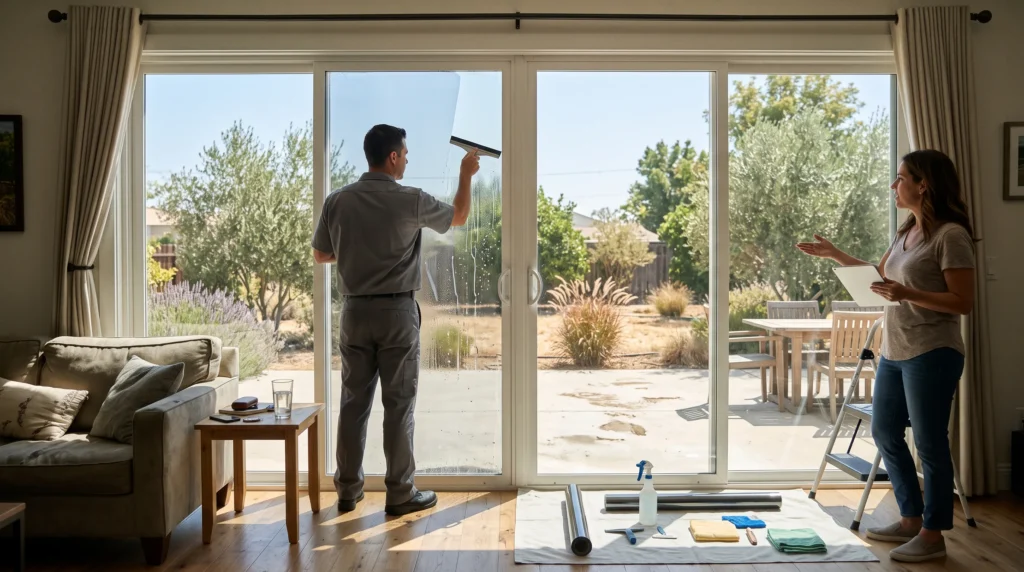
When the patio door represents a large percentage of one wall, treating the glass can address a major source of solar gain in that room.
Why Patio Door Glare Can Be So Strong
Heat is only part of the problem.
Large sliding glass doors can also create glare.
Low-angle sunlight can reflect from:
- Television screens
- Laptop monitors
- Phones
- Tablets
- Glass tables
- Polished countertops
- Tile floors
- Hardwood or laminate flooring
You may find yourself changing seats or closing the curtains every afternoon.
Glare is tied closely to visible light.
That means Visible Light Transmission, or VLT, becomes one of the film specifications worth checking.
A film with lower VLT allows less visible light through than a film with higher VLT.
Reducing visible light can help reduce glare, but going too dark can change the feel of the room more than you want.
The goal is usually to find a balance.
Can Window Film Reduce Heat Through Sliding Glass Doors?
Yes. Residential solar-control film can reduce part of the solar energy passing through treated glass.
The exact amount depends on the film and the glass system.
Window film manufacturers publish measurements such as:
- Solar Heat Gain Coefficient
- Total Solar Energy Rejected
- Visible Light Transmission
- UV rejection
- Visible Light Reflection
These figures give you a better basis for comparing film than asking which product looks darkest.
The U.S. Department of Energy describes SHGC as a measurement of solar heat transmitted through glazing. A lower SHGC means less solar heat passes through under the stated conditions.
This can be useful when your sliding door receives hours of direct Bakersfield sun.
Film cannot stop every source of room heat.
Heat can also move through walls, ceilings, doors, air leaks, and other windows.
Film deals with the solar energy coming through the treated glass.
When a large patio door is one of the room’s biggest exposed glass areas, that can matter.
Can Window Film Reduce Patio Door Glare?
Yes.
Window film can reduce the amount of visible light entering through the glass, depending on the film’s VLT.
This may make a living room or dining area easier to use during bright afternoon hours.
Suppose you have a sofa facing the patio and a television mounted on the opposite wall.
At 4 PM, sunlight begins coming through the sliding door and reflecting across the television.
You could close the curtains.
You could also consider a film that reduces enough visible light to soften the glare while keeping an outdoor view.
The right VLT depends on how bright the room already is.
A patio room with several windows may tolerate a lower VLT.
A darker room with only one sliding door may benefit from a lighter film.
What Type of Film Works on Sliding Glass Doors?
Sliding glass doors should use architectural film selected for the glass.
Do not assume automotive window tint can simply be moved from a car to a patio door.
Building glass can be very different from vehicle glass.
Residential doors may use:
- Tempered glass
- Dual-pane insulated glass
- Laminated glass
- Low-e glass
- Factory-tinted glass
Film construction and solar absorption can interact differently with these glass systems.
Before choosing film, have the glass checked.
Once compatibility is established, compare residential film using the measurements that matter for your room.
For Heat
Look at SHGC and TSER.
For Glare
Look at VLT.
For Daytime Privacy
Look at VLT and visible light reflection along with the appearance of the film.
For Keeping the Room Bright
Compare higher-VLT options.
For UV Reduction
Check the manufacturer’s published UV-rejection figure.
What Does SHGC Mean for Patio Door Film?
SHGC stands for Solar Heat Gain Coefficient.
It is expressed as a number between 0 and 1.
A lower number means less solar heat passes through the glazing system under the stated test conditions.
The U.S. Department of Energy notes that solar heat gain through windows can add to cooling loads and describes lower-SHGC glazing as suited to climates where reducing solar gain is desired.
For sliding glass doors in Bakersfield, this is one of the more useful numbers to compare.
Suppose Film A has an SHGC of 0.58.
Film B has an SHGC of 0.45.
Under the stated testing, Film B allows a smaller share of solar heat through.
That does not automatically make Film B right for every patio door.
Film B may also allow less visible daylight.
That is why SHGC should be considered with VLT.
What Does TSER Mean?
TSER stands for Total Solar Energy Rejected.
This figure represents the percentage of total solar energy rejected by the filmed glass under the manufacturer’s test conditions.
A higher TSER indicates more total solar energy is being rejected.
If afternoon heat is one of your main concerns, compare TSER between compatible films.
Do not confuse TSER with UV rejection.
Do not confuse it with VLT either.
They describe different characteristics.
A film can have high UV rejection while offering a different level of total solar energy rejection.
A film can also have strong TSER while allowing more visible light than you might expect.
How Much Natural Light Will You Lose?
That depends on VLT.
VLT stands for Visible Light Transmission.
A 70% VLT film allows more visible light through than a 50% film.
A 50% film allows more light through than a 35% film.
For a patio door, the difference can be noticeable because the glass area is so large.
You may want more glare reduction in a west-facing room.
You may want a lighter film if the sliding door is the room’s main source of daylight.
Ask yourself:
- Is the room already bright?
- Does it have other windows?
- Do I keep curtains open most of the day?
- Is glare a bigger concern than brightness?
- Do I want more daytime privacy?
- How much do I value the outdoor view?
These questions can narrow the film choices quickly.
Rayno Platinum Film for Sliding Glass Doors
Dynamic Window Tint carries Rayno architectural window film for residential glass in Bakersfield, CA.
Rayno Platinum is designed for residential and commercial spaces and publishes separate figures for visible light, solar heat, UV, and reflection.
Rayno Platinum PL-BL5099
Rayno currently lists PL-BL5099 with:
- 50% VLT
- 99.9% UV rejection
- 0.49 SHGC
- 51% TSER
- 6.8% visible light reflection
A 50% VLT can allow a substantial amount of daylight through while changing the solar performance of the glass.
For a large patio door, this may appeal to homeowners who want heat and glare control without making the room look heavily tinted.
Rayno Platinum PL-BC3599
Rayno currently lists PL-BC3599 with:
- 35% VLT
- 99.9% UV rejection
- 0.45 SHGC
- 55% TSER
- 6.8% visible light reflection
Compared with the 50% VLT product, this film allows less visible light through and carries a lower published SHGC and higher published TSER.
That may be worth comparing for patio doors receiving stronger direct afternoon sunlight.
You can learn more about Rayno architectural film on the Rayno Platinum product page.
Rayno Trinity Film for Patio Doors
Rayno Trinity is another architectural film designed for residential and commercial glass.
Rayno currently lists Trinity with:
- 50% VLT
- 99% UV rejection
- 0.49 SHGC
- 51% TSER
- 6.8% visible light reflection
Trinity also incorporates glass-retention properties as part of the film construction.
This can interest homeowners who are looking beyond solar control alone.
Still, the glass must be checked before choosing the film.
The fact that a product is architectural film does not mean it belongs on every type of sliding door.
Rayno Platinum Air 7090 for a Lighter Look
Some homeowners want to keep a very light appearance.
Rayno Platinum Air 7090 is a lighter nano-ceramic product Rayno lists for automotive and architectural applications.
Current published specifications include:
- 70% VLT
- 99% UV rejection
- 0.58 SHGC
- 42% TSER
- 7.3% visible light reflection
The higher VLT allows more visible daylight through than the 35% and 50% Platinum products.
The solar-control measurements are also different.
This creates a useful comparison.
A homeowner who wants the sliding door to stay visually light may prefer to discuss a higher-VLT film.
A homeowner whose west-facing patio produces heavy heat and glare may want to compare a stronger solar-control option.
Film selection is about choosing the balance you want rather than choosing the darkest sample.
Sliding Glass Door Film vs Curtains and Blinds
Window film does not have to replace curtains or blinds.
The two can work together.
Film remains on the glass throughout the day.
It can reduce solar energy and glare without requiring you to cover the patio view.
Curtains and blinds give you another level of control when you want:
- More darkness
- Nighttime privacy
- A different interior appearance
- Less daylight at certain times
For many Bakersfield homes, the combination works well.
Leave the curtains open when you want daylight and a patio view.
Close them when you need stronger privacy or darkness.
Can Patio Door Film Add Daytime Privacy?
Certain architectural films can make it more difficult to see into a home during daylight.
This usually depends on the lighting difference between indoors and outdoors.
When the patio area outside is much brighter than the room, reflective or tinted film can reduce the view inside.
Rayno describes its Platinum architectural film as providing outside visibility while adding privacy from exterior viewing.
This can be useful for patios that face:
- Neighboring homes
- Shared walkways
- Apartment common areas
- Pools
- Alleyways
- Nearby streets
Daytime privacy should still be treated separately from nighttime privacy.
What About Nighttime Privacy?
Reflective or tinted film cannot guarantee the same privacy after dark.
At night, your interior lights may make the room brighter than the patio outside.
That can make it easier for someone outdoors to see into the home.
If you need privacy at night, keep curtains, shades, or blinds available.
For glass where you do not need an outdoor view, frosted film may be another option.
If privacy is one of your main goals, read our guide to privacy window film for Bakersfield homes.
Will Window Film Protect Floors and Furniture?
Sunlight through a large patio door can expose floors, furniture, rugs, and other interior materials to UV and solar energy.
Rayno’s current Platinum architectural films list 99.9% UV rejection.
Rayno Trinity and Platinum Air 7090 list high UV-rejection figures as well.
UV is one contributor to fading, but it is not the only one.
Visible light, heat, material composition, and other environmental conditions can also play a role.
Window film can reduce UV exposure through treated glass, but it should not be described as making furniture fade-proof.
Check the Patio Door Glass Before Installing Film
This step matters.
Sliding glass doors frequently use tempered glass for safety.
Many newer patio doors also use insulated dual-pane units.
Others may contain low-e coatings designed to control heat transfer.
These details affect film selection.
The U.S. Department of Energy explains that insulated glazing and low-e coatings can already change the U-factor and SHGC of a window or door.
Adding film changes the way solar energy interacts with the glass again.
That is why a professional should check the door before choosing film.
Tell the installer if you know:
- The door manufacturer
- Whether the glass is dual-pane
- Whether it has low-e glass
- Whether the glass is tempered
- Whether the door has factory tint
- How old the door is
If you do not know, that is fine.
The installer can inspect the glass and discuss suitable film choices.
Which Bakersfield Patios Benefit Most From Window Film?
Sliding glass door film can make sense in several situations.
West-Facing Patios
These often receive direct late-afternoon sunlight.
If your family room becomes uncomfortable between the afternoon and sunset, check which direction the patio faces.
Southwest-Facing Patios
These doors can also receive prolonged afternoon exposure depending on the property.
Patios With Little Exterior Shade
A patio cover, mature tree, neighboring structure, or awning can block part of the sun before it reaches the glass.
Doors without this exterior shade receive more direct exposure.
Large Multi-Panel Doors
Some newer homes use very wide sliding or stacking glass doors.
More glass means more area available for solar energy and visible light to enter.
Rooms With Television Glare
If your television becomes difficult to watch every afternoon, a glare-reducing architectural film may be worth discussing.
Home Offices Near Patio Doors
A desk beside a patio door can receive intense visible light.
Film may help reduce screen glare while preserving a view outside.
Dining Areas With Afternoon Sun
Late-day sun can make a dining area uncomfortable around the same time your family wants to use it.
A suitable film may reduce some of that solar load through the glass.
Sliding Glass Door Window Film in Bakersfield, CA
Sliding glass door window film can give Bakersfield homeowners another way to manage patio heat and glare without keeping the view covered all afternoon.
The right film depends on more than shade.
Compare:
- SHGC
- TSER
- VLT
- UV rejection
- Visible light reflection
- Glass compatibility
- Patio direction
- Desired privacy
- Desired daylight
A west-facing sliding door dealing with heavy afternoon sun may call for a different product than a shaded north-facing door where the homeowner mainly wants UV reduction.
Dynamic Window Tint installs Rayno residential window film for homeowners in Bakersfield, CA and nearby Kern County communities.
Dynamic Window Tint is located at:
4609 New Horizon Blvd Suite #10 Bakersfield, CA 93313
Homeowners in Bakersfield, CA, Rosedale, CA, Oildale, CA, and nearby communities can contact the shop to discuss patio doors, large residential windows, glare, solar heat, privacy, and glass compatibility.
When you call, it helps to know:
- Which direction the patio faces
- When the room gets hottest
- Whether glare is a problem
- Whether privacy matters
- Whether you want the glass to stay light
- Whether the door is single-pane or dual-pane, if known
- Whether the glass has a low-e coating, if known
Dynamic Window Tint is certified and carries warranties on its products and services.
Call (661) 634-5585 or visit the Dynamic Window Tint contact page to schedule an appointment.
FAQs About Sliding Glass Door Window Film
1. Can you put window film on sliding glass doors?
Yes, architectural window film can be installed on many sliding glass doors. The glass should be checked first because patio doors may use tempered, insulated, laminated, factory-tinted, or low-e glass. Film must be matched to the glazing system.
2. Does window film reduce heat through patio doors?
Solar-control window film can reduce part of the solar energy entering through treated patio-door glass. Compare SHGC and TSER when looking at heat-related performance.
3. What window film is good for a west-facing sliding glass door?
The right choice depends on the glass and how much daylight you want. West-facing doors dealing with afternoon heat may benefit from a film with lower SHGC and higher TSER, while VLT helps determine how bright the room remains.
4. Does patio door film reduce glare on a television?
Window film can reduce visible light entering the room, which may help with glare on televisions and computer screens. Compare the film’s VLT when glare is one of your main concerns.
5. Will window film make my sliding door too dark?
Not necessarily. Architectural films come in different VLT levels. Rayno offers lighter and darker architectural options, allowing homeowners to compare daylight levels with solar-control performance.
6. Does sliding glass door film give privacy at night?
Reflective or tinted film should not be relied on for full nighttime privacy. When the room is brighter than the patio outside, people outside may be able to see in more easily. Curtains, blinds, shades, or another privacy solution may still be needed.
7. Where can I get sliding glass door window film in Bakersfield, CA?
Dynamic Window Tint installs Rayno residential window film for patios, sliding glass doors, and other home windows in Bakersfield, CA. Call (661) 634-5585 or visit the contact page to discuss heat, glare, privacy, and your patio-door glass.
Sources
- Rayno Platinum Architectural Window Film
Publisher: Rayno Window Film
Publication Date: Not listed
Information referenced: Residential applications, VLT, UV rejection, SHGC, TSER, visible light reflection, glare reduction, privacy, and solar-control specifications. - Rayno Trinity Architectural Window Film
Publisher: Rayno Window Film
Publication Date: Not listed
Information referenced: VLT, UV rejection, SHGC, TSER, visible light reflection, solar control, and glass-retention properties. - Rayno Platinum Air 7090
Publisher: Rayno Window Film
Publication Date: Not listed
Information referenced: Architectural application, VLT, UV rejection, SHGC, TSER, and visible light reflection. - Rayno Architectural Window Film
Publisher: Rayno Window Film
Publication Date: Not listed
Information referenced: Residential film applications, solar heat, natural light, UV exposure, and architectural film choices. - Purchasing Energy-Efficient Residential Windows, Doors, and Skylights
Publisher: U.S. Department of Energy
Publication Date: Not listed
Information referenced: Solar Heat Gain Coefficient, solar heat passing through glazing, visible transmittance, insulated glazing, and window and door performance. - Window Types and Technologies
Publisher: U.S. Department of Energy
Publication Date: Not listed
Information referenced: Insulated glazing, low-e coatings, solar heat gain, and visible daylight transmission. - Contact Dynamic Window Tint
Publisher: Dynamic Window Tint
Publication Date: Not listed
Information referenced: Bakersfield contact and appointment information.
