

Apartment window film in Bakersfield can help renters deal with bright afternoon sun, glare, UV exposure, unwanted visibility, and rooms that feel uncomfortable near large windows. The challenge is that renters do not own the glass. A film that works well in a house may not be the right choice for an apartment if the lease limits changes to windows or requires the unit to be returned in its original condition.
That does not mean renters have no options.
Temporary static-cling film, removable privacy coverings, interior shades, curtains, and landlord-approved professional architectural film can all be considered depending on the apartment, lease, window type, and problem you are trying to solve.
For Bakersfield, CA renters, solar exposure can be especially noticeable on west-facing bedrooms, upstairs apartments, sliding glass doors, and home-office windows. One room may receive strong afternoon sunlight while another part of the apartment stays comfortable.
The right renter-friendly choice starts with a simple question: do you need privacy, less glare, solar control, or all three?
Dynamic Window Tint provides residential window tint in Bakersfield, CA using Rayno Window Film. For renters, professional adhesive film should be discussed with the landlord or property manager before installation so everyone agrees on the product, glass, installation, and what happens when the tenancy ends.
Table of Contents
- Why Renters Consider Apartment Window Film in Bakersfield
- Check Your Lease Before Putting Film on Apartment Glass
- Renter-Friendly Option 1: Static-Cling Window Film
- Renter-Friendly Option 2: Removable Privacy Film
- Renter-Friendly Option 3: Temporary Window Shades
- Renter-Friendly Option 4: Landlord-Approved Architectural Film
- Apartment Window Film for Bakersfield Heat
- Apartment Window Film for Glare
- Privacy Film for Street-Facing Apartments
- Does Privacy Film Work at Night?
- UV Protection for Apartment Interiors
- Sliding Glass Door Film for Apartments
- Bedroom Window Film Options
- Home Office Window Film for Renters
- Why Glass Type Matters Before Applying Film
- Can Window Film Damage Apartment Glass?
- Rayno Architectural Film for Approved Apartment Installations
- What to Ask Your Landlord Before Professional Installation
- Schedule Residential Window Film in Bakersfield, CA
- Frequently Asked Questions
- Sources
Why Renters Consider Apartment Window Film in Bakersfield
Apartment window film in Bakersfield can be useful when closing the blinds all day is not the solution you want.
Many renters like natural daylight but do not like the problems that sometimes come with direct sun.
A bright window can create:
- Glare on televisions
- Glare on computer monitors
- Direct sunlight on furniture
- Less privacy from sidewalks or parking areas
- Bright bedrooms during daytime hours
- Hot areas near sliding glass doors
- Strong afternoon sunlight
- UV exposure on flooring and furnishings
The problem can depend heavily on the apartment’s direction.
A west-facing window may receive strong sun late in the day.
An east-facing bedroom may become bright early in the morning.
A ground-floor apartment may have a bigger privacy concern than an upper-floor unit.
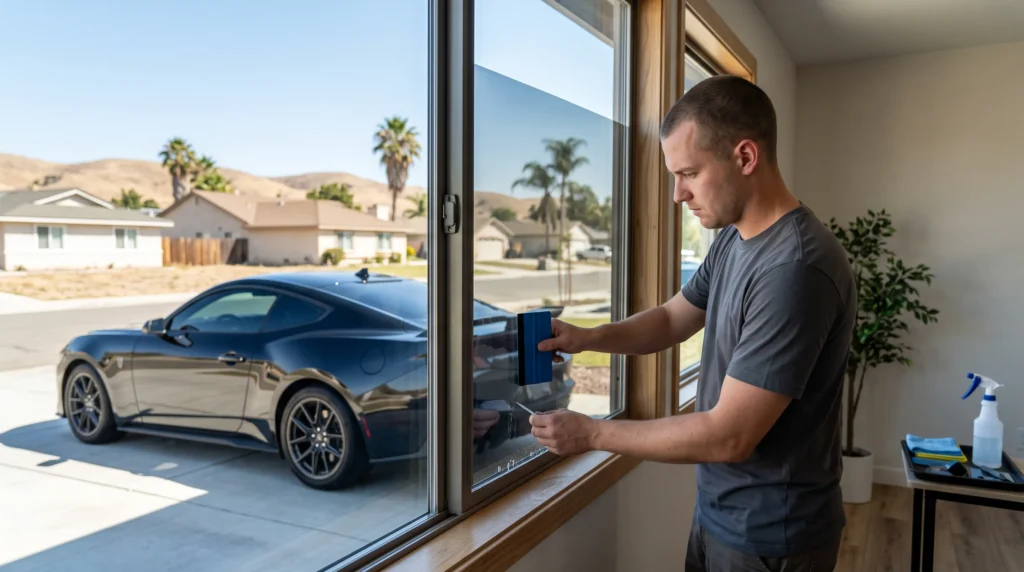
This is why apartment window film in Bakersfield should be chosen around the room rather than buying one roll of film and applying it to every window.
Check Your Lease Before Putting Film on Apartment Glass
Renters should start with the rental agreement.
The California Department of Real Estate’s tenant guide recommends keeping a copy of the rental agreement and reviewing its terms. A lease may contain rules covering alterations, window coverings, adhesives, appearance, or restoration of the unit.
Window film can be a physical change to property you do not own.
Before installing adhesive film, ask the landlord or property manager whether it is allowed.
Written approval is better than relying on a casual conversation because it gives both sides a record of what was approved.
Your request can include:
- Which windows you want treated
- The type of film
- Whether adhesive is used
- Who will install it
- Whether the film can be removed
- Who is responsible for removal
- Whether the glass needs to be restored when you leave
The real question is not only whether the film can come off.
You also need to know whether the property owner allows it on that glass in the first place.
Renter-Friendly Option 1: Static-Cling Window Film
Static-cling film is one of the first products renters often consider.
Unlike many professional architectural films, static-cling products are generally designed to stay on glass without a permanent adhesive layer.
That can make them easier to remove when you move.
Static-cling films are available in styles aimed at:
- Frosted privacy
- Decorative appearance
- Reduced visibility
- Light diffusion
- Daytime shading
Performance varies by product.
A decorative static-cling film should not automatically be expected to provide the same solar specifications as professionally installed architectural film.
If heat is the reason you want apartment window film in Bakersfield, check whether the manufacturer publishes information for solar heat rather than assuming a dark-looking product will make the room much cooler.
The same idea applies to UV protection.
Look for actual product specifications.
Renter-Friendly Option 2: Removable Privacy Film
Privacy can be the biggest concern for renters living near sidewalks, parking lots, courtyards, pools, or neighboring buildings.
Removable privacy film can make sense on:
- Bathroom windows
- Ground-floor bedrooms
- Front-facing living rooms
- Entry-door glass
- Home-office windows
Frosted film is often easier to understand from a privacy standpoint because it obscures the view through the glass in both directions.
Reflective privacy film behaves differently.
Many reflective films depend on having more light on one side of the window than the other.
During daylight, the exterior may be much brighter than the apartment interior.
After sunset, interior lights can reverse that relationship.
This means a film that provides strong daytime privacy may not provide the same privacy at night.
Curtains or blinds may still be needed after dark.
Renter-Friendly Option 3: Temporary Window Shades
Window film is not the only renter-friendly answer.
A removable shade may be easier when the lease does not allow anything to be attached directly to the glass.
Temporary choices may include:
- Tension-mounted shades
- Curtains
- Removable blinds
- Solar shades
- Blackout curtains for bedrooms
These products work differently from window film.
A shade blocks or filters sunlight after it passes through the glass, while many solar-control window films are designed to reduce part of the solar energy at the glazing.
Still, shades have a major renter benefit: they can often move with you.
They can also be opened when you want a clear view.
For someone who expects to move soon, a removable shade may make more sense than pursuing approval for permanent architectural film.
Renter-Friendly Option 4: Landlord-Approved Architectural Film
If you plan to stay in the apartment and the landlord approves the work, professional architectural film becomes another option.
Rayno lists apartments and condominiums among the applications for its architectural window films.
These products are made for building glass rather than automobile windows.
Professional architectural film can be selected around:
- Solar heat
- Glare
- UV exposure
- Privacy
- Natural light
- Glass appearance
The property owner should be part of this decision.
Professional film may remain useful for future tenants, so a landlord may sometimes view it differently from a temporary covering.
Do not make that assumption yourself.
Ask.
If the property manager approves the film, get the approval in writing before installation.
Apartment Window Film for Bakersfield Heat
Heat is one of the biggest reasons renters look into apartment window film in Bakersfield.
A sunny room can feel very different from the shaded side of the same apartment.
Sliding doors and large windows can expose a wide area of the room to sunlight.
Rayno says its architectural films are made to reduce solar heat gain through treated glass.
When comparing products, look at measurements such as Solar Heat Gain Coefficient and Total Solar Energy Rejected.
These figures tell you more about solar performance than darkness alone.
A dark film is not automatically the film that handles the most solar energy.
This matters for renters who want to keep natural light.
A professional film may provide solar-control properties without making the apartment look heavily tinted.
Apartment Window Film for Glare
Glare can make an apartment uncomfortable even when temperature is not the main issue.
A television opposite a bright window can become difficult to watch.
A computer monitor beside a window may reflect bright sunlight.
A home office can become uncomfortable for several hours each afternoon.
Window film can reduce visible light passing through treated glass.
VLT means Visible Light Transmission.
A higher VLT allows more visible light through.
A lower VLT allows less visible light through.
If glare is the issue, you may not need the darkest film available.
You need enough visible-light reduction to make the room easier to use while retaining the daylight you want.
Privacy Film for Street-Facing Apartments
Ground-floor apartments can feel exposed.
Someone walking through a parking lot or common area may have a direct view into the living room.
Privacy film can change that.
Frosted film can work well when preserving a clear view outside is not necessary.
That may make sense for:
- Bathrooms
- Small bedroom windows
- Glass near entry doors
- Lower sections of large windows
Reflective or tinted architectural films can preserve more outward visibility during daylight, depending on lighting conditions and film choice.
The catch is that privacy changes with lighting.
If you need privacy day and night, pair suitable film with curtains or blinds.
Does Privacy Film Work at Night?
Not all privacy films provide the same effect after dark.
This deserves attention before choosing apartment window film in Bakersfield.
Reflective privacy usually works most strongly on the brighter side of the glass.
During daylight, outdoor conditions are often brighter than the interior.
At night, interior lights can make the apartment brighter than the outdoors.
That can reduce the daytime privacy effect.
Frosted film does not depend on the same mirror-like lighting relationship because it obscures the view through the glass.
The tradeoff is that you also lose a clear view outside.
Choose based on what matters more:
- Clear daytime view
- Daytime privacy
- Night privacy
- Natural light
- Full visual separation
UV Protection for Apartment Interiors
Sunlight can affect furnishings over time.
UV radiation is one contributor to fading, along with visible light, heat, material construction, and time.
Rayno says its Trinity architectural film blocks 99% of UV rays.
Its Platinum architectural film also provides high UV reduction while maintaining visibility.
For renters, this can matter when personal belongings sit near bright windows.
That can include:
- Sofas
- Rugs
- Artwork
- Desks
- Books
- Curtains
- Electronics
- Wood furniture
A renter may not own the flooring or blinds, but they may own nearly everything else in the room.
Professional UV-reducing film can be worth discussing with the landlord when sunlight reaches expensive furnishings every day.
Sliding Glass Door Film for Apartments
Sliding glass doors can create one of the largest solar openings in an apartment.
They are common around patios and balconies.
Because they contain large panes of glass, renters may notice:
- Heat near the door
- Bright afternoon sun
- Glare
- Less privacy
- Direct sunlight on flooring or furniture
A removable covering may work when the lease does not allow adhesive film.
If professional film is approved, the installer should identify the glass construction before selecting a product.
Do not assume that any film sold online should be applied to a sliding door.
Architectural glass can differ in construction, coatings, thickness, and insulating design.
Film needs to be compatible with the glass.
Bedroom Window Film Options
Bedrooms create a different set of needs.
Some renters want privacy.
Others want less morning brightness.
Some want help with solar exposure during afternoon hours.
Frosted film may work for a bedroom where privacy matters more than the outside view.
A solar-control film may fit a room where heat and glare are the bigger concerns.
Blackout curtains may still be the better choice when the goal is sleeping in a very dark room.
Window film and blackout curtains do different jobs.
Film can reduce light and solar exposure while still allowing daylight.
Blackout curtains are designed to block far more visible light when closed.
Using both may make sense when the landlord approves the film.
Home Office Window Film for Renters
More renters use bedrooms, dining areas, and spare spaces as home offices.
A desk near a bright window can create glare that changes throughout the day.
If you move the monitor, the sun may still become a problem a few hours later.
Apartment window film in Bakersfield can help reduce the amount of visible light entering through the window.
For a renter, there are three paths worth comparing:
- Removable glare-control film
- A temporary solar shade
- Landlord-approved professional architectural film
The right choice depends on how long you expect to remain in the apartment and how much of the outside view you want to keep.
Why Glass Type Matters Before Applying Film
Film should not be selected without thinking about the glass.
Apartment windows may use:
- Single-pane glass
- Dual-pane insulated glass
- Factory-tinted glass
- Coated glass
- Tempered glass
- Laminated glass
Different films absorb different amounts of solar energy.
The glass itself also behaves differently depending on its construction.
That is one reason professional architectural-film manufacturers provide product specifications and installation guidance.
If you are considering professional apartment window film in Bakersfield, the installer should identify the glass before recommending film.
The property manager may also know what window system the building uses.
Can Window Film Damage Apartment Glass?
The answer depends on the film, glass, installation, existing glass condition, and how removal is handled.
This is why renters should avoid treating every peel-and-stick product as harmless simply because it is marketed as removable.
Some adhesive products can leave residue.
Removing film incorrectly can also create trouble around coatings, seals, or damaged glass.
Professional architectural film needs to be matched to compatible glazing.
Before installing any product:
- Read the manufacturer’s glass-compatibility instructions
- Check your lease
- Ask the property manager
- Inspect the glass for cracks or damage
- Do not use automotive film on building glass unless the manufacturer approves that application
- Avoid scraping coated glass without knowing what surface is present
If the apartment owner approves professional film, using a trained architectural-film installer removes much of the guesswork around product selection.
Rayno Architectural Film for Approved Apartment Installations
Rayno makes architectural films for residential and commercial buildings.
The manufacturer lists apartments among its applications.
Rayno Trinity
Rayno Trinity is an architectural film made around solar control, UV rejection, visibility, and added glass retention.
Rayno currently publishes the following figures for its TR-BL5099-04 product:
- 50% Visible Light Transmission
- 99% UV rejection
- 6.8% Visible Light Reflection
- 51% Total Solar Energy Rejected
Those figures show why film should be compared using more than shade.
A film that transmits a fair amount of visible light can still provide published solar-control properties.
Rayno Platinum
Rayno Platinum is another architectural line for homes, apartments, condominiums, offices, and other buildings.
Rayno says Platinum film can reduce glare and heat gain while cutting up to 99% of UV radiation.
If your landlord approves professional apartment window film in Bakersfield, the installer can discuss which architectural product fits the existing glass and your goals.
What to Ask Your Landlord Before Professional Installation
Keep the request simple and clear.
You can ask:
- Is professionally installed window film allowed?
- Are there restrictions on exterior appearance?
- Does the building require a certain film shade?
- Does management need to approve the product?
- Can film remain after I move?
- Will I have to pay for removal?
- Does the owner want to choose the installer?
- Does management know what type of glass is installed?
- Can approval be provided in writing?
Some apartment communities may want all units to have a uniform exterior appearance.
That can affect reflective or darker film choices.
Others may not allow adhesive products on windows at all.
Find that out before scheduling installation.
Schedule Residential Window Film in Bakersfield, CA
Apartment window film in Bakersfield can range from simple removable privacy material to professionally installed architectural film.
Renters should start with the lease and the property manager.
If permanent adhesive film is not allowed, removable static-cling material, curtains, or temporary shades may be better choices.
If professional film is approved, Dynamic Window Tint can discuss Rayno architectural film for the apartment’s glass.
Professional film may be considered for:
- Living rooms
- Bedrooms
- Home offices
- Sliding glass doors
- Street-facing windows
- Rooms with strong afternoon sun
Dynamic Window Tint is located at:
4609 New Horizon Blvd Suite #10 Bakersfield, CA 93313
Call (661) 634-5585 to discuss residential window film.
You can also use the Dynamic Window Tint contact page to schedule an appointment or ask about a residential project.
The shop serves Bakersfield, CA and nearby communities including Rosedale, CA, Oildale, CA, Shafter, CA, Lamont, CA, Arvin, CA, Wasco, CA, Greenacres, CA, and other Kern County areas.
If you rent, mention that when calling.
Tell the team:
- Whether the landlord has approved film
- Which windows are involved
- Whether you need privacy, glare control, UV reduction, or solar control
- Whether the glass is single or dual pane if known
- Whether the window is part of a sliding door
- Whether any existing film is present
The shop can then discuss whether professional architectural film is suitable for the project.
Call (661) 634-5585 or use the contact form for information based on the apartment and approved work.
Frequently Asked Questions
1. Can renters put window film on apartment windows in Bakersfield, CA?
That depends on the rental agreement and property rules. Check your lease and ask the landlord or property manager before installing adhesive film. Getting written approval is a good way to document what the owner has allowed.
2. What window film is most renter-friendly?
Static-cling and other products made for easy removal may be better suited to renters who cannot make lasting changes to the unit. Product quality and removal methods vary, so read the manufacturer’s instructions and check the lease before applying anything to the glass.
3. Can apartment window film help with Bakersfield heat?
Solar-control architectural film can reduce part of the solar energy passing through compatible treated glass. Rayno publishes solar-performance figures for its architectural products. Professional adhesive film should only be installed in a rental after approval from the landlord or property manager.
4. Does privacy window film work at night?
It depends on the film. Reflective privacy can become less private at night when interior lighting is brighter than the outdoor area. Frosted film obscures the view more consistently but also prevents a clear outward view. Curtains or blinds may still be needed for nighttime privacy.
5. Can window film help with glare in an apartment home office?
Yes. Film with lower Visible Light Transmission can reduce visible light entering through treated glass and may help with monitor and television glare. Renters can compare removable glare-control products, temporary solar shades, or landlord-approved architectural film.
6. Can I put professional Rayno window film on an apartment window?
Rayno lists apartments among the applications for its architectural film, but renters need permission from the property owner or manager before making a change to rental-unit glass. The film also needs to be compatible with the existing glazing.
7. Who installs residential window film in Bakersfield, CA?
Dynamic Window Tint provides residential window-film installation in Bakersfield, CA and carries Rayno Window Film. Renters should obtain property-owner approval before scheduling adhesive architectural film. Call (661) 634-5585 or use the contact page to discuss the apartment and approved project.
Sources
California Tenants: A Guide to Residential Tenants’ and Landlords’ Rights and Responsibilities, 2026 Edition
Publisher: California Department of Real Estate
Publication Date: 2026
Information referenced: Rental-agreement guidance, landlord-tenant responsibilities, physical modifications in covered circumstances, and keeping documentation related to the tenancy.
Residential Window Tint in Bakersfield, CA
Publisher: Dynamic Window Tint
Publication Date: Not listed
Accessed: August 28, 2026
Information referenced: Residential film for privacy, glare, indoor comfort, natural light, Rayno Window Film, warranties, Bakersfield location, service areas, and phone number.
The Best Residential Window Film Options for Bakersfield Homes
Publisher: Dynamic Window Tint
Publication Date: Not listed
Accessed: August 28, 2026
Information referenced: Solar-control film, UV-reducing film, privacy film, glare reduction, residential rooms, and Bakersfield solar exposure.
Trinity Architectural Window Film
Publisher: Rayno Film
Publication Date: Not listed
Accessed: August 28, 2026
Information referenced: Apartment applications, 50% VLT, 99% UV rejection, visible-light reflection, TSER, solar control, visibility, and architectural-film uses.
Platinum Architectural Window Film
Publisher: Rayno Film
Publication Date: Not listed
Accessed: August 28, 2026
Information referenced: Apartment and condominium applications, UV reduction, solar heat control, glare reduction, privacy, and visibility.
Dynamic Window Tint Contact Page
Publisher: Dynamic Window Tint
Publication Date: Not listed
Accessed: August 28, 2026
Information referenced: Appointment and contact path for residential window-film projects.
